
Background
We're blessed a day doesn't go by without someone reaching about asking for advice about equipping a model. While the airframes vary widely, the interest is always expressed along the lines of . . .
- Just ordered a 33% Extreme Flight Edge 540T and need servos.
- Buying an Apex Aerotech 102" Slick 360, what servos do I get?
- Have a Extreme Flight Extra 260 with DLE130, what about servos?
- My 103 inch PilotRC Sbach just got here, still need the servos.
- Traded for a Extreme Flight Extra NG with a GP123 but need servos.
. . . and notably, all are variations on a theme. Outfitting a 33% scale aerobatic model powered by a 120-class twin.
And while I obviously love being asked because servos are our daily bread, it does make for something of a problem because I don't know these guys well enough to make an intelligent recommendation.
Airframe vendors often link specific servos to models by size, like this screen grab . . .
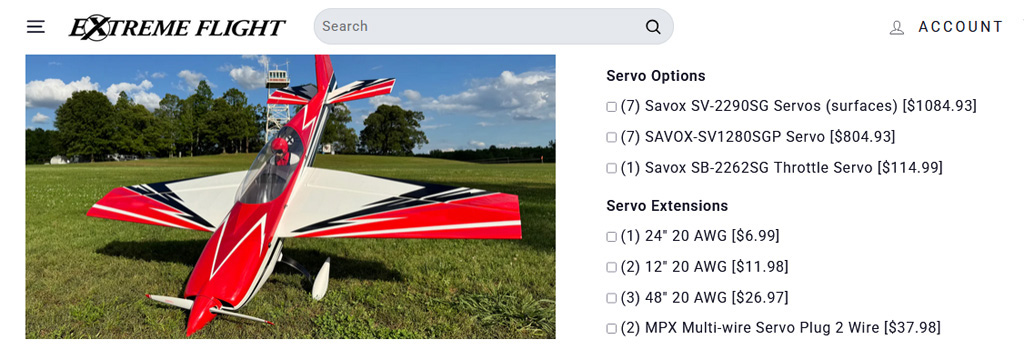

. . . but I'm not keen on it because it's unlikely two guys need the same set of servos. Here's how I come to hold this opinion. First, let's circle back to the above recommendations, 2 different sets of flight control servos, plus throttle.
- SAVÖX SV-2290SG (972oz-in @ 0.11sec/60°)
- SAVÖX SV-1280SGP (678oz-in @ 0.12sec/60°)
- SAVÖX SB-2262SG (4440z-in @ 0.065sec/60°)
So, without knowing you, I'd bet a good milkshake these aren't the best servos for you. Not because they're SAVÖX instead of ProModeler, but because everybody has different levels of experience, hopes, and dreams (plus budget).
What's more, I think I can prove the point with just three examples;
- First guy's a club pilot; 2-3 flights and calls it a day until next week. Maneuver-wise, we're talking about the odd loop or roll, plus an obligatory snap roll on take off. Can perform a credible knife edge pass, says he can hover and is practicing waterfalls (so light 3D), but has zero interest in high energy (XA). Goes to the Joe Nall every year, but is shy about flying so he mostly enjoys catching up with his mates. Importantly, he has more money than God and wants the good stuff but won't go overboard.
- Second guy is a totally different cat. Also a good pilot, but driven. Relentless competitor who attends 6-8 IMAC events, and practices 3X a week. Just advanced to Intermediate from Sportsman with a Godfrey Extra 330 and DA100 that's been through three hands before him. Model's equipped with JR DS8611a servos but solid skills means he's already won enough this year he's a lock for moving to Advanced, next season. This is his first brand new 33% and he dreams of making it Unlimited but for him, it's a tool. Importantly, he's a buy once, cry once, kind of guy.
- Third guy lives on his simulator. His Crack YAK's been in the dirt a hundred times because he's flying after work until it's too dark to see. Been flying two years and already performs rolling harriers in either direction and is getting pretty good at high energy maneuvers (think blenders and rifle rolls). All this using his 67-inch OMP Extra, and by the way, this is his first 33% model and first gasser but the old guy in the club took him under wing and will get him up to speed engine-wise. Honestly? Who knows, maybe he's the next Jase!
So, what are the odds these three need the same servos? My bet is . . . not a chance in hell.
But it goes deeper because I don't even agree with using the same servos on all the flight controls! So, the only way to be reasonably sure of making a good servo recommendation is to ask folks how they fly before I open my yap.
Setting the table
So, I'm gonna do what I don't want to and share my thoughts about outfitting a large scale aerobatic model for Sport, IMAC, and XA. We're also going to delve into foundational stuff about setup. What's more, this stuff applies not just to our servos, but also Futaba's. Ditto Hitec, JR, MKS, SAVÖX, as well as off-brand servos because this isn't opinion . . . it's mathematics and physics.
Also, while a giant scale P-51 is definitely aerobatic, our focus is on civilian aircraft used in aerobatic competition. So, we're talking about equipping models like an Edge 540T, Extra 300, Laser 200, Slick, or YAK-55M from the usual suspects, e.g. Apex Aerotech, Extreme Flight, and/or PilotRC.
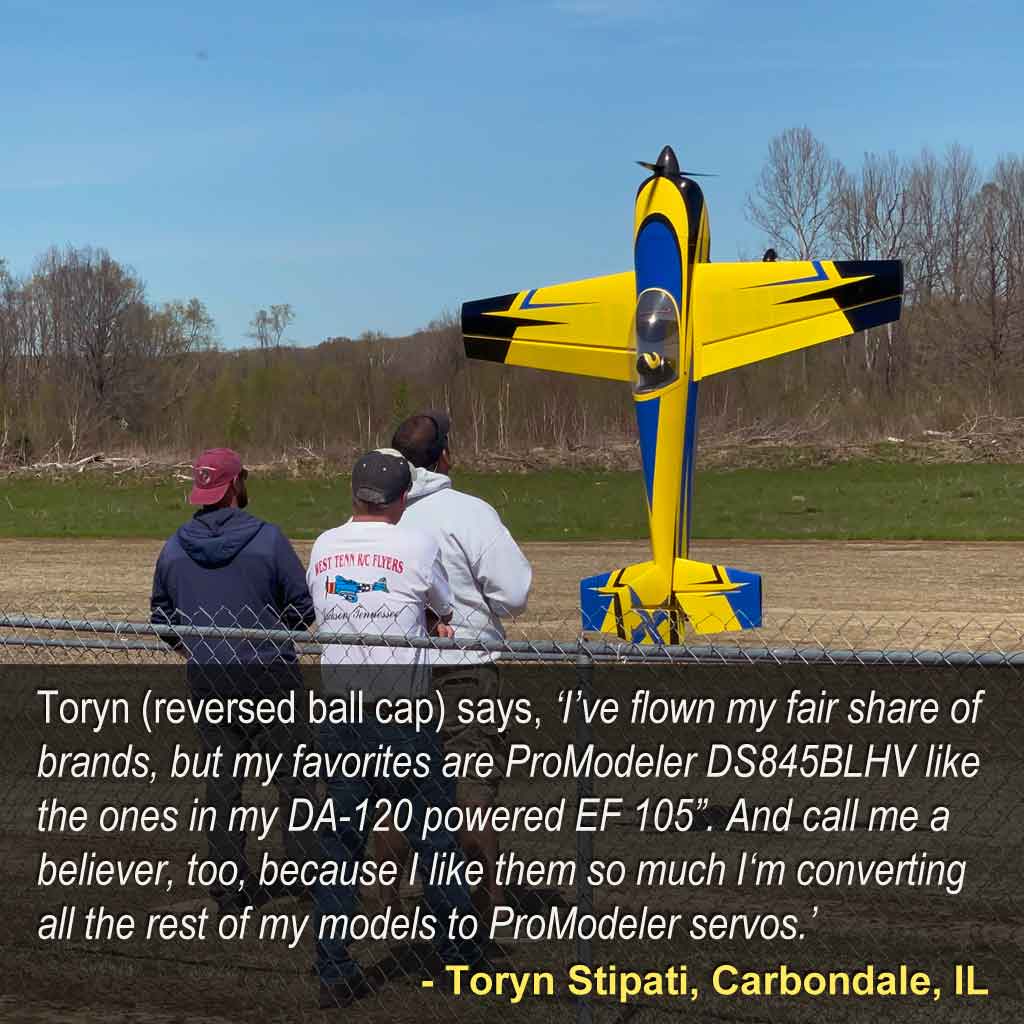
But because we also about folks flying high end 40% airframes from the likes of CARF, Dalton, or KAM Aero, we're going to discuss their needs, also. What's different is these bespoke models (e.g. hand-made versus mass produced) are used almost exclusively for IMAC competition versus XA (extreme aerobatics).
And these guys want chapter and verse about equipment and setup just as much as XA-oriented pilots.
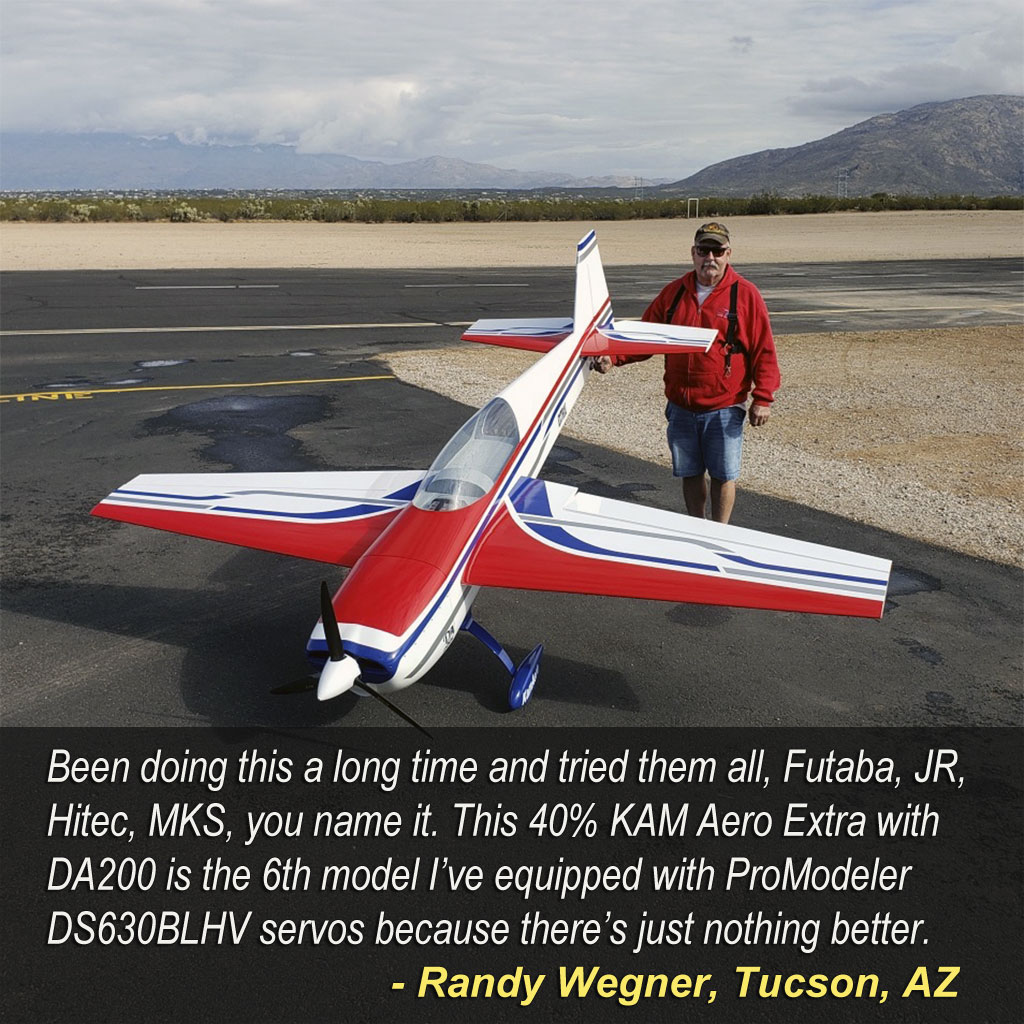
So, three different guys; one's about fun and farting off, another is about centering and precision, the third's about transit speed and torque. Interestingly, most sport guys fall into one of two camps; IMAC-oriented or XA-oriented.
- Unlike the XA-guy, an IMAC-competitor opts for shorter servo arms because he only wants enough throw to perform his schedule of maneuvers. Unless he's flying Freestyle in Unlimited, transit speed's a non-issue. Instead, hes about maxing resolution to get buttery smooth control throw.
- An XA-guy is totally different. He pays through the nose for our fastest servos. He also uses longer servo arms than for an IMAC setup. He needs both big torque servos with rapid transit speeds for high energy XA-stuff like walls, blenders, rifle rolls, and lots of throw for post stall 3D-maneuvers (waterfalls, torque rolls, and Harriers).
Point being, if two guys call about equipping the exact same Extreme Flight 105-inch Extra 300, the guy making IMAC noises gets a different servo recommendation from the guy talking XA. Why? For the same reason the Bible, in Matthew 6:24, teaches us . . . No one can serve two masters.
So, we're going to delve into two different setups. And not just the difference in mechanical setup between an IMAC versus XA model, but also about the electronic-setup to optimize resolution.
And look, if you already know why transit speed matters, how servo arm length relates to ATV, resolution in terms of milliseconds, plus fundamentals of mechanical setup as reflected in the rule of 90°, then there's no need to read further.
But if you don't, then you'll gobble this down and after digesting, you'll never again depend on us (or anybody) to tell you how to set up your model.
Background
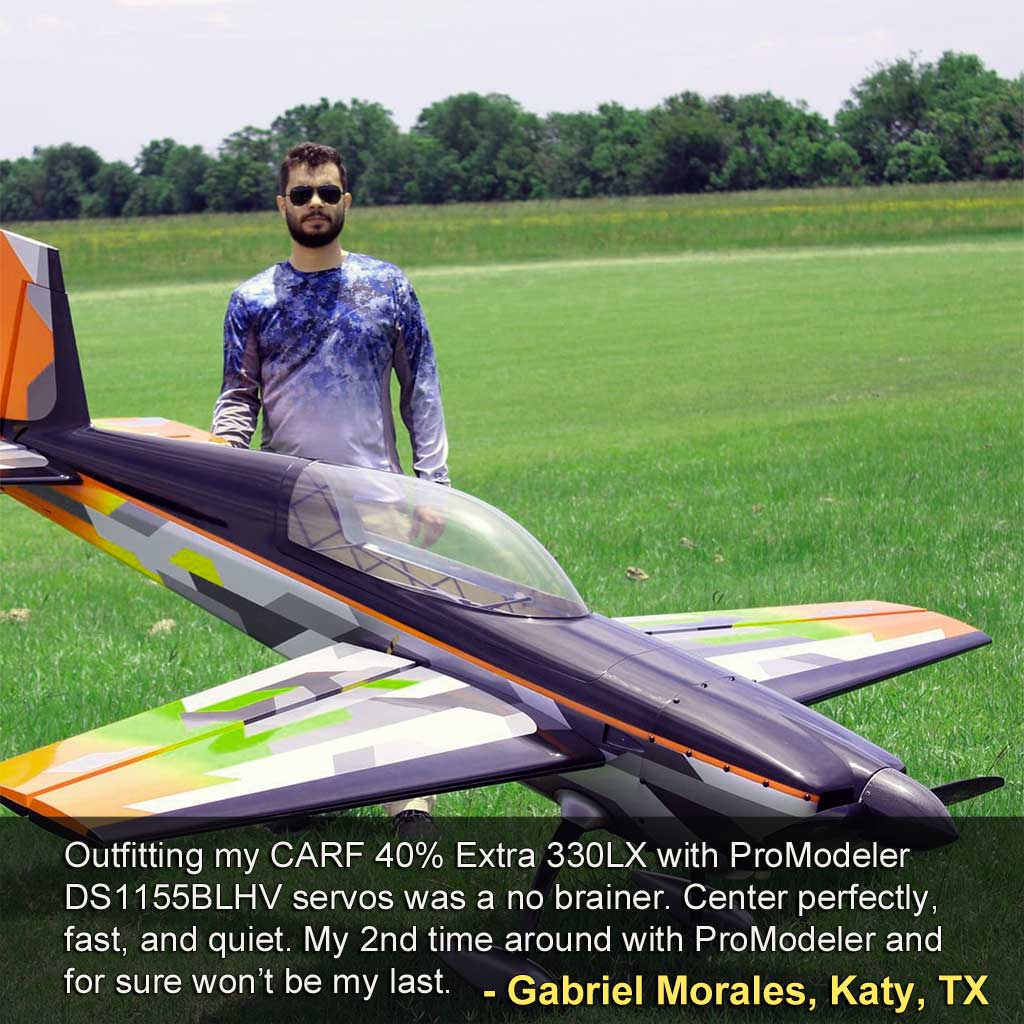
To begin, anybody who mentions equipping a bespoke model is pretty easy, customer-wise. Why? It's because these guys are almost 100% about centering and precision. Yes, there are exception (guys flying Unlimited Freestyle who use the same servos as XA-pilots), but by and large, IMAC guys flying Basic, Sportsman, Intermediate and Advance don't give a toss about a servo's transit speed.
Means almost to a certainty BLS1-series versus BLS2 servos. These are our best servo-thoughts for IMAC pilots.
IMAC servo recommendation
For throttle, many are happy with the DS270DLHV. For flight controls, our DS505BLHV, DS630BLHV, and/or DS930BLHV.
- DS270LHV - 270oz-in @ 0.12sec/60°
- DS505BLHV- 505oz-in @ 0.098sec/60°
- DS630BLHV- 630oz-in @ 0.10sec/60°
- DS930BLHV - 930oz-in @ 0.12sec/60°
And as you'd expect, folks tend to throw more torque at larger models - but - straight up, you don't need as much torque as some would have you believe. Why not? Simple, it's because a lot depends on the class of maneuvers you're flying. Basically, the harder the maneuvers, the more torque you need.
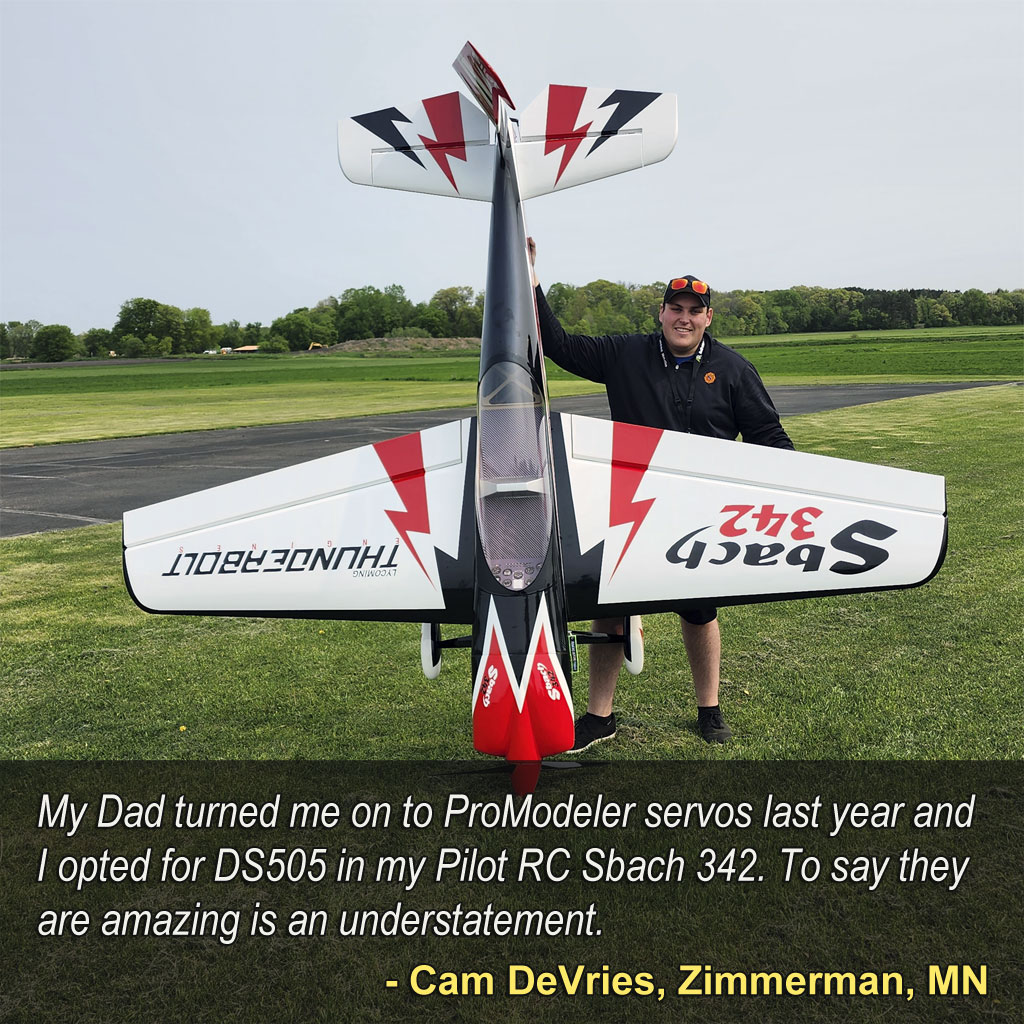
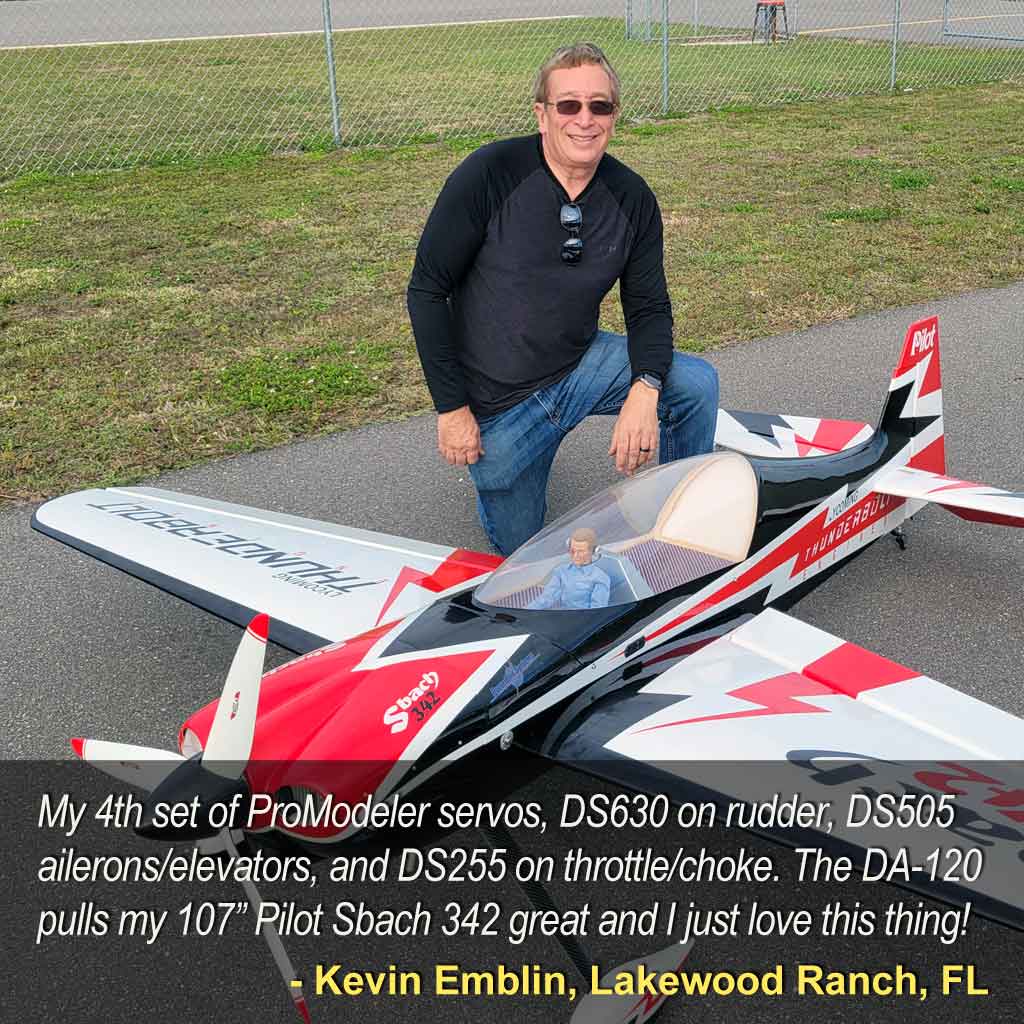
Case in point? This fellow, happy as a clam after equipping his 33% PilotRC Sbach 342 with DS505BLHV servos.
XA servo recommendation
Meanwhile, since XA-oriented pilots lust for speed, we created our BLS2-series servos for their desires. Basically, these servos are faster (a lot faster). And not just for flight controls but throttle, too. And FYI, the DS255BHV is actually a BLS0-series, which just means it's built within a hybrid case. Hybrid means polymer plus alloy instead of all-alloy. We switch up from hybrid construction once torque goes much north of 400oz-in.
Anyway, for XA, the flight controls get DS635BLHV, DS845BLHV, and/or DS1155BLHV.
- DS255BLHV - 255oz-in @ 0.052sec/60°
- DS645BLHV- 635oz-in @ 0.042sec/60°
- DS845BLHV- 845oz-in @ 0.085sec/60°
- DS1155BLHV - 1155oz-in @ 0.10sec/60°
Note; as regards centering and precision, both BLS0, BLS1 and BLS2 are built to the exact same standard and use the exact same Noble 1mc potentiometer. The only downside of BLS2 servos is they cost more because speed costs. Saying if your money grows on trees, buy them even if your maneuvers don't need the speed. Honestly, if you don't need speed then the only place you'll feel the difference is in your wallet.
Why speed matters
So, everybody understands price. Everybody understands torque. What folks have trouble with is transit speed.
For example, this next image is a screen grab from the Extreme Flight website. It's of their 85-inch Turbo Raven. Reason I show it is because a guy I know decided to go in a different direction after assembling his. Sold me his like new model. with just 4-flights! And nothing wrong with it, just not his cup of tea.
So let me make two points . . .
- He didn't skimp. I know because it came with SAVÖX SV-1280SGP (763oz-in @ 0.12sec/60°) cheaper SV-1270TGP (625oz-in @ 0.10sec/60°) servos. And both are relatively inexpensive because you get coreless versus brushless motors.
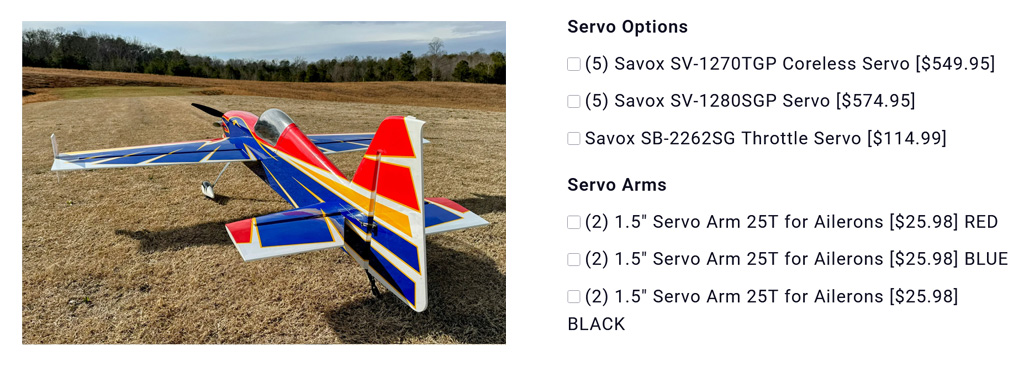
- So, we have a different opinion servo-wise than Extreme Flight. And because we bought the Turbo Raven to serve as company demonstrator for our XA-oriented servos (we already have an IMAC oriented PAU 89-inch Extra 300LX equipped with DS505BLHV servos), our plan from the beginning involved swapping out servos and selling them off on Flying Giants.
But before we did, to showcase the day-night difference speed-wise between 0.042sec/60° versus 0.12sec/60°, watch this slow motion video. That's our DS635BLHV in the left stab while the SAVÖX SV-1280SGP is in the right.
Anyway, when a customer commented, John, that video is like the difference between whisky and good whisky! then to be honest, it resonated because as it happens, I agree, once you've tasted the good stuff, you'll forevermore know the difference.
Now let me caution you. Like, it's a given you're interested in good servos (else you're not on our site), but when we ask if you want servos for sport, IMAC, or XA, please don't bullshit us. Saying we don't really care, we only ask because we want to guide you to the right servos for you.
So be careful with what you say because your answer determines how much you gonna pay for servos. And just like you can't be a little bit pregnant, if you say both to the IMAC or XA question, then you should equip it for XA. Also, please don't be dumb and equip the model for XA just to practice because we're talking a lot more money.
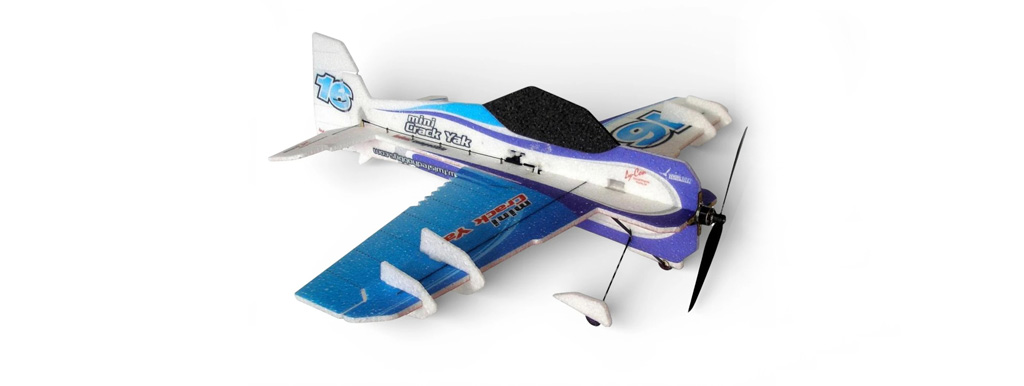
Instead, and your money, your choice but let's be real. If you're into IMAC and want to practice XA-stuff, then you'll be a mile ahead of the game practicing with something like a foam Crack Yak 55M from Twisted Hobbies versus outfitting your 33% toy with XA-class servos, capisce?
Major point being, IMAC models are highly specialized tools with setups optimized for the precision demanded by the schedule of maneuvers. Guys wanting to perform both IMAC and XA maneuvers - with the same model - won't do either very well. And we can prove it.
Just as golf has irons and woods, and fencing has foils and sabres, models can be tailored for IMAC and XA. In golf, you tee off with a wood for distance, then switch to versatile irons to enable better control. Similarly, their tactical use in fencing means the foil is all about strategy and precision, whilst the sabre is the tool required for speed and aggression.
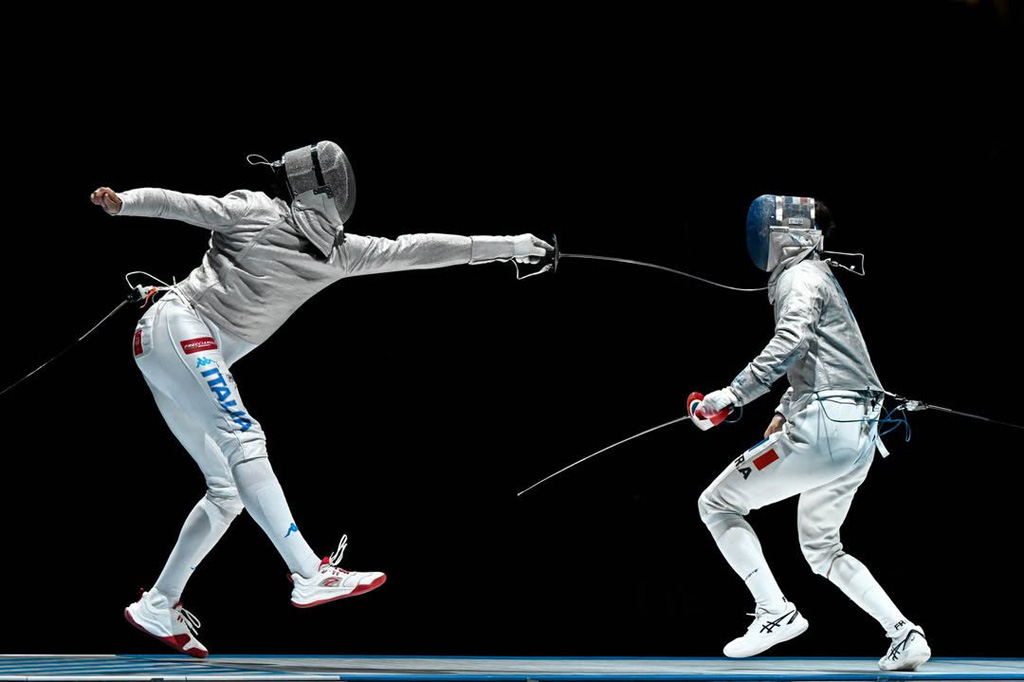
And it's almost the exact same in modeling between IMAC vs XA except you CAN use the same model for both and tailor your approach with the servos and mechanical setup. Problem is, because we're working on the assumption you don't want to spend more than is strictly necessary, then we assume price enters the equation.
So, let's touch next on what you want servo-wise for an IMAC model. This, before delving into pricier servos created expressly for XA-models.
In this order because once we show you, you'll understand why it is XA-guys happily pony up the dough for fast servos!

By the way, IMAC is an acronym for International Miniature Aerobatics Club. Specifically, aerobatics flown with reduced scale models of full scale aerobatic aircraft (meaning unlike F3A models, ones that look like the real thing).
Anyway, poke around their site if you like models that closely resemble full scale, e.g. an Extra, Edge, Slick, Pitts Special, YAK, Laser, etc. because if realistic looking aerobatic models are what float your boat, then these are like-minded fellows.
IMAC-maneuvers
So when it comes to selecting servos, a model equipped for IMAC competition is optimized to achieve high precision. This is almost 100% to do with maximizing servo resolution and about not using more throw than is needed for the schedule of maneuvers. True, whether it's Basic, Sportsman, Intermediate, Advanced, or Unlimited.
What about servo speed? This doesn't really matter for IMAC! Why not?
Because precision maneuvers on the IMAC schedule are 100% about smooth execution. It's kind of like the US Navy Seal's mantra . . . Slow is smooth, and smooth is fast. For the accomplished IMAC pilot, it's all about smoothly executing maneuvers for the judges. Basically, IMAC-oriented pilots guys don't give a flip about fast servos because they're not stick banging!
But of course, you're welcome to pay for fast servos if you like because who knows, maybe your money grows on trees! Just don't pony up for fast servos because you think you need them for IMAC, because you don't.
So who decides what's fast in the servo world? We do! More later.
Another thing, optimizing for high precision also means shorter servo arms vs XA-setups. For example, for a 33% model, it typically means using 1-1/2" arms for an IMAC setup versus 2" arms for an XA-setup . . . for the exact same model. Why?
Resolution. This next bit is going to need a little math . . . sorry, it can't be helped.
Resolution
Resolution speaks to the number of steps as the servo transits from one side to the other. We measure this electronically using an oscilloscope (milliseconds), and mechanically using a protractor (degrees).
Since we used protractors in grade school, I'm going with we all know what these look like. However, this next photo shows something you may not be familiar with, the measure of servo output in milliseconds on an oscilloscope display.
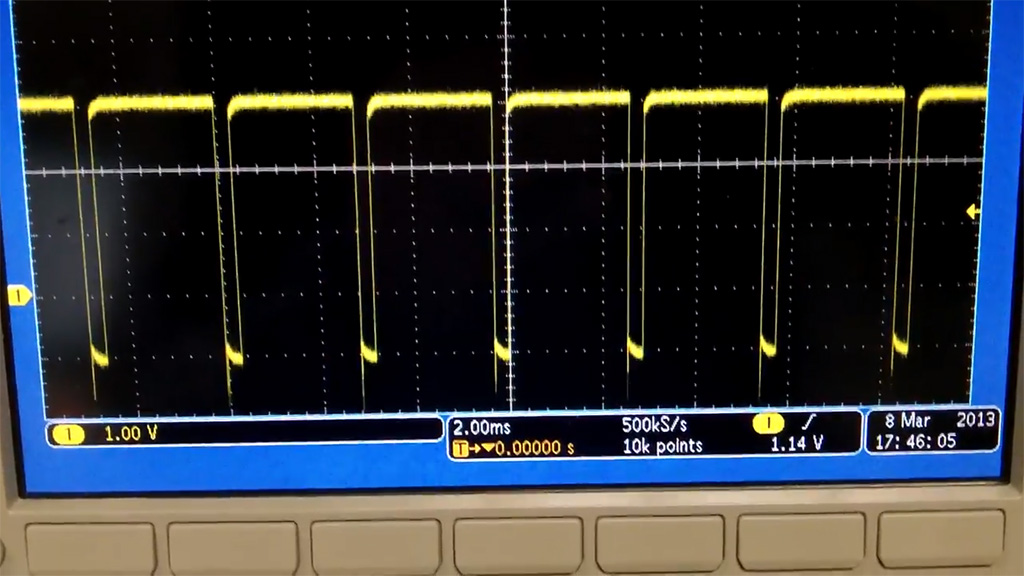
So, everyone knows you get more control throw with 2" vs 1-1/2" long servo arms, right? We're going to show you why in a moment. However, we've all experienced a model has too much throw, right? It's no fun because the model is too sensitive to enjoy (unless you fly XA in which case you want MORE throw).
When the fix makes it worse
Unfortunately, because too much throw makes the model too sensitive for IMAC maneuvers, folks who don't understand resolution, 'fix' this with the radio. How? By dialing back ATV from 100% to 50% because using dual-rates is quick and easy.
Thing is, an IMAC pilot knows this is a stupid approach. Why? Simple, because in going from 100% to 50% using rates this instantly gives away half the servo's resolution! And resolution is everything when it comes to precision maneuvers. Let me explain.
This chart for our DS630BLHV tells the story. Look to find Travel (90°), which is expressed in milliseconds.
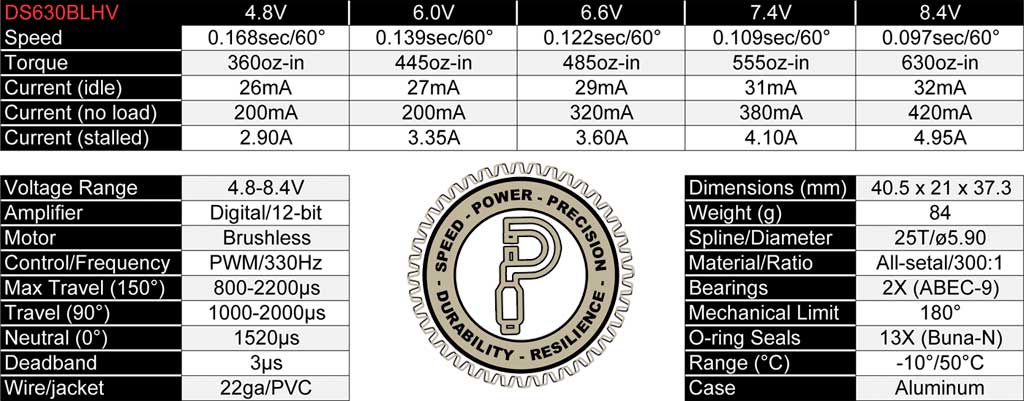
So the specs tell you 90° is is a range between 1000-2000ms. Means the total range is 1000ms (because 2000ms-1000ms=1000ms).
The specs also disclose neutral, or 0° at about 1500ms (technically 1520ms but let's just use 1500ms to keep the math easy).
Note; 90° means total sweep, so it's 45° in each direction.
So, we measure this with the oscilloscope as 500ms in each direction from neutral. This, because 1500ms-500ms gets you to 1000ms in one direction, and 1500ms+500ms gets you to 2000ms in the other. Again, 1000ms is the total range for 90° of sweep.
Anyway, if we divide the range (1000ms) by 90° (the degrees of motion), then this works our to 11.1ms/degree (1000ms÷90°=11.1ms/°). Or put another way, digital servos take 1000 steps to sweep 90° and each step is 11.1ms long.
Now let's put this data to use to explain why resolution matters as it relates to servo arm length. Basically, steps don't change in length and when you use long servo arms, it takes fewer steps to achieve the same amount of motion.
And fewer steps is the same as less resolution. So, let me explain how the length of the servo arm plays a role in this because it's the key to understanding the mindset of a competitive IMAC pilot.
Servo arm length
In this next graphic, we show a short arm/linkage (red) and a long arm/linkage (blue). Think of the red as the servo arm length for giving you throw for IMAC-maneuvers, while the longer blue arm, is giving the throw required for XA-maneuvers.
Note; the servo travels the exact same number of degrees (steps), but the longer arm deflects the control surface further.

Effect of throw and resolution
Now, guess what happens when you use ATV to reduce the travel of the long arms to match the throw of the short arm? I bring this up because it's exactly what a club pilot does when he uses dual rates to make a model equipped with long servo arms more flyable by reducing throw using ATV.
So, let's say he cranks in 50% for dual-rates. And this does what he wants, it reduce the travel volume and make the model less sensitive. Now when he flips a switch he goes from having throws suited for XA, to control throws more suited for IMAC. And just like that, the plane is easier to handle. Yippee? No, not really. Here's why.
Using rates is fine for a club pilot because few have the skills to feel the difference in resolution, but an actual IMAC pilot (defined as someone who practices), now he can feel a huge difference. Why? Because it's just like using coarser versus finer teeth on a gear (meaning the power transfer is smoother with finer vs coarser gears), the exact same thing happens with the flight controls; e.g. the elevator or aileron response is coarser because it's using 50% fewer steps!
Bottom line? Pilots who fly IMAC never use long arms and dial back the throw electronically. So instead of reducing throw electronically, he does it mechanically by using shorter arms.
As I said before, he'd use 1-1/2 instead of 2-inch arms. But he then goes further. Like, if he's using a good servo arm, after flying the model and realizing a 1-1/2 inch arms still requires him to reduce the ATV, then he'll move the control ball inward (for less throw) to maybe 1-3/8 or even 1-1/4". After flying, if now he doesn't have enough throw for his schedule of maneuvers, he'll crank the ATV up from maybe 100% to 120% or even 130% to regain the throw. Why?
It's because increasing ATV gives him more steps and thus, finer control. This what old timers mean when they speak of mechanical setup to increase resolution. Shorter arms with more ATV is the secret sauce of an experienced IMAC competitor. It's using resolution the smart way!
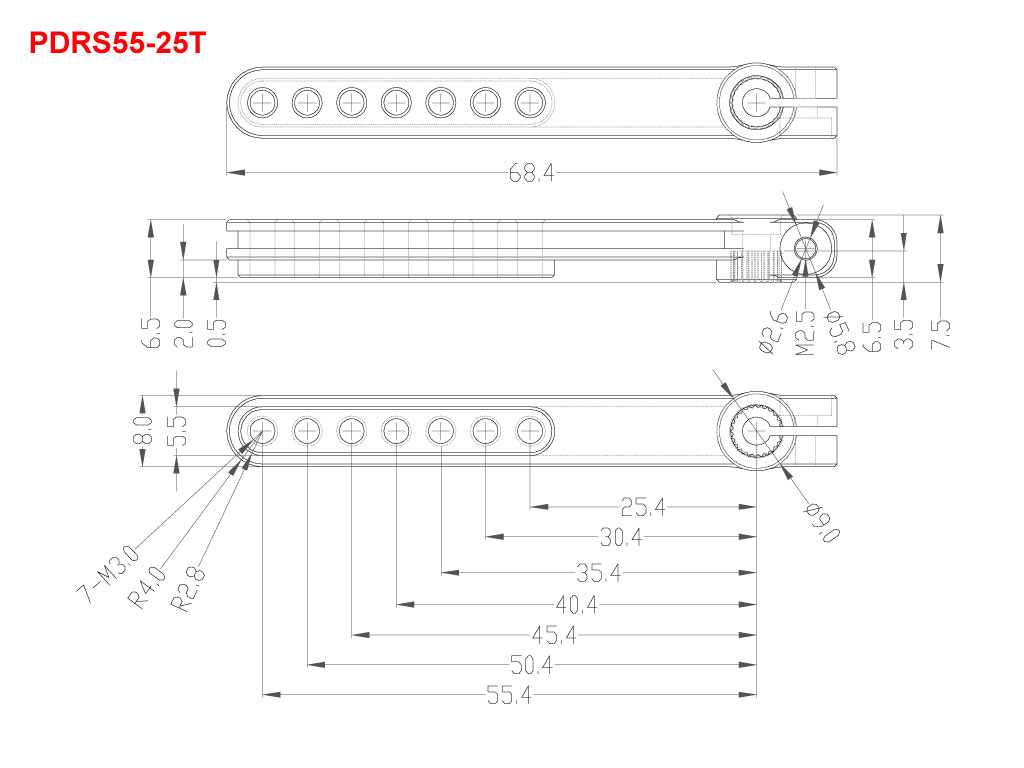
Anyway, in terms of placing the control ball on the servo arm, distance refers to the measure from the center of the output shaft to where the ball is mounted. And the better the arm, the more mounting points because it allows you to more finely tune the mechanical setup (more adjustment). Let's touch on this, next.
Mechanical setup
We (ProModeler) offer servo arms in lengths ranging from 15mm to 60mm long. This example is 55mm long (2-inches) and as you can see, it gives you 7 mounting positions (they're on 5mm centers).
Note; if you were buying a model from a manufacturer whose models are synonymous with XA-performance (which, I hasten to add, are perfectly capable of performing IMAC-class maneuvers once the servos and servo arms are mechanically optimized for precision), then they'll typically offer you a product with significantly fewer adjustments.
However, the one thing they give which we don't are more colors to match your color scheme. This, because like Ford only offered the iconic Model T in black, we'll give you any color you want . . . as long as it's natural aluminum!
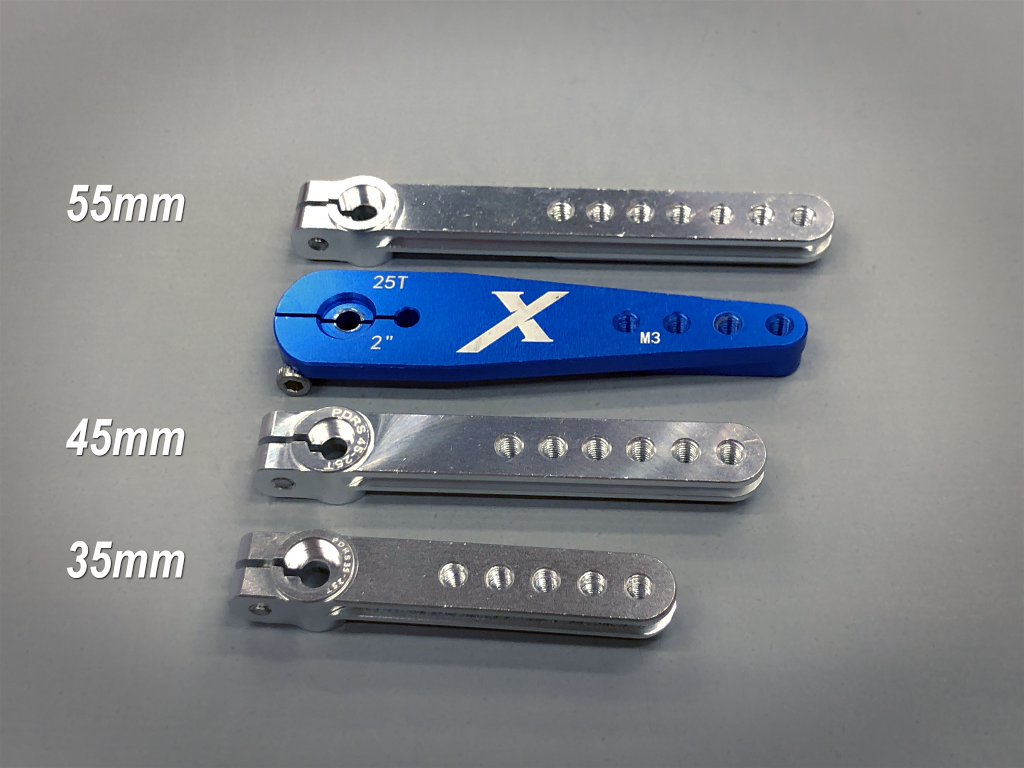
By the way, please do not interpret this as criticism. Instead, it is an observation. One, basically in regards to why our arms have more adjustability. Saying I am sharing an opinion you're better off with more adjustment but because opinions are like belly buttons (in that we all have one), this is mine. And I posit they offer more colors because their focus is on helping modelers who focus is on the best look for their airframes. Conversely, our focus is on offering you the best arms in the world and to Hell with looks!
But I'm not here to judge, you do you, I'm just giving you the information. How you decide to set up your model is your business! However, make no mistake, what I'm just saying is this . . . unless you dream of XA and nothing but, then don't buy fast servos and use long ass servo arms because unless you're the 2nd coming of Jason Dussia, all you're going to end up doing if having to dial down the throw electronically with rates, which give away resolution.
So next let's touch on an XA-setup where long servo arms and really fast servos pay off with the ability to exit a crankshaft, rifle roll, or the wall-maneuver on time. Maneuvers like these depend on servo speed.
And addressing slow transit speed is why we also make servos expressly for XA-pilots!
XA (extreme aerobatics)
So inherently, an IMAC setup is the total opposite of how XA-guys set up a model.
An XA-setup uses a much longer servo arm (perhaps 2" vs 1-1/2"). Then to get the rapid control travel needed to flick the control surface and effect an instant stall, this means the XA-pilot pay through the nose for really, really, really fast servos.
Let's put numbers to this and see how it plays out;
- DS630DLHV - 630oz-in @ 0.097sec/60° . . . great for IMAC
- DS635BLHV - 635oz-in @ 0.042sec/60° . . . great for XA
Why does the DS635BLHV cost so much more than the DS630BLHV? For the same reason old hot rodders say; Speed costs, how fast do you want to go? The DS635BLHV are more expensive because of what we have to do to make them fast!
Note; ignore the difference in torque because nobody on God's green earth could discern the difference between 630oz-in and 635oz-in during flight (like we can in the lab).
So what you're really paying out the wazoo for when buying XA-optimized servos is the difference in transit speed because 0.042 vs 0.097sec/60° means the IMAC-oriented servos are 130% slower.
By the way, since earlier I said we are who defined fast . . . 0.042sec/60° is how ProModeler define fast in the servo-world!
Now let's circle back to control throw, for tiny bit more math because this helps explain why fast matters.
Control throw from a rotating source (servo's output shaft) is dictated by the angle of rotation and the distance from center at which you place the control ball. Pure physic determines this. So next let's discuss two important factors, throw and rotation. First up is throw.
Control throw
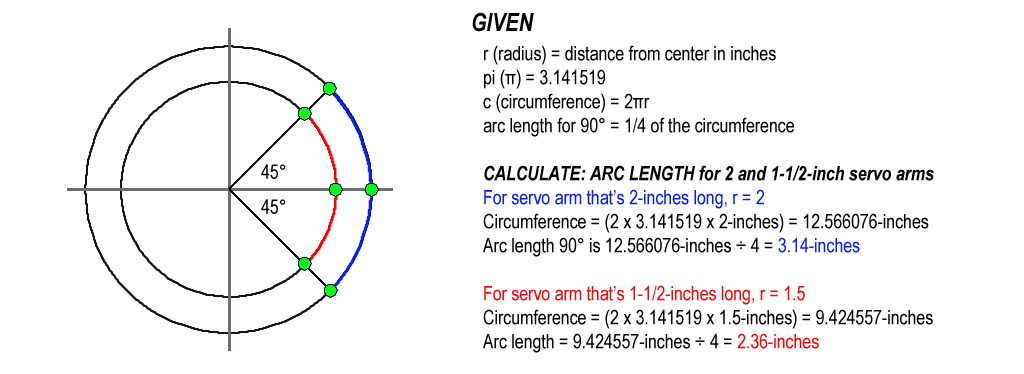
So the control ball on the servo arm actually transits a path on an arc. So you won't be surprised this distance is called an arc length and we write is as the letter-s. And recalling from middle school trig, the circumference of a circle is defines as 2πr, now let's use this graphic to nail this down because a picture is worth a thousand words.
Note; the inner circle represents a 1-1/2" servo arm, the outer circle a 2" servo arm. The two arcs, red and blue, are typical of an IMAC and an XA-setup.
And by the way, you can ignore the math, just look at the relative lengths of the two arcs for the point we're trying to make, the further out, the longer the arc.
Rotation
The other factor is rotation measured in degrees. So the more rotation, the longer the arc of travel. But there's really a 3rd factor, which is time. Basically, the longer the arc, the more time it takes to transit from one extreme of travel to the other. An example is it takes twice as long for the servo arm to transit 120° versus 60°, agreed?
So in terms of placing the control ball on the servo arm, distance refers to the measure from the center of the output shaft to where the ball is mounted. And the better the arm, the more mounting points because it allows you to really fine tune the mechanical setup.
And as we already know, the further from center the control ball is mounted, the more throw you can get out of the servo. Proof comes from visualizing the path the ball transits as it rotates, the further out, the larger the diameter and thus, the circumference. Since the balls travels further, so does anything connected to it!
This graphic shows control surface deflection, one with the ball at 1-3/8" and the other mounted at 2-inches with 30° of rotation from the servo in each direction, or 60° total. The blue linkage is mounted further out and the result is more control surface deflection angle.

Interestingly, both IMAC and XA-pilots will crank up the ATV from 100% to 120%, or higher to get more control surface deflection. However, the IMAC pilot only wants the deflection needed and will progressively move the control ball inward (thus reducing throw), until he can no longer perform the maneuvers. Then he cranks up the ATV to get back the required travel to perform the maneuvers . . . and this is how you conserve resolution when optimizing for IMAC!
What ATV does
Per OSHA 1910.25(c)(2), walking up a flight of stairs involves a standard step, which in the USA has a rise of 9-1/2". So let me use an analogy to stairs. What if instead of 13-steps between flights, you had 17 steps? Short answer? You'd actually climb higher than one floor!
So, when you crank ATV up from 100% to 150%, this is what you're doing, you're actually adding more steps.
Conversely, cranking ATV down to 50% from 100%, reduces the number of steps by half. And since the size of the electronic step in ms it means with 150% it's like climbing 1-1/2 flights, and with 50% you only climb 1/2 a flight of stairs. And this is an important point, the steps of travel for the servo don't get wider or narrower, it's 11.2ms/° of travel and to get more degrees of travel, you add steps! And this is what adding or subtracting steps does when you adjust ATV.
So reviewing the specs for our servos reveals two different specs regarding the number of steps in our digital servos. Look in the first column for lines labeled Max Travel and Travel. These are expressed in terms of ms (milliseconds) when using an oscilloscope, and in degrees when using a protractor.
This time let's look at the DS350DLHV, a fine servo for sport use.

So for this particular servo, the range for 90° is about 1000 steps (2000ms-1000ms=1000ms). We label this Travel. And taking 1000ms and dividing by 90° gives us the number of ms/step. Simple math, 1000ms÷90°=11.1ms/°. Is there a term for the 1000ms? Yes, there is but we don't use it because we don't determine it, the RF manufacturers do and they refer to this as Volume.
Turns out you can expand the number of steps coming from your transmitter using a function called ATV (Adjustable Travel Volume). The typical range is from 800ms to 2200ms, or 1400ms total. And dividing 1400ms÷11.1ms/°=125°, which is how we get to Max Travel. And adjusting ATV adds or subtracts steps, it does not vary the length of the step.
Note; 1000÷90 isn't actually 11.1ms.° is 11.1111111111111 to infinity. So 1400÷11.1 equals 127°, divide by a number with more trailing 1s, e.g. 11.1 with 13 trailing 1s get 126 degrees, and the more 1s, you eventually get to 125°, which is what we state in the specs. Of course, this is another one of those differences that makes no difference in the real world.
But as regards the size of the steps themselves? They don't get larger, or smaller, they're 1ms each. So why does this matter? Simple, to get more control surface travel what folks do is use a long ass arm and also make the servo swing more degrees by increasing ATV.
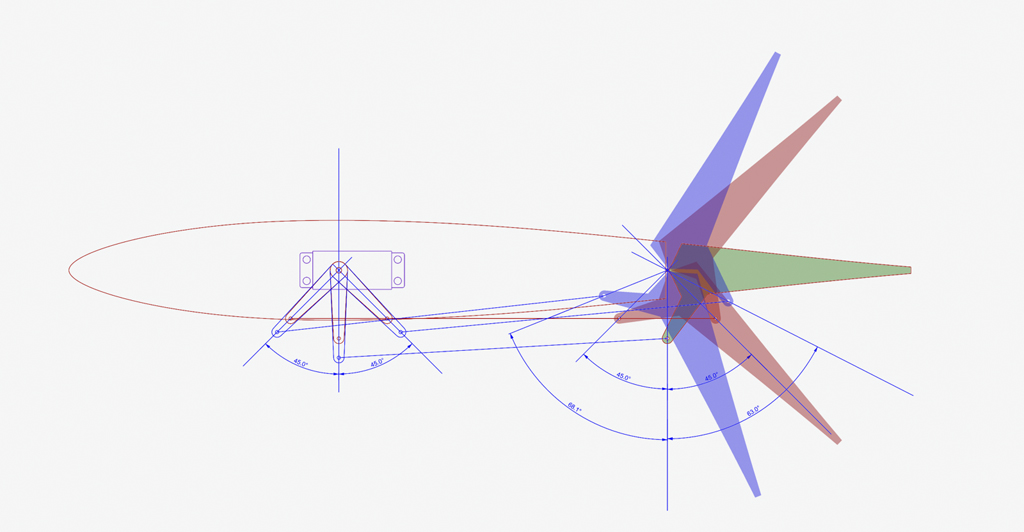
Note; this next drawing is familiar. Last time we used 60° of total travel (30° in each direction). This time it's 45° of travel in each direction, or 90° total.
So, this is what happens when you crank up ATV and for IMAC, this means greater precision for smoother maneuvers and for XA it means more throw to enable maneuvers which haven't even been invented, yet. But remember, when you crank up ATV, it means more rotation, which means it takes longer to travel the full distance, now we're talking time.
Time
When folks wonder why it is we guide IMAC pilots to our range of BLS1-series servos operating in area of 0.10sec/60° of travel - and - BLS2-series servos, which get down into the 0.042sec/60° for XA, it's because these stupid fast transit speeds solve the problem of long arm and more degrees of rotation happening fast enough for the really good pilots of the world.
Problem is, BLS2-series are a fair bit more expensive than BLS1. Can't be helped because speed costs money.
So if IMAC is your thang then don't pay up to buy XA-class servos! And if you are an XA-pilot, then be glad we offer our BLS2 servos because they're faster than what the other guys offer you.
So what's the problem? It's the wannabe who says he does both IMAC and XA. What's the real problem? The wannabe doesn't understand why real XA-pilots use fast servos. Basically, he thinks he can pay for IMAC-class transit speeds thinking he can just fit long ass arms to get the required huge control surface deflection. Yes, he can - but - the reason this doesn't work for the gifted XA pilots is speed!
Basically, although our BLS1 servos are fast compared to hobby grade servos, remember, we build for the military's requirements. he servos are too slow. Sure, they're fast enough for basic XA-maneuvers like the elevator because the surface deflects to 45° to initiate the descent, but isn't deflected very much otherwise during the rest of the maneuver. But these servos are nowhere near fast enough for reversing rifle-rolls, crankshafts, and walls. Maneuvers, which need fast control surface deflections to time the entry. Look, this isn't my opinion, it's down to physics!
In summary, an XA setup calls for the fast servos while an IMAC pilot doesn't care a flip about speedy servos. Nor should he because precision doesn't call for the same kind of speed. And knowing this, we offer servos optimized for speed, but they cost a whole lot more than servos optimized for IMAC work (and they cost a lot also), they don't cost as much as the stupid fast servos.
Of course, if your money grows on trees, buy XA-class fast servos (our BLS2 series), and fit them with XA-type arms (2-inches), and then use dual rates to cut down the throw. Of course, we can't repeal physics so this means you instantly give away half the system resolution! Put another way, there goes any hope of achieving precision. It's really true what it says in the Bible about serving two masters.
If you want competitive level precision, you don't need to pay for fast servos. And you fit the shortest arm needed. If you want to fly XA, then you do pay for fast servos, you fit long arms, and you don't give a flip about precision.
And if an IMAC model is fitted with long ass arms to get the required throw, then the servos created for an IMAC model aren't really quick enough for aggressive maneuvers so just using long arms isn't the solution when the servos are slow. True, unless you're fitting XA-class servos (really fast) in an IMAC model. Obvious downside, of course, is fast servos costs a lot of money and fast is otherwise wasted on an IMAC model where the goal is precision instead of a lot of throw.
Anyway, when equipped for XA, the servos are faster than you need to pony up for IMAC-maneuvers and worse, because the arms are really, really long (this, to develop the required control surface throw of 45° in each direction), then the flight controls are so freakin' sensitive, you have to dial the control throw down to fly (and then, this is bad for precision).
Like it's one thing if you take an XA setup and reduce throw mechanically (by installing shorter arms), but that's a lot of work. So what most guys do, instead, is opt to do a mechanical setup for XA, then use dual rates (or ATV) to tame the model down enough to fly (with at least with some semblance of precision). Problem with this is now you're giving away all the resolution you paid through the nose to get! To say nothing of having forked over big bucks for fast servos.
Like mental masturbation is real, I get it. And with enough time online, some guys can convince themselves of anything. But I don't really care, you're not paying me to stroke you. These are the facts. And this means it's time for the talk
No, not regarding the birds and the bees, but the one regarding IMAC vs XA servos (and setups).
Setting expectations - IMAC vs XA
So it's a given you're interested in good servos (else you're not here).
Thing is, when equipping your 33% model, the real question is . . . do you want servos for sport, IMAC, or XA? And be careful regarding you response because the answer determines how much you pay.
Also, just as you can't be a little bit pregnant, if you say both to the IMAC or XA question, then you should equip it for XA. Why? Two reasons;
- Servos and mechanical setups optimized for IMAC suck at XA-maneuvers like crankshafts and rifle rolls because they're too slow. That, and the mechanical setup doesn't really give enough control throw.
- And the flip side is servos optimized for XA cost more because the servos are faster. Added to which, because these setups use longer servos arms, the flight controls end up too sensitive for IMAC, so folks resort to dual rates to make it flyable. Problem with this is precision goes out the window!
And don't overlook costs more because just as the more powerful the servo, the more it costs, the faster the servo, the more it also costs.
This matters because servos for performing aggressive XA-maneuvers are way the hell faster than the servos to which we guide IMAC pilots. And faster costs more. So what this really means is unless you really fly hard XA-maneuvers, then the only place you'll feel the difference - if - you're primarily an IMAC-guy . . . is in your wallet!
And of course, your money, your choice but let's be real, if you're into IMAC and want to practice XA-stuff, then you'll be a mile ahead of the game practicing with something like a foam Crack Yak 55M from Twisted Hobbies, instead of outfitting your 33% toy with XA-class servos, capisce?
Major point being, IMAC models are highly specialized tools with setups optimized for the precision demanded by the schedule of maneuvers. Thus, wanting to perform both IMAC and XA maneuvers with the same model means doing neither very well.
Kindly allow me to beat on the dead horse just a little more . . .
. . . the point I'm really trying to make is this; just as golf has irons and woods, and fencing has foils and sabres, models can be tailored for IMAC and XA.
In golf, you tee off with a wood because woods give you more distance while irons are more versatile and enable better control. Similarly, their tactical use in fencing means the foil is all about strategy and precision, whilst the sabre is the tool for speed and aggression.
And it's almost the exact same in modeling between IMAC vs XA except you can use the same model for both and tailor your approach with the servos and mechanical setup.
Added to which, because we're working on the assumption you don't want to spend more than is strictly necessary, money enters the equation. So, let's touch next on what you want servo-wise for an IMAC model. This, before delving into pricier servos created expressly for XA-models.
In this order because once we show you, you'll understand why it is XA-guys happily pony up the dough for fast servos!
By the way, IMAC is an acronym for International Miniature Aerobatics Club. Specifically, aerobatics flown with reduced scale models of full scale aerobatic aircraft (meaning unlike F3A models, ones that look like the real thing).
Anyway, poke around their site if you like models that closely resemble full scale, e.g. an Extra, Edge, Slick, Pitts Special, YAK, Laser, etc. because if realistic looking aerobatic models are what float your boat, then these are like-minded fellows.
IMAC-maneuvers
So when it comes to selecting servos, a model equipped for IMAC competition is optimized to achieve high precision. This is almost 100% to do with maximizing servo resolution and about not using more throw than is needed for the schedule of maneuvers. True, whether it's Basic, Sportsman, Intermediate, Advanced, or Unlimited.
What about servo speed? This doesn't really matter for IMAC! Why not?
Because precision maneuvers on the IMAC schedule are 100% about smooth execution. It's kind of like the US Navy Seal's mantra . . . Slow is smooth, and smooth is fast. For the accomplished IMAC pilot, it's all about smoothly executing maneuvers for the judges. Basically, IMAC-oriented pilots guys don't give a flip about fast servos because they're not stick banging!
But of course, you're welcome to pay for fast servos if you like because who knows, maybe your money grows on trees! Just don't pony up for fast servos because you think you need them for IMAC, because you don't.
So who decides what's fast in the servo world? We do! More later.
Another thing, optimizing for high precision also means shorter servo arms vs XA-setups. For example, for a 33% model, it typically means using 1-1/2" arms for an IMAC setup versus 2" arms for an XA-setup . . . for the exact same model. Why?
Resolution. This next bit is going to need a little math . . . sorry, it can't be helped.
Resolution
Resolution speaks to the number of steps as the servo transits from one side to the other. We measure this electronically using an oscilloscope (milliseconds), and mechanically using a protractor (degrees).
Since we used protractors in grade school, I'm going with we all know what these look like. However, this next photo shows something you may not be familiar with, the measure of servo output in milliseconds on an oscilloscope display.
So, everyone knows you get more control throw with 2" vs 1-1/2" long servo arms, right? We're going to show you why in a moment. However, we've all experienced a model has too much throw, right? It's no fun because the model is too sensitive to enjoy (unless you fly XA in which case you want MORE throw).
When the fix makes it worse
Unfortunately, because too much throw makes the model too sensitive for IMAC maneuvers, folks who don't understand resolution, 'fix' this with the radio. How? By dialing back ATV from 100% to 50% because using dual-rates is quick and easy.
Thing is, an IMAC pilot knows this is a stupid approach. Why? Simple, because in going from 100% to 50% using rates this instantly gives away half the servo's resolution! And resolution is everything when it comes to precision maneuvers. Let me explain.
This chart for our DS630BLHV tells the story. Look to find Travel (90°), which is expressed in milliseconds.
So the specs tell you 90° is is a range between 1000-2000ms. Means the total range is 1000ms (because 2000ms-1000ms=1000ms).
The specs also disclose neutral, or 0° at about 1500ms (technically 1520ms but let's just use 1500ms to keep the math easy).
Note; 90° means total sweep, so it's 45° in each direction.
So, we measure this with the oscilloscope as 500ms in each direction from neutral. This, because 1500ms-500ms gets you to 1000ms in one direction, and 1500ms+500ms gets you to 2000ms in the other. Again, 1000ms is the total range for 90° of sweep.
Anyway, if we divide the range (1000ms) by 90° (the degrees of motion), then this works our to 11.1ms/degree (1000ms÷90°=11.1ms/°). Or put another way, digital servos take 1000 steps to sweep 90° and each step is 11.1ms long.
Now let's put this data to use to explain why resolution matters as it relates to servo arm length. Basically, steps don't change in length and when you use long servo arms, it takes fewer steps to achieve the same amount of motion.
And fewer steps is the same as less resolution. So, let me explain how the length of the servo arm plays a role in this because it's the key to understanding the mindset of a competitive IMAC pilot.
Servo arm length
In this next graphic, we show a short arm/linkage (red) and a long arm/linkage (blue). Think of the red as the servo arm length for giving you throw for IMAC-maneuvers, while the longer blue arm, is giving the throw required for XA-maneuvers.
Note; the servo travels the exact same number of degrees (steps), but the longer arm deflects the control surface further.
Effect of throw and resolution
Now, guess what happens when you use ATV to reduce the travel of the long arms to match the throw of the short arm? I bring this up because it's exactly what a club pilot does when he uses dual rates to make a model equipped with long servo arms more flyable by reducing throw using ATV.
So, let's say he cranks in 50% for dual-rates. And this does what he wants, it reduce the travel volume and make the model less sensitive. Now when he flips a switch he goes from having throws suited for XA, to control throws more suited for IMAC. And just like that, the plane is easier to handle. Yippee? No, not really. Here's why.
Using rates is fine for a club pilot because few have the skills to feel the difference in resolution, but an actual IMAC pilot (defined as someone who practices), now he can feel a huge difference. Why? Because it's just like using coarser versus finer teeth on a gear (meaning the power transfer is smoother with finer vs coarser gears), the exact same thing happens with the flight controls; e.g. the elevator or aileron response is coarser because it's using 50% fewer steps!
Bottom line? Pilots who fly IMAC never use long arms and dial back the throw electronically. So instead of reducing throw electronically, he does it mechanically by using shorter arms.
As I said before, he'd use 1-1/2 instead of 2-inch arms. But he then goes further. Like, if he's using a good servo arm, after flying the model and realizing a 1-1/2 inch arms still requires him to reduce the ATV, then he'll move the control ball inward (for less throw) to maybe 1-3/8 or even 1-1/4". After flying, if now he doesn't have enough throw for his schedule of maneuvers, he'll crank the ATV up from maybe 100% to 120% or even 130% to regain the throw. Why?
It's because increasing ATV gives him more steps and thus, finer control. This what old timers mean when they speak of mechanical setup to increase resolution. Shorter arms with more ATV is the secret sauce of an experienced IMAC competitor. It's using resolution the smart way!
Anyway, in terms of placing the control ball on the servo arm, distance refers to the measure from the center of the output shaft to where the ball is mounted. And the better the arm, the more mounting points because it allows you to more finely tune the mechanical setup (more adjustment). Let's touch on this, next.
Mechanical setup
We (ProModeler) offer servo arms in lengths ranging from 15mm to 60mm long. This example is 55mm long (2-inches) and as you can see, it gives you 7 mounting positions (they're on 5mm centers).
Note; if you were buying a model from a manufacturer whose models are synonymous with XA-performance (which, I hasten to add, are perfectly capable of performing IMAC-class maneuvers once the servos and servo arms are mechanically optimized for precision), then they'll typically offer you a product with significantly fewer adjustments.
However, the one thing they give which we don't are more colors to match your color scheme. This, because like Ford only offered the iconic Model T in black, we'll give you any color you want . . . as long as it's natural aluminum!
By the way, please do not interpret this as criticism. Instead, it is an observation. One, basically in regards to why our arms have more adjustability. Saying I am sharing an opinion you're better off with more adjustment but because opinions are like belly buttons (in that we all have one), this is mine. And I posit they offer more colors because their focus is on helping modelers who focus is on the best look for their airframes. Conversely, our focus is on offering you the best arms in the world and to Hell with looks!
But I'm not here to judge, you do you, I'm just giving you the information. How you decide to set up your model is your business! However, make no mistake, what I'm just saying is this . . . unless you dream of XA and nothing but, then don't buy fast servos and use long ass servo arms because unless you're the 2nd coming of Jason Dussia, all you're going to end up doing if having to dial down the throw electronically with rates, which give away resolution.
So next let's touch on an XA-setup where long servo arms and really fast servos pay off with the ability to exit a crankshaft, rifle roll, or the wall-maneuver on time. Maneuvers like these depend on servo speed.
And addressing slow transit speed is why we also make servos expressly for XA-pilots!
XA (extreme aerobatics)
So inherently, an IMAC setup is the total opposite of how XA-guys set up a model.
An XA-setup uses a much longer servo arm (perhaps 2" vs 1-1/2"). Then to get the rapid control travel needed to flick the control surface and effect an instant stall, this means the XA-pilot pay through the nose for really, really, really fast servos.
Let's put numbers to this and see how it plays out;
- DS630DLHV - 630oz-in @ 0.097sec/60° . . . great for IMAC
- DS635BLHV - 635oz-in @ 0.042sec/60° . . . great for XA
Why does the DS635BLHV cost so much more than the DS630BLHV? For the same reason old hot rodders say; Speed costs, how fast do you want to go? The DS635BLHV are more expensive because of what we have to do to make them fast!
Note; ignore the difference in torque because nobody on God's green earth could discern the difference between 630oz-in and 635oz-in during flight (like we can in the lab).
So what you're really paying out the wazoo for when buying XA-optimized servos is the difference in transit speed because 0.042 vs 0.097sec/60° means the IMAC-oriented servos are 130% slower.
By the way, since earlier I said we are who defined fast . . . 0.042sec/60° is how ProModeler define fast in the servo-world!
Now let's circle back to control throw, for tiny bit more math because this helps explain why fast matters.
Control throw from a rotating source (servo's output shaft) is dictated by the angle of rotation and the distance from center at which you place the control ball. Pure physic determines this. So next let's discuss two important factors, throw and rotation. First up is throw.
Control throw
So the control ball on the servo arm actually transits a path on an arc. So you won't be surprised this distance is called an arc length and we write is as the letter-s. And recalling from middle school trig, the circumference of a circle is defines as 2πr, now let's use this graphic to nail this down because a picture is worth a thousand words.
Note; the inner circle represents a 1-1/2" servo arm, the outer circle a 2" servo arm. The two arcs, red and blue, are typical of an IMAC and an XA-setup.
And by the way, you can ignore the math, just look at the relative lengths of the two arcs for the point we're trying to make, the further out, the longer the arc.
Rotation
The other factor is rotation measured in degrees. So the more rotation, the longer the arc of travel. But there's really a 3rd factor, which is time. Basically, the longer the arc, the more time it takes to transit from one extreme of travel to the other. An example is it takes twice as long for the servo arm to transit 120° versus 60°, agreed?
So in terms of placing the control ball on the servo arm, distance refers to the measure from the center of the output shaft to where the ball is mounted. And the better the arm, the more mounting points because it allows you to really fine tune the mechanical setup.
And as we already know, the further from center the control ball is mounted, the more throw you can get out of the servo. Proof comes from visualizing the path the ball transits as it rotates, the further out, the larger the diameter and thus, the circumference. Since the balls travels further, so does anything connected to it!
This graphic shows control surface deflection, one with the ball at 1-3/8" and the other mounted at 2-inches with 30° of rotation from the servo in each direction, or 60° total. The blue linkage is mounted further out and the result is more control surface deflection angle.
Interestingly, both IMAC and XA-pilots will crank up the ATV from 100% to 120%, or higher to get more control surface deflection. However, the IMAC pilot only wants the deflection needed and will progressively move the control ball inward (thus reducing throw), until he can no longer perform the maneuvers. Then he cranks up the ATV to get back the required travel to perform the maneuvers . . . and this is how you conserve resolution when optimizing for IMAC!
What ATV does
Per OSHA 1910.25(c)(2), walking up a flight of stairs involves a standard step, which in the USA has a rise of 9-1/2". So let me use an analogy to stairs. What if instead of 13-steps between flights, you had 17 steps? Short answer? You'd actually climb higher than one floor!
So, when you crank ATV up from 100% to 150%, this is what you're doing, you're actually adding more steps.
Conversely, cranking ATV down to 50% from 100%, reduces the number of steps by half. And since the size of the electronic step in ms it means with 150% it's like climbing 1-1/2 flights, and with 50% you only climb 1/2 a flight of stairs. And this is an important point, the steps of travel for the servo don't get wider or narrower, it's 11.2ms/° of travel and to get more degrees of travel, you add steps! And this is what adding or subtracting steps does when you adjust ATV.
So reviewing the specs for our servos reveals two different specs regarding the number of steps in our digital servos. Look in the first column for lines labeled Max Travel and Travel. These are expressed in terms of ms (milliseconds) when using an oscilloscope, and in degrees when using a protractor.
This time let's look at the DS350DLHV, a fine servo for sport use.
So for this particular servo, the range for 90° is about 1000 steps (2000ms-1000ms=1000ms). We label this Travel. And taking 1000ms and dividing by 90° gives us the number of ms/step. Simple math, 1000ms÷90°=11.1ms/°. Is there a term for the 1000ms? Yes, there is but we don't use it because we don't determine it, the RF manufacturers do and they refer to this as Volume.
Turns out you can expand the number of steps coming from your transmitter using a function called ATV (Adjustable Travel Volume). The typical range is from 800ms to 2200ms, or 1400ms total. And dividing 1400ms÷11.1ms/°=125°, which is how we get to Max Travel. And adjusting ATV adds or subtracts steps, it does not vary the length of the step.
Note; 1000÷90 isn't actually 11.1ms.° is 11.1111111111111 to infinity. So 1400÷11.1 equals 127°, divide by a number with more trailing 1s, e.g. 11.1 with 13 trailing 1s get 126 degrees, and the more 1s, you eventually get to 125°, which is what we state in the specs. Of course, this is another one of those differences that makes no difference in the real world.
But as regards the size of the steps themselves? They don't get larger, or smaller, they're 1ms each. So why does this matter? Simple, to get more control surface travel what folks do is use a long ass arm and also make the servo swing more degrees by increasing ATV.
Note; this next drawing is familiar. Last time we used 60° of total travel (30° in each direction). This time it's 45° of travel in each direction, or 90° total.
So, this is what happens when you crank up ATV and for IMAC, this means greater precision for smoother maneuvers and for XA it means more throw to enable maneuvers which haven't even been invented, yet. But remember, when you crank up ATV, it means more rotation, which means it takes longer to travel the full distance, now we're talking time.
Time
When folks wonder why it is we guide IMAC pilots to our range of BLS1-series servos operating in area of 0.10sec/60° of travel - and - BLS2-series servos, which get down into the 0.042sec/60° for XA, it's because these stupid fast transit speeds solve the problem of long arm and more degrees of rotation happening fast enough for the really good pilots of the world.
Problem is, BLS2-series are a fair bit more expensive than BLS1. Can't be helped because speed costs money.
So if IMAC is your thang then don't pay up to buy XA-class servos! And if you are an XA-pilot, then be glad we offer our BLS2 servos because they're faster than what the other guys offer you.
So what's the problem? It's the wannabe who says he does both IMAC and XA. What's the real problem? The wannabe doesn't understand why real XA-pilots use fast servos. Basically, he thinks he can pay for IMAC-class transit speeds thinking he can just fit long ass arms to get the required huge control surface deflection. Yes, he can - but - the reason this doesn't work for the gifted XA pilots is speed!
Basically, although our BLS1 servos are fast compared to hobby grade servos, remember, we build for the military's requirements. he servos are too slow. Sure, they're fast enough for basic XA-maneuvers like the elevator because the surface deflects to 45° to initiate the descent, but isn't deflected very much otherwise during the rest of the maneuver. But these servos are nowhere near fast enough for reversing rifle-rolls, crankshafts, and walls. Maneuvers, which need fast control surface deflections to time the entry. Look, this isn't my opinion, it's down to physics!
In summary, an XA setup calls for the fast servos while an IMAC pilot doesn't care a flip about speedy servos. Nor should he because precision doesn't call for the same kind of speed. And knowing this, we offer servos optimized for speed, but they cost a whole lot more than servos optimized for IMAC work (and they cost a lot also), they don't cost as much as the stupid fast servos.
Of course, if your money grows on trees, buy XA-class fast servos (our BLS2 series), and fit them with XA-type arms (2-inches), and then use dual rates to cut down the throw. Of course, we can't repeal physics so this means you instantly give away half the system resolution! Put another way, there goes any hope of achieving precision. It's really true what it says in the Bible about serving two masters.
If you want competitive level precision, you don't need to pay for fast servos. And you fit the shortest arm needed. If you want to fly XA, then you do pay for fast servos, you fit long arms, and you don't give a flip about precision.
And if an IMAC model is fitted with long ass arms to get the required throw, then the servos created for an IMAC model aren't really quick enough for aggressive maneuvers so just using long arms isn't the solution when the servos are slow. True, unless you're fitting XA-class servos (really fast) in an IMAC model. Obvious downside, of course, is fast servos costs a lot of money and fast is otherwise wasted on an IMAC model where the goal is precision instead of a lot of throw.
Anyway, when equipped for XA, the servos are faster than you need to pony up for IMAC-maneuvers and worse, because the arms are really, really long (this, to develop the required control surface throw of 45° in each direction), then the flight controls are so freakin' sensitive, you have to dial the control throw down to fly (and then, this is bad for precision).
Like it's one thing if you take an XA setup and reduce throw mechanically (by installing shorter arms), but that's a lot of work. So what most guys do, instead, is opt to do a mechanical setup for XA, then use dual rates (or ATV) to tame the model down enough to fly (with at least with some semblance of precision). Problem with this is now you're giving away all the resolution you paid through the nose to get! To say nothing of having forked over big bucks for fast servos.
Like mental masturbation is real, I get it. And with enough time online, some guys can convince themselves of anything. But I don't really care, you're not paying me to stroke you. These are the facts. And this means it's time for the talk
No, not regarding the birds and the bees, but the one regarding IMAC vs XA servos (and setups).
Budget and speed
First up is budget. Then we'll touch on speed. And in support, we'll share three very brief videos.
Budget
Money matters. Anyone says it doesn't is lying. We're going to introduce you to some of our servos. One is our DS360DLHV servo.
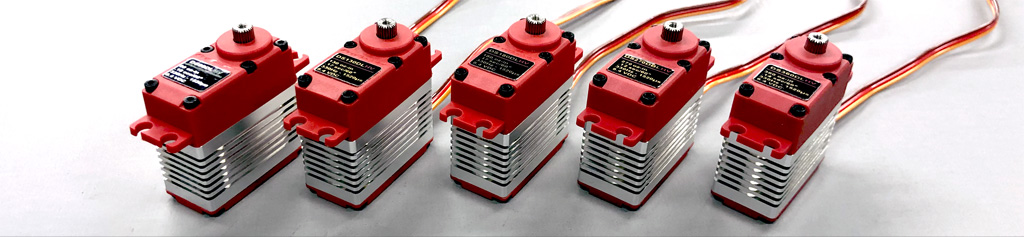
It's one of five budget friendly servos in the DL-series. While they're a solid product, they're not particularly fast. And while they range from 90oz-in, and top out at 360oz-in, they make up the vast majority of standard class sales. Why?
In a word, it's because they're so good. And for sporting use, because the DS360DLHV is in the same league as the JR DS8611s speed-wise, whilst offering a touch more torque, then it's both strong enough and plenty fast enough for this model. But true, only depending on who you are as a pilot and what your performance expectations are.
But again, I'm getting ahead of myself. More in a bit. Meanwhile, meet the DL-series.
Speed
Now, let's talk speed. While we can talk until we're blue in the face, seeing is believing. These three videos are very brief.
This first one is of the DS360DLHV side-by-side with a SAVÖX SV1280SGP. Why this servo? Simple, it's because the sole purpose of the video is to show the difference in transit speed between one of our sport-oriented budget servos versus a very popular servo. One offered up by well known airframe vendors expressly for XA-models ranging in size from 85-inches to 105-inches of wingspan.
- 5-SEC VIDEO DS360DLHV-vs-SV1280SGP
This next video is of one of our IMAC-oriented servos. This time it's our DS505BLHV versus the same SV1280SGP.
Now our purpose is to show the transit speed difference between our idea regarding a good servo for the purpose of flying IMAC maneuvers. This, versus a servo often touted by air frame dealers whose goal is selling package deals.
- 5-SEC VIDEO DS505BLHV-vs-SV1280SGP
Obviously, the ProModeler versus this east Asian import showed ours has better speed. But when the goal is a good set of IMAC-oriented servos and maybe some light XA, then the added speed is a big deal.
And in support of the DS505BLHV servo for IMAC, allow me to share the thoughts of a customer on the subject. And remember, this isn't a sponsored pilot we can pay to put our words in their mouth and say these things, it's form a paying customer.
Put another way, their words of praise can't be bought and thus, are priceless!
Finally, this video matches up one of our XA-oriented servos, our DS845BLHV, against the same SAVOX SV1280SGP. This time the purpose is to show the transit speed difference when you pony up for a real set of XA-servos.
- 5-SEC VIDEO DS845BLHV-vs-SV1260SGP
Why put these two head to head? Simple, it's because this servo features in our recommendation for XA-oriented pilots. Add to which, it's especially worth showing because we feel ours is the better built servo, and we can prove it.
- matchUP: SAVÖX SV1280SGP versus DS845BLHV
Look, if you're really into XA, then you'd be an idiot if you didn't appreciate the incredible transit speed difference in our BLS2 servos. Problem is, a set of these will gonna cost you about 50% more dough. Against . . .
- $1600 for the air frame (plus $250 for freight)
- $1100 for an east Asian engine with mufflers, prop and spinner (and more for a European engine)
. . . plus receiver, switches, batteries, smoke system, etc. This, on your way to a $3500-4000 build. Saying only you can do the math - but - know this, just like with hot rodding . . . speed costs How fast do you want to go? And what's the real cost of going cheap on the servos and discovering you can't perform the maneuvers you dreamed of simply because the response is too slow? Just saying.
And not to put too fine a point on it, but this is where the rubber hits the road. If you're doing crankshafts and walls, then you have to get off your wallet. But if these maneuvers aren't really in the frame because you're more into smooth versus harsh, then don't be stupid, buy a set of our BLS1 servos, instead. This way you get a really fine set of servos whilst saving some serious dough.
Also, if you're a club pilot doing loops, rolls, stall turns, the odd snap roll on take off, etc. then know this, the DL360DLHV outperforms the JR8611 with which this model was flown for more than a decade! How good are these?
Eyeball this matchUP-article where we tore down a JR DS8711, the next step up from the DS8611a, and where we put them head-to-head with our DS360DLHV. Don't wonder, use your own eyes and judge for yourself!
Summary
So what I'm really saying is this . . . be realistic with your expectations and don't set up your model with long ass servo arms to have big time XA-throw just to flash the surfaces at the peanut gallery and hear them go Oooooh! This, before flipping the dual rates to low in order to throttle up and fly.
Your money, I won't ever know, just saying, watch out for your best interests. Next, how to know which servos are right for you. So let's touch on types of pilots.
Note; this is yet another bit of boilerplate you may have seen before.
Sport vs IMAC vs XA-pilots
Who you are as a pilot is a big deal. It matters far more than you might imagine when selecting your servos. So who you are also touches on; what are your expectations for the model? Do you intend to fly it for sport? IMAC competition? Or extreme attitude, or XA? Basically what I am asking is this; what do you expect performance-wise from the model?
For example, if you're a club pilot and love the size and look - but - have no intention of practicing slow rolls three times a week, then you simply don't have to pay big bucks to equip the model. But if you really go out and practice several times a week, then a budget set of servos may not have the required torque to perform IMAC level competition maneuvers. So if you don't compete in regional and national IMAC events, then you can save some serious money on our servo recommendation for sporting use.
Similarly, if you're gonzo nuts for performing aggressive XA maneuvers like crankshafts and walls, then your servos are totally different (speed-wise) from what suits an IMAC-pilot perfectly. And no, I am not saying one or the other has better servos, saying we create servos for totally different purposes!
Note; if you say, I fly both IMAC and XA, then I'll respond with . . . remember what it says in the Bible about serving two masters (Matthew 6:24). Basically, you can't.
What do I mean? It's the same as the coach deciding to whom the QB will hand off the football because which is better, the fullback or the halfback depends on how the offensive and defensive lines are responding. Same with modeling! Just as a fullback dances poorly, doing both IMAC and XA requires a compromise between speed and precision. And the answer to which is best for you is . . . it depends! On what? On you!
So to get the reduced throws from an XA-setup to make the model manageable in precision maneuvers, and because the setup uses extremely long servo arms to pitch control surfaces to 45°, then you're forced to throw away nearly half the resolution you've paid dearly for by dialing back the ATV (electronically reduce the throw, or or degrees of travel).
Conversely, when set up for precision maneuvers, the arms aren't long enough to get XA-type travel, and even if you fit long ass arms to this set of servos, they're nowhere near quick enough for aggressive XA-maneuvers!
What I'm saying is this; you should know what the real price is of trying to serve the IMAC-master and XA-master with the same set of servos and arms in the aerobatic world. Oh, and I hope you noticed the decision doesn't just involve the servos because the servo arms are part of the equation also because it relates to throw and resolution! But more later.
Anyway, and depending on who you are as a pilot, whether you're primarily into sport, IMAC, or XA pretty much determines the servos and arms you should select to equip the model.
So with three basic pilot types, are you surprised we have three servo recommendations? And while we can refer to them as good, better, and best - in no universe - is one set of of these servo built better, or to a higher standard than any other in our lineup. I know this is going to sound like corporate bullshit, but they really are all built to the same standard.
Major point being, we offer a great set of servos for this model, which are perfectly suited for sport pilots. Plus a different set of servos optimized for IMAC-oriented precision pilots. And a third set, whose existence is expressly for those of you who live and breathe XA and are willing to pay for the transit speed.
Oh, and the one thing you can count on is there's zero difference in quality . . . just in the price. However by mentioning money, we're getting ahead of ourselves, again. More in a bit. But next let's delve a little into engines because believe it or not, this also matters when it comes to selecting servos.
Engines - and how this affects servo


