
Background
We're blessed a day doesn't go by without someone reaching out for advice about equipping their 33% aerobatic model. And while the airframes vary by manufacturer (think AJ Aircraft, Apex Aerotech, CARF, Extreme Flight, Flex Innovations, PilotRC, and RC Skywing), they're all variations on a theme. Scale models of civilian aerobatic aircraft, which have competed in IAC (full scale aerobatics), are powered by 120cc class engines and span 103-106 inches.
Introduction
To begin, let me admit up front, this white paper has been incredibly hard to write because I disagree 100% with the recommendation of respected air frame vendors. They guide folks toward the same servos on all the control surfaces. But worse, they don't account for pilot-needs at all. My thesis is;
- Servos for sport-pilots, IMAC-oriented pilots, and 3D/XA-pilots are all different.
- Optimizing servos for ailerons, elevators, and rudder means better performance.
- Budget always enters the picture, we can guide toward reasonable compromise.
What's more . . . I think I can prove it. We'll begin with different servos per control surface then circle back to pilot requirements. Then I'll share thoughts on servos.
So when I ask folks why they want the same servo for the entire air frame, they point to the manufacturer of their model. So I visited the website of the most popular vendor on the planet, Extreme Flight, and snagged this screen grab . . .
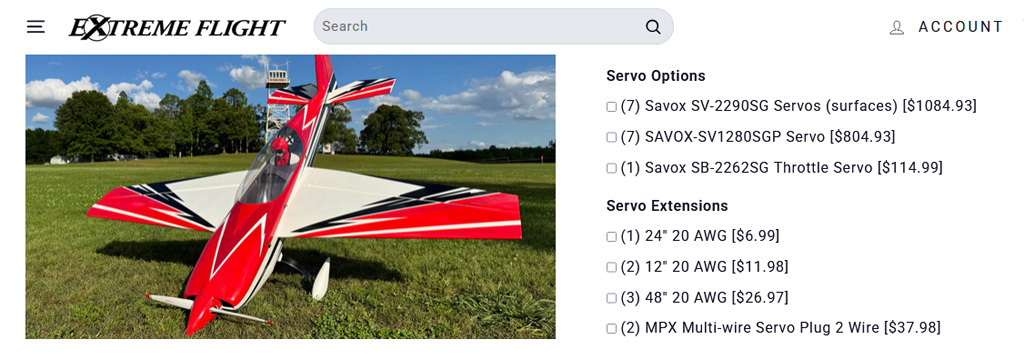

. . . and what customers say is true. Their 33% models offer two 7-servo bundles (plus throttle). The two being either, 768oz-in or 972oz-in. Curious, I poked around and discovered it's the same across their vast range of models.
Basically, regardless of the wingspan, two different servos for the control surfaces. And lots of overlap because these come from a pool of just 3-servos. So, models spanning 70-114 inches get two recommendations from amongst the same three;
- 70-85 inches - 625oz-in @ 0.10sec/60° - or - 768oz-in @ 0.12sec/60°
- 91-105 inches - 768oz-in @ 0.12sec/60° - or - 972oz-in @ 0.11sec/60°
- 114-in and larger, 972oz-in @ 0.11sec/60° (4-servo or 6-servo wings)
The big picture takeaway is . . . stronger servos as air frames get larger. And always, the same torque on all the flight controls. So, next, I visit Flex Innovations's website where I found a similar pattern; 120cc models offered with either of 2 house brands;
- Potenza DS49010BLHV (490oz-in @ 0.10sec/60°)
- Axis 500 (500oz-in @ 0.10sec/60°)
- Axis 650 (650oz-in @ 0.10sec/60°) - interestingly, an 8mm spline.
Curious, I peeked at their 40% model and found a 3rd party vendor, MKS, instead. Specifically, the HBL3850 (792oz-in @ 0.104sec/60° - also 8mm spline - more later). Regardless, once again, the big picture holds. Larger model = stronger servo, and the same servo on all control surfaces.
Lastly, it's worth noting many vendors say nothing - it's on you to figure things out!
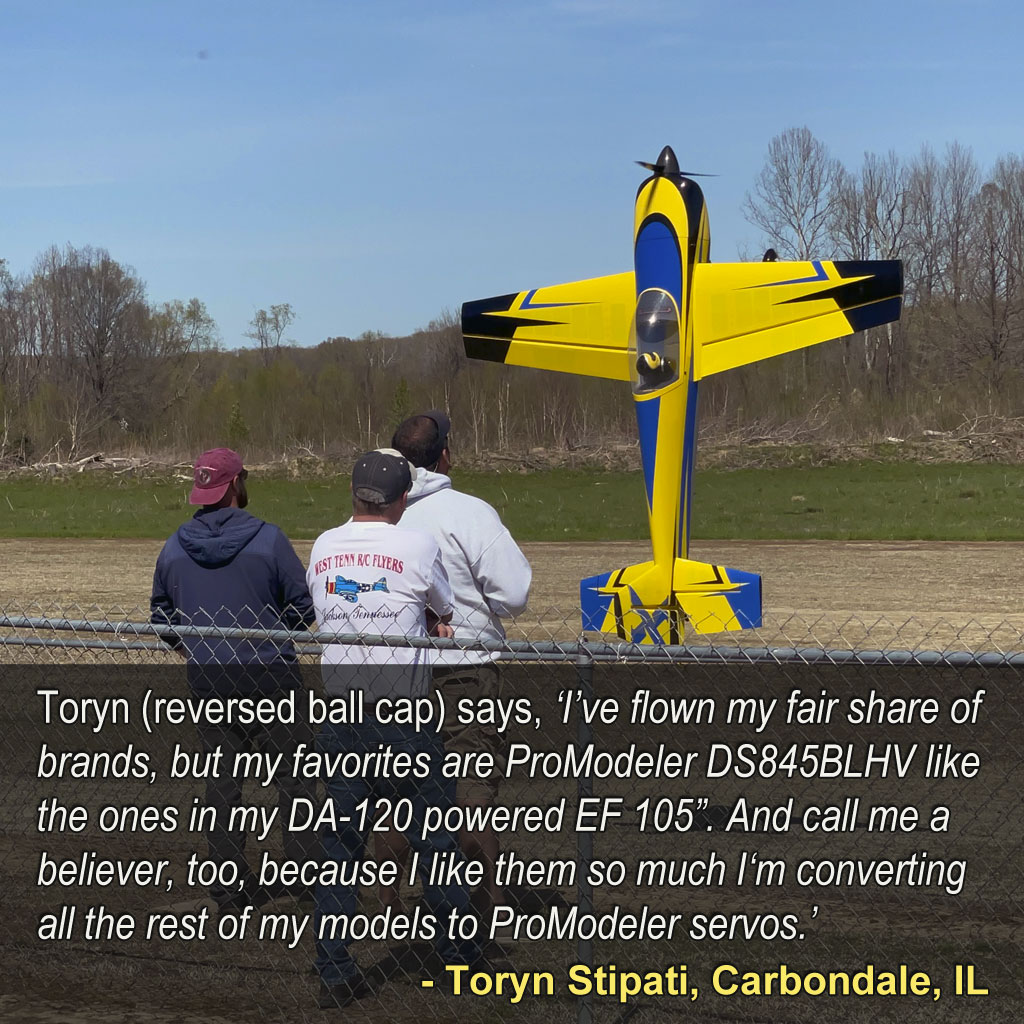
So what's the problem?
Well, as an engineer, our approach takes into account other factors. Sure, more torque for bigger models (duh!), but the big area of focus is on pilots because of these 3-questions;
- Are servos for sport the same as for IMAC or 3D/XA?
- IMAC has 5-different classes, same servos for all?
- 3D (low/slow) vs XA (fast/aggressive), same-same servos?
The answer to all three isn't just no, but Hell no!
And to whether models perform better with different servos for each control surface? The answer is yes! How do we this know for sure?
Well, we think proof comes once you realize some 33% models use two servos for rudder instead of one. Similarly, some 40% models may be outfitted with two vs three-servos on ailerons! Same model, builder's choice. Thus, vendors know some surfaces need more torque.
But, did you notice everybody ignores how different pilots have different needs?
Addressing this, it's our experience sport pilots mimic IMAC-pilots in some regards. For example, few give a flip about low transit speed servos once they realize these cost more. Exceptions? IMAC pilots competing in Freestyle.
Those guys, and 100% of 3D/XA-pilots, obsess over low transit speeds. That, and they don't give a damn about the difference in price. Why not? I don't know because every head is its own universe, but maybe it comes down to spending $3500 for a model, where another $300 means the difference between everybody else, and inventing new maneuvers. But in truth, I don't really know.
Meanwhile, if you noticed servos offered by Extreme Flight and Flex Innovations range between 0.10sec/60° and 0.12sec/60°, let me observe this; we offer two different 3-servo series of suitable servo. Our BLS1 are aimed more at IMAC pilots, the BLS2 at 3D/XA pilots. The difference? Transit speed. And price because speed costs.
- BLS1 - from 630-930oz-in and ranging between 0.010sec/60° and 0.12sec/60°
- BLS2 - from 635-1155oz-in and ranging between 0.042sec/60° and 0.10sec/60°
Basically, if you fly IMAC, BLS1 are the no brainer. Cost less, too. And if Freestyle/3D/XA floats your boat, then the BLS2 are better for you.
So let's touch on transit speed because it's not as intuitive as price and torque.
On why speed matters
So, everybody understands price. Everybody understands torque. What folks have trouble with is transit speed. It's said a picture is a worth a thousand words, so we turn to video to show why speed matters.
Recalling, the SAVÖX SV-1280SGP (768oz-in @ 0.12sec/60°), then because we guide some folks to our DS635BLHV (635oz-in @ 0.042sec/60°), then watch this.
And if it's not obvious, ours on the left and theirs on the right. Any questions?
Thing is, a pal was visiting when I uploaded this video. Suddenly, he quipped . . .
Damn, that's the difference between whisky and good whisky!
. . . which, because we were enjoying a wee libation of 12 y/o single malt at the time, led me to chuckle. But what's weird is now, I think of this video whenever I have a taste of the water of life. Go figure!
The other thing is this; gyros respond waaaay before flesh and blood realize the model's losing heading. So, while gyros aren't allowed in IMAC or XA competition, anyone using a gyro in their model will realize a huge benefit with fast servos because gyros thrive with low transit speeds. What's more, for duffers like me, fast servos make a world of difference in learning 3D - basically, a heck of a lot easier!
Next, because some of you don't have time to dive into minutia regarding the how and why of selecting servos, here's a quick TL;DR
TL;DR (too long; didn't read)
We recommend different servos for ailerons, elevators, rudder, and throttle. They're based not just on how you fly, but your budget, also. And these 7-recommendations only scratch the surface because we have suitable servos we've not mentioned!
Add to it, no dog in that hunt (airplane sales to protect), means no divided loyalties between el cheapo servos versus good ones scaring off air frame customers.
- Budget -1) DS90DLHV, 6) DS360DLHV, 1) DS505BLHV
- Sport - 1) DS90DLHV, 4) DS415BLHV, 2) DS505BLHV, 1) DS630BLHV
- Basic —> Intermediate - 1) DS270DLHV, 6) DS505BLHV, 1) DS630BHV
- Advanced - 1) DS255BLHV, 4) DS505BLHV, 2) DS630BLHV, 1) DS930BLHV
- Unlimited - same as either 3D or XA, pick your poison
- 3D - 1) DS255BLHV, 4) DS635BLHV, 2) DS845BLHV, 1) DS1155BLHV
- XA - 1) DS255BLHV, 4) DS845BLHV, 2) DS1155BLHV, 2) DS1155BLHV
No clue what the number/letter combinations in our part numbers mean?
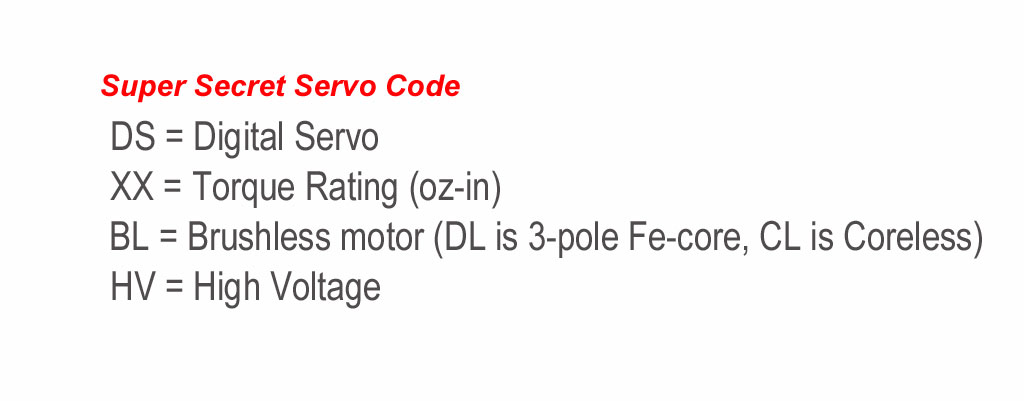
Next, before we jump into the servo guide, let's first touch on servo arms.
Servo arms
In terms of the servo arms, these models universally call for 1-1/2 inch for ailerons and 2-inch for stabs. These would be our equivalent part numbers;
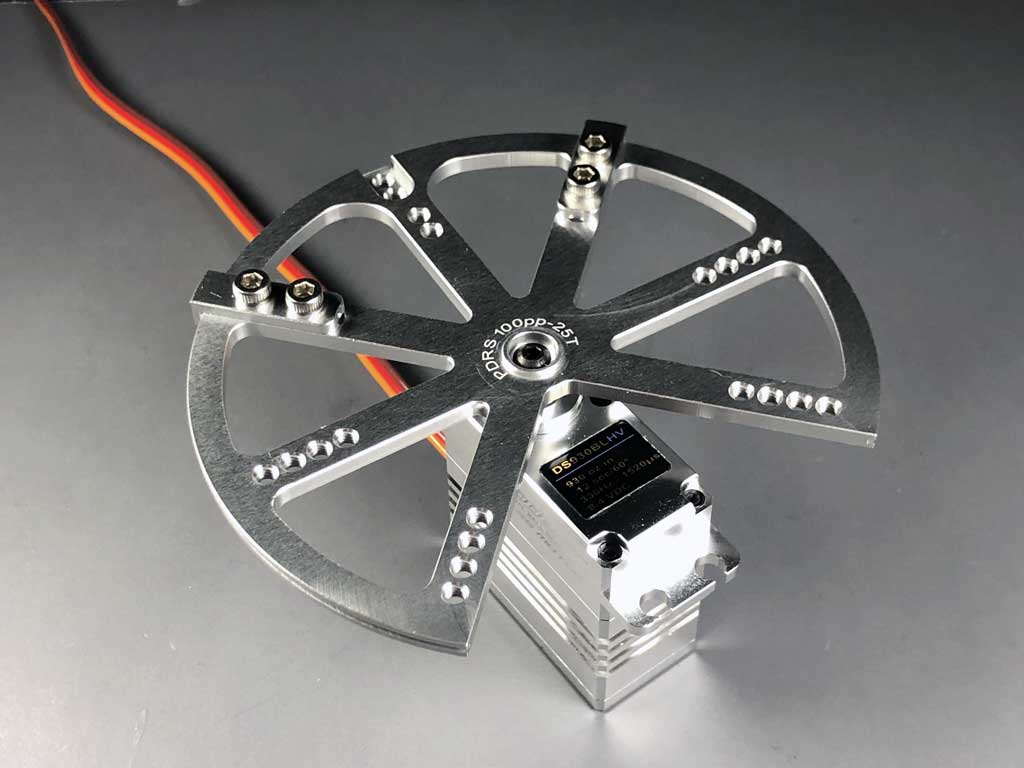
We produce servos arms ranging from 15mm to 55mm to better bracket your needs. When deciphering the product code, e.g. PDRS55-25T, the PDRS refers to our industry designation. What's important is the 55, which refers to the outermost mounting point in mm.
Note; they're threaded M3 and the -25T refers to the servo spline. Same arm, but ending in -15T means it's for our 8mm 15-tooth spline.
Next, while you're free to buy color coordinated servo arms, what makes ours better is the stiffer H-beam design. That, and we make them with 7075-T6 alloy (rivals 1018 steel in terms of strength, so lots stronger than 6061-T6). But no colors, sorry.
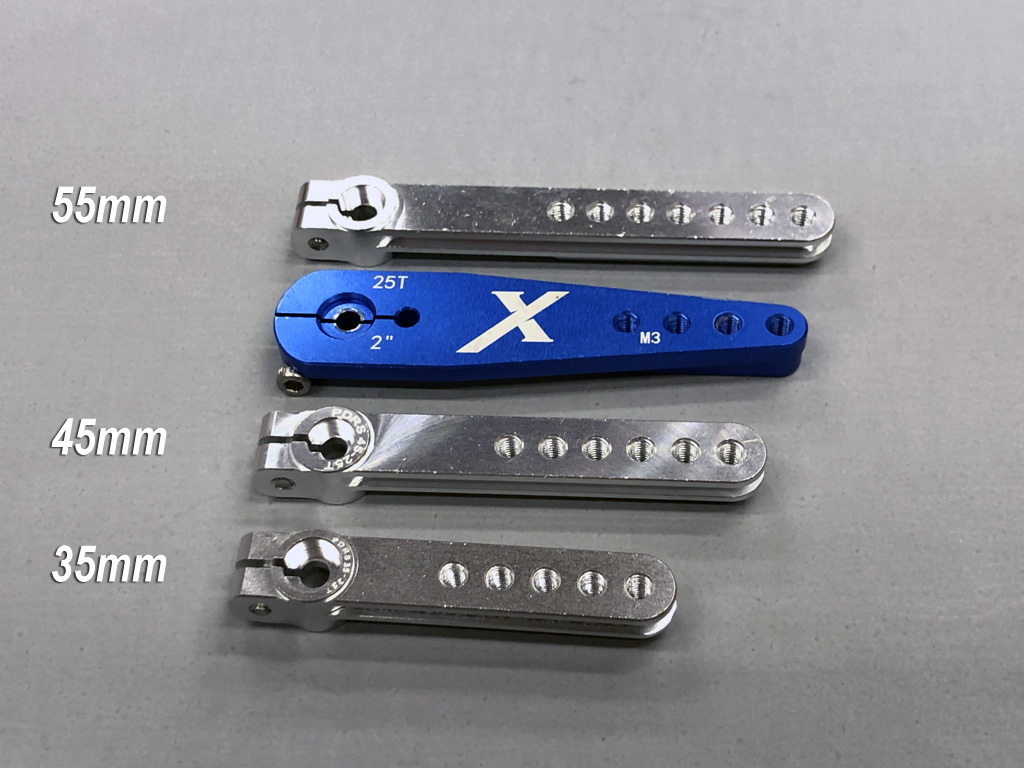
This next photo shows three of ours; PDRS55-25T, PDRS45-25T, and PDRS35-25T alongside a familiar import.
Note; besides extra mounting points, they're closer. Means mechanical setup is more granular, too.
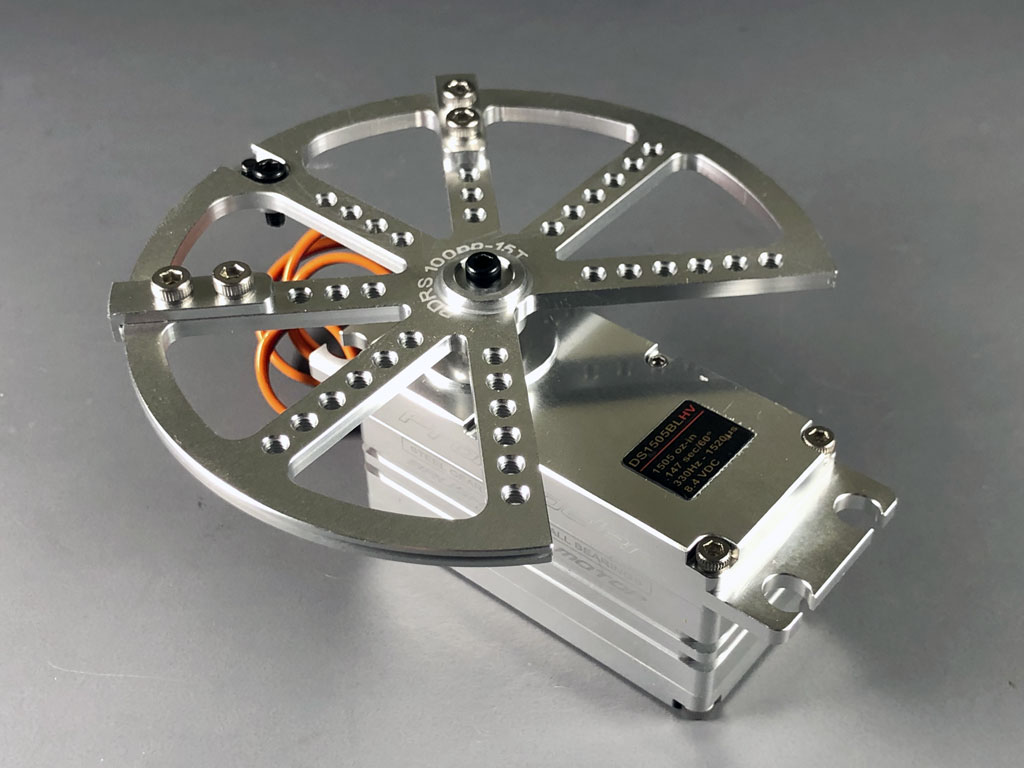
One last arm to speak of, but it's actually a pulley. For this size model, PDRS100PP-25T is the heat for pull-pull setups.
Servo recommendations by pilot
So, now I'm gonna do what I don't want to, which is share my thoughts about outfitting a 33% scale aerobatic model with a Budget Build, a Sport Setup, two different IMAC configurations, plus Freestyle, and both 3D and XA setups, 7-total.
Budget Build
- DS90LHV - 90oz-in @ 0.17sec/60° - throttle
- DS360LHV - 360oz-in @ 0.15sec/60° - ailerons and elevators
- DS505BLHV- 505oz-in @ 0.098sec/60° - rudder
Flight controls - when money is tight, opt for six of our DS360DLHV (360oz-in @ 0.15sec/60°). Four for the ailerons, two more for the elevators. After all, this class of model flew just fine back in the day with JR DS8611a (320oz-in 0.15sec/60°) servos.
Maybe consider a DS505BLHV (or possibly DS630BLHV for rudder if you're into knife edge loops). And because back in the day they ganged two servos together for rudder, then if you have a 2-servo frame laying around, consider just getting another pair of DS360DLHV for the rudder!
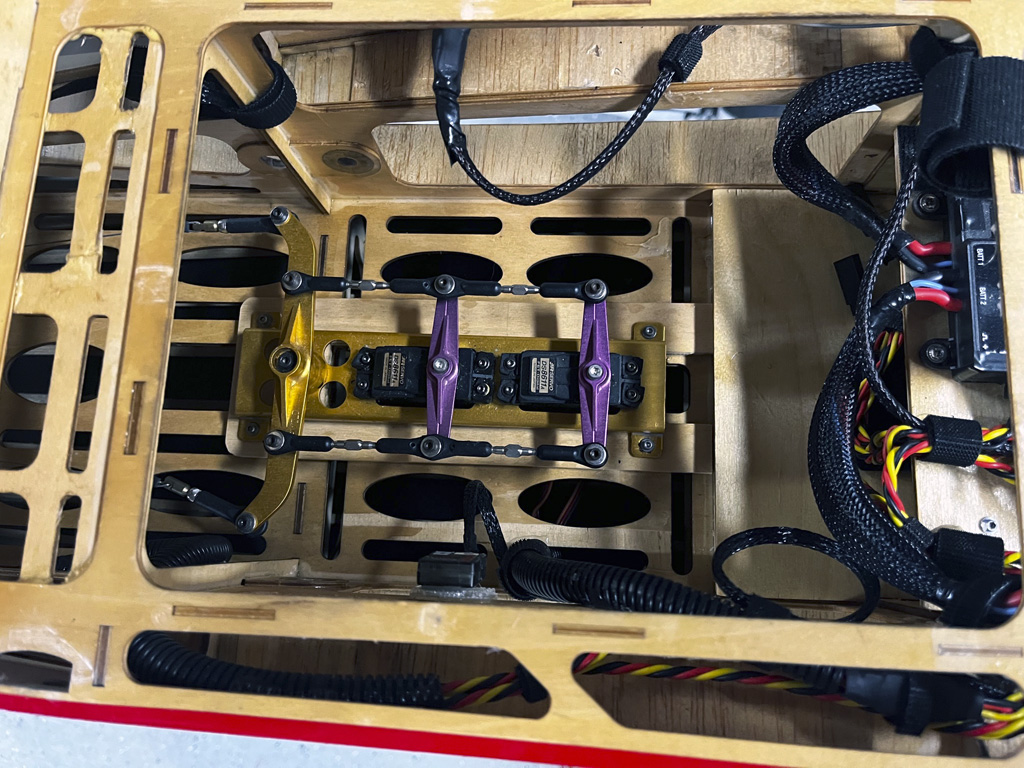
Throttle - all you'll need is a DS90DLHV. Spend more money if you want but this one will do the job nicely.
As far as flight controls go, these are based largely on pilots staring down a tight budget situation. But, if you have access to some old-school hardware, there's nothing wrong with a pair of DS360DLHV on rudder.
Sport Setup
This is a great setup if you're in taller cotton budget-wise.
Ailerons - we guide you to the DS415BLHV on ailerons because at 0.052sec/60° they let you futz around with 3D. But opting for DS505BLHV on ailerons gives you more power if your maneuvers benefit.
Elevators - while we guide you toward DS505 servos on the elevators, depending on how hard you fly you can use one of these on rudder, also. Otherwise, consider splurging on DS630BHV for both rudder (and elevator if you're feeling flush).
Throttle - as regards a DS270DLHV on throttle? It's quicker than the economical DS90DLHV, but without breaking the bank.
Ultimately, flying is on a continuum, there's no one right answer when it comes to servos.
- DS270LHV - 270oz-in @ 0.12sec/60° - throttle
- DS415BLHV- 415oz-in @ 0.052sec/60° - ailerons
- DS505BLHV- 505oz-in @ 0.098sec/60° - ailerons (option)
- DS505BLHV- 505oz-in @ 0.098sec/60° - elevators
- DS630BLHV- 630oz-in @ 0.10sec/60° - rudder (and optionally on elevators)
IMAC servo recommendation
To begin, anybody who mentions equipping a model for IMAC is pretty easy, customer-wise. Why? It's because these guys are almost 100% about centering and precision, not so much torque and speed. That, and because they fly a lot, it means they already understand brushless servos are a much better deal than ones with coreless motors (because they last 5X longer).
Look, coreless vs brushless is like the difference between a shingle roof and a metal roof. Only one will still be with you in 50 years. Same with the longevity of servo motors, so don't assume! Don't know diddly about servo-motors? Then read up:
Meanwhile, by and large, IMAC guys flying Basic, Sportsman, Intermediate and Advance don't give a toss about a servo's transit speed. Means almost to a certainty opting for our BLS1-series versus BLS2-series servos (BLS1 cost a lot less).
Note; BLS2 servos are what we guide our 3D/XA-oriented pilots and IMAC-pilots flying Unlimited Freestyle, toward.
Throttle - same as for sport. It's our opinion many IMAC-pilots will be plenty happy with the same DS270DLHV to which we guide sport pilots. And yes, you can spend more money for a faster throttle servo.
Our DS255BLHV (255oz-in @ 0.052sec/60°) is a great servo because, like the SAVÖX SB-2262SG (444oz-in @ 0.065sec/60°), ours are pretty quick, also. Torque is, of course, immaterial for throttle.
But in all honestly, we reserve a throttle servo with this kind of transit speed for our 3D/XA-recommendation. And because ours is faster than the SAVÖX by a country mile (25%), we think this makes ours the better servo when speed is a consideration. That said, trust me in this if nothing else, short of folks flying 3D/XA and Freestyle IMAC-maneuvers, the throttle requirements just don't call for such rapid transit speeds in most IMAC-classes. Thus, this is a good place to save some dough because you're not giving up anything that will affect maneuvers.
Flight controls - as regards control surface servos, if you're flying Basic, Sportsman, or Intermediate, we'll guide you to four of our DS505BLHV on aileron, plus two DS630BLHV on elevator, and either another DS630BLHV for rudder, or opt for the more powerful DS930BLHV.
- DS270DLHV - 270oz-in @ 0.12sec/60° - throttle
- DS255BLHV - 255oz-in @ 0.052sec/60° - fast alternate throttle
- DS505BLHV- 505oz-in @ 0.098sec/60° - four for ailerons
- DS630BLHV- 630oz-in @ 0.10sec/60° - three for elevators and rudder
- DS930BLHV - 930oz-in @ 0.12sec/60° - more powerful rudder alternative
If you're flying Advanced, then use your judgement based on the schedule of maneuvers you fly. E.g. maybe use DS630BLHV on ailerons, also. Or maybe the DS930BLHV based on how much yaw work you do.
Maybe you noticed the overlap between the well-heeled Sport recommendation versus the IMAC recommendation. My advice is look to the IMAC-schedule of maneuvers for your class. Consider also, whether you're likely to stay within the same class for a while, or are moving up quickly. Means the right answer for you will be obvious.
Anyway, and as you'd expect, folks tend to throw more torque at larger models, but straight up, you don't need as much torque as some would have you believe. Why not? Simple, it's because a lot depends on the class of maneuvers you're flying. For example, Intermediate maneuvers are less demanding on the servos than Advanced-maneuvers.
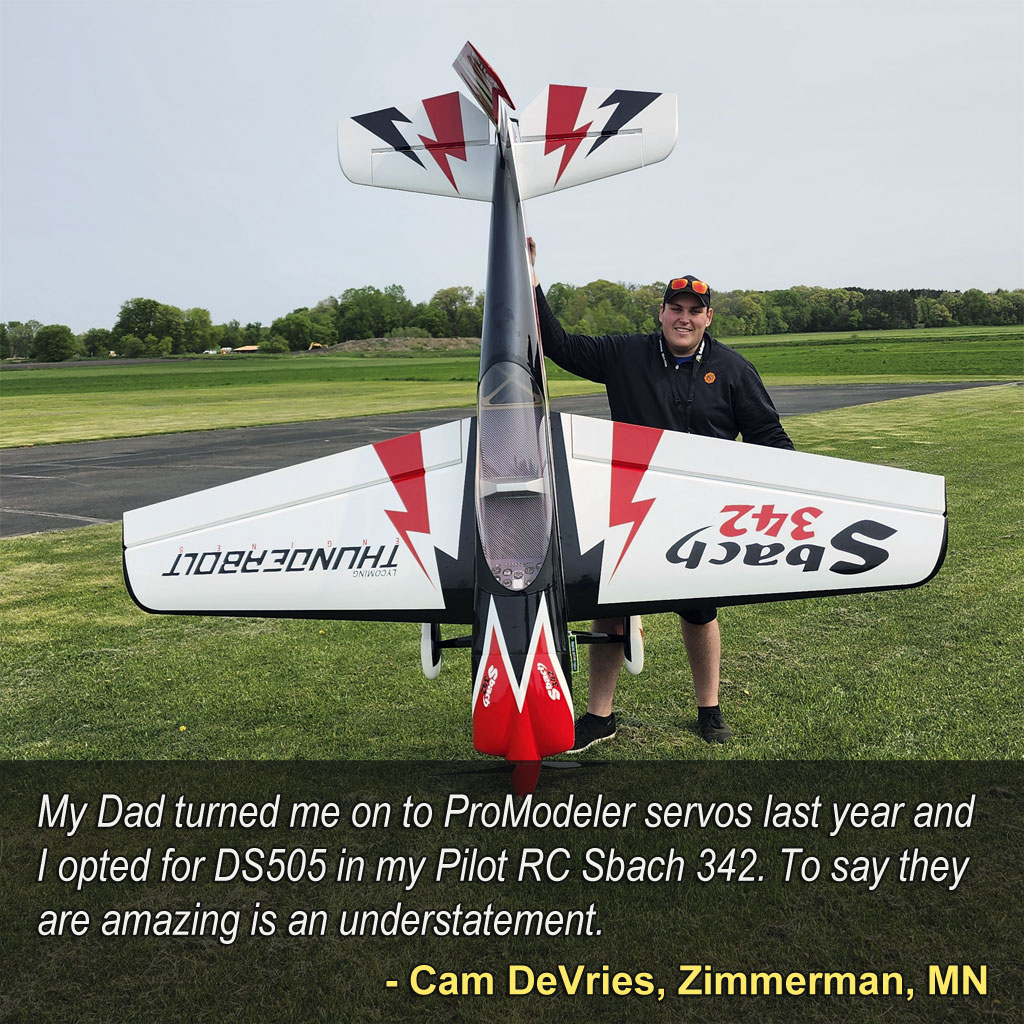
But use your judgement because it's not black & white. Case in point? This fellow, happy as a clam with a 42% PilotRC Sbach 342 equipped with DS505BLHV servos! And to nail down the point, he flies for fun and this is the proof you don't have to over-servo your models if you balance how you fly against what you actually need servo-wise. So if you call us to chat so we can get to know you, then maybe we can help you save some serious money with your servos compared to what the Facebook experts will tell you to buy. Just saying.
IMAC - Advanced
We'll keep it short and sweet. Once you're flying advanced you know if a DS270DLHV is better for you than the DS255BLHV we recommend. Your call. Otherwise, this is what we have in mind for this class.
- DS255BLHV - 255oz-in @ 0.052sec/60° - throttle
- DS505BLHV- 505oz-in @ 0.098sec/60° - four for ailerons
- DS630BLHV- 630oz-in @ 0.10sec/60° - two for elevators (maybe rudder, also)
- DS930BLHV - 930oz-in @ 0.12sec/60° - the more powerful rudder alternative
IMAC - Unlimited
- IMAC (Unlimited - Freestyle) - same as either 3D or XA, pick your poison
3D - low and slow
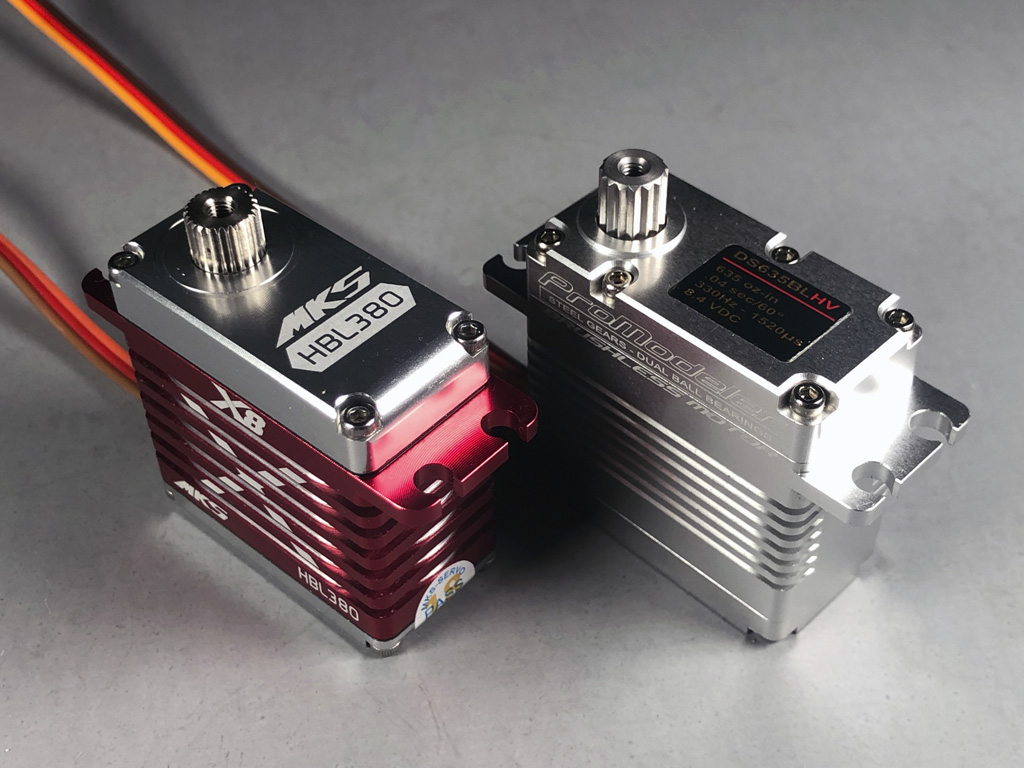
So, because 3D is all about rapid transit speed versus the brute strength required for XA, we guide you toward our quickest and beefiest servos. These are built on the BLS2 frame set. The DS845BLHV and DS1155BLHV share the same case and layout. Still standard size, but because the servos are faster, they hit harder. Thus, we followed MKS with their 8mm output shaft, the famous X8 class of servos (HBL380, HBL388, and HBL3850).
Difference is they opted to go with 25-teeth (as used with 6mm servos, theirs and ours), but at 8mm the teeth are considerably finer than the gnarly (and immensely stronger) 15-tooth profile we went to (both are an ISO standard).
Note; this also means, any 6mm servo horns you own won't fit theirs, or ours.
Throttle - our DS255BLHV is best for throttle. And if you're using a choke servo, then a DS90DLHV is all you need.
Flight controls - we guide you to four DS635BLHV on ailerons, two DS845BLHV on elevators, plus a DS1155BLHV for rudder.
- DS255BLHV - 255oz-in @ 0.052sec/60° - throttle
- DS645BLHV- 635oz-in @ 0.042sec/60° - four for ailerons
- DS845BLHV- 845oz-in @ 0.085sec/60° - two for elevators
- DS1155BLHV - 1155oz-in @ 0.10sec/60° - rudder
Note; as regards centering and precision, all of our servos (to include DL-series plus BLS0, BLS1 and BLS2) are built to the exact same performance standard and use the exact same Noble 1mc potentiometer.
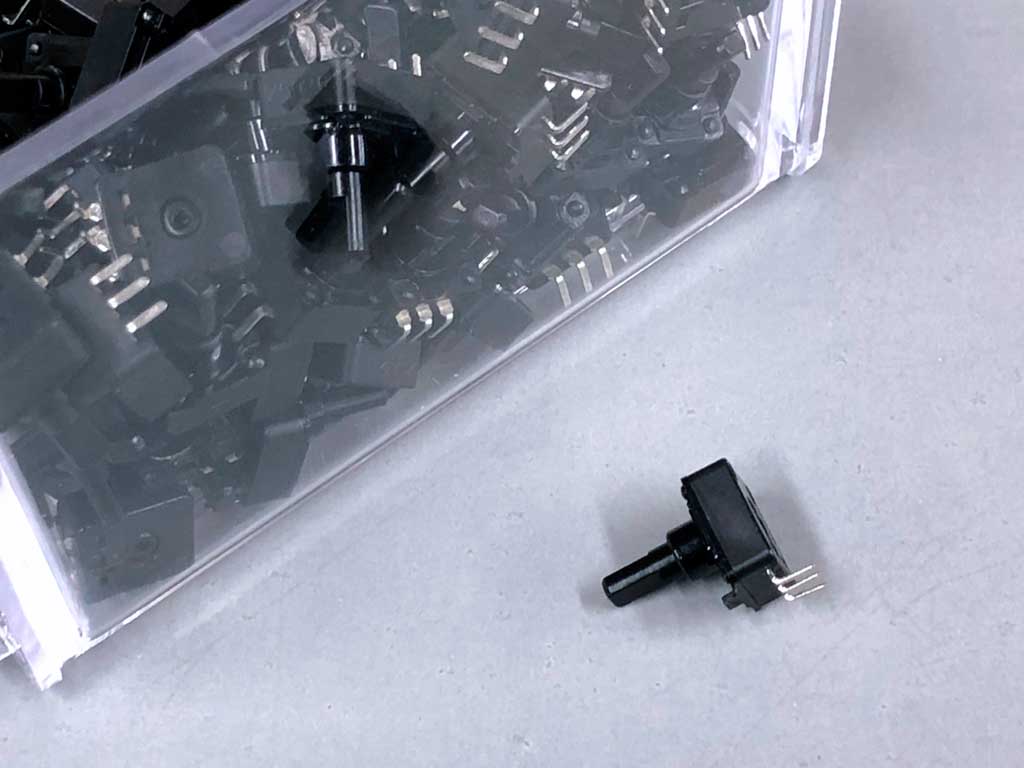
Note; all our servos have had soft-start since 2019. Anyway, if there's downside of our BLS2 servos, it's because they cost more (and it can't be helped simply because, just like hot rodding, speed costs).
Last thing, some wonder about using electronic potentiometers, either magnetic or Hall Effect based. There's good reason but it's out of scope to discuss here. If you're curious, review this article;
XA - fast and aggressive
As with the servos for 3D, you are going to reach for your wallet, again, for BLS2 series servos. But to fly XA (extreme aerobatic) maneuvers, you need both strength and speed. Straight up, it's pilots like you that led us to create our BLS2-series servos. Basically, BLS2 servos are stronger and faster (a lot faster) than our BLS1-series (or what the SAVÖX servos offered Extreme Flight deliver). And not just for flight controls, but throttle, too.
Note; our DS255BHV is actually a BLS0-series (alongside the DS415BLHV). BLS0-series just means it's a brushless servo built within a hybrid case.
Hybrid means polymer plus alloy instead of all-alloy. Makes for a lot lighter servo, but the flip side is it's not as rugged. This is why we switch up from hybrid construction to all-alloy once torque goes north of 415oz-in.
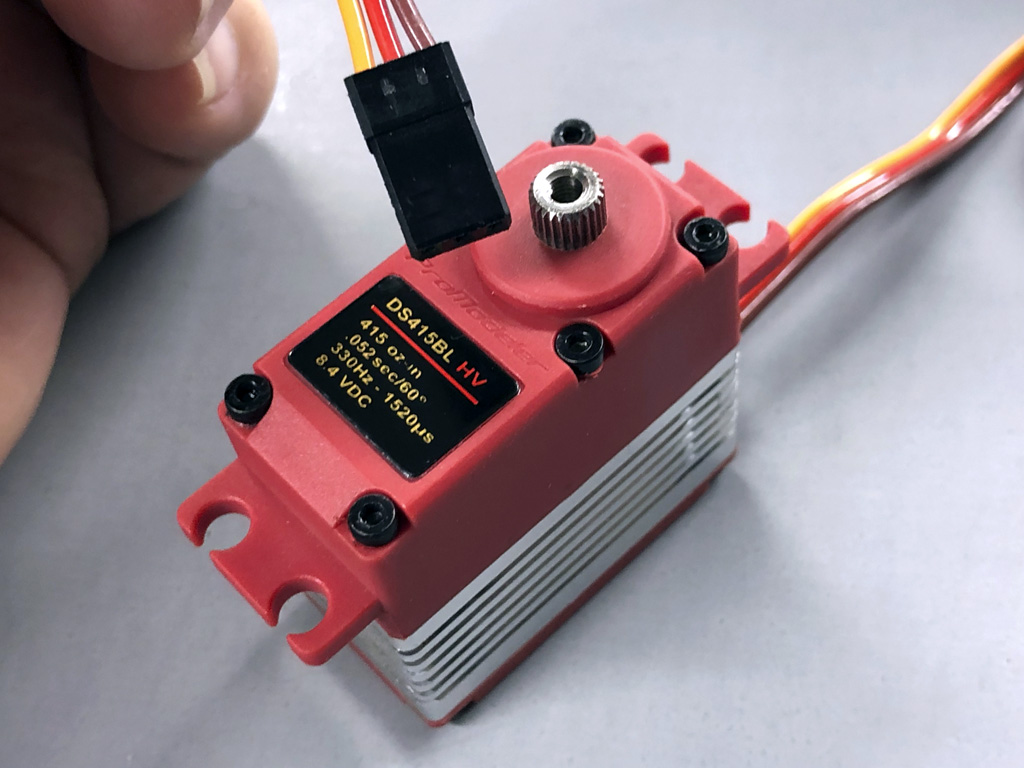
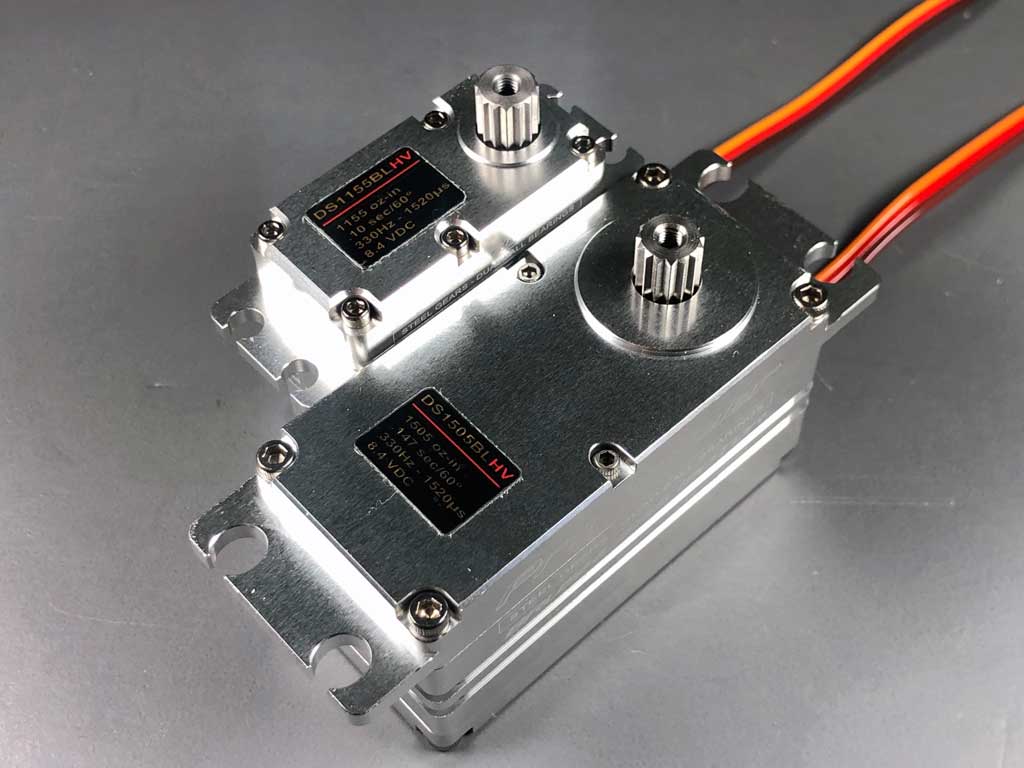
Our all-alloy range extends from DS505BLHV through DS2685BLDP servos. I mention it because of an alternative rudder servo we're going to suggest. It's our low-profile giant, the DS1505BLHV, which outputs the enormous amount of torque called on by gifted pilots.
Outputting a whopping 1505oz-in, this servo is considered by some as capable of making Earth turn faster! So, this big bastard is reminiscent of the old Futaba giant class workhorse, the famous S-34, but because of it's low-profile isn't as tall.
What's more, compared to a pair of rudder servos, using this one saves an ounce (as if anyone who flies hard enough to need this monster, cares).
Throttle - our DS255BLHV is perfect for throttle. And if you're using a choke servo, then an inexpensive DS90DLHV is all you need.
Flight controls - for XA control surfaces, we guide you to four DS845BLHV on ailerons, two DS1155BLHV on elevators, plus another DS1155BLHV for rudder. Two if if you fly in beast-mode. Or the DS1505BLHV if you're a monster!
- DS255BLHV - 255oz-in @ 0.052sec/60° - throttle
- DS845BLHV- 845oz-in @ 0.085sec/60° - four for ailerons
- DS1155BLHV - 1155oz-in @ 0.10sec/60° - two for elevators
- DS1155BLHV - 1155oz-in @ 0.10sec/60° - two more for rudder
- DS1505BLHV - 1505oz-in @ 0.14sec/60° - mounted mid-ship with pull pull
Loose ends
Now, let me caution you about one thing; like, it's a given you're interested in good servos (else you're not on our site), but when we ask if you want servos for sport, IMAC, or XA, please don't bullshit us. Saying we're not going to be impressed with your skills, we only ask because we want to guide you to the best servos for your purpose.
Point being, be careful about what you say because your answer determines how much you gonna pay for servos. Reason is, just like you can't be a little bit pregnant, if you say both to the IMAC or XA question, then you should equip your model for XA. And please don't be dumb and equip your model for XA just to practice because we're talking a lot more money.
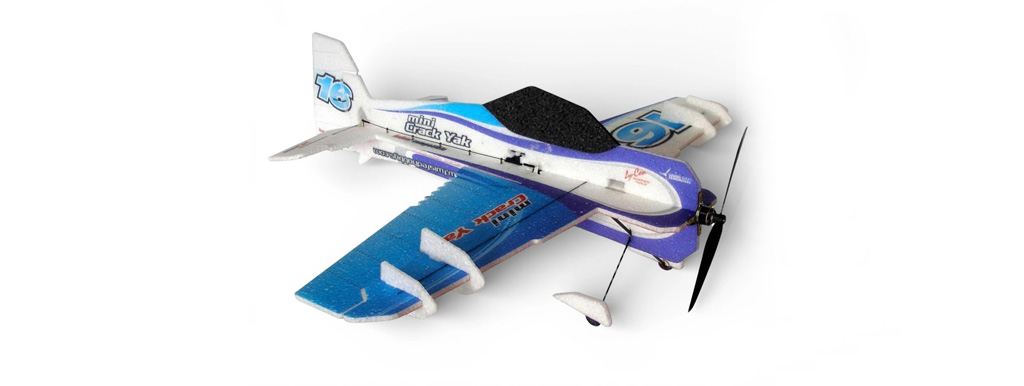
Instead, and of course it's your money, your choice - but - let's be real. If you're into IMAC and want to practice XA, then you'll be a mile ahead of the game practicing with something like a foam Crack Yak 55M from Twisted Hobbies versus outfitting your 33% toy with XA-class servos, capisce?
Wrapping things up
Selecting the right servos based on whether you fly for sport, IMAC, 3D, or XA can save you a lot of money. Optimizing mechanical setup to expand resolution is a good thing. As for which servos, the more aggressive BLS2, or finesse servos like BLS1 suit you better? That's your call.
Bottom line? 33% models are highly specialized aircraft and with setups optimized for precision - or - aggression. They are incredibly fun to fly. However, it's our opinion guys wanting to perform both IMAC and XA maneuvers (at the same time and with the same model) won't do either, very well. This is because the mechanical setup and servo transit speed designed to optimize for IMAC vs XA are way different. Food for thought.
Finally, we set out to show why using the same servos on all the flight controls is limiting. And we tried hard to get the message across you are different from other pilots. What's perfect for somebody on Facebook is likely not best for you because you're unique.
Thus, our intent was to showcase several examples where you can end up with a model better suited for you by being selective in terms of servos, and in what control surface gets which servo. Do both and it means enhancing control surface throw by optimizing both torque and speed for what you like. Means automatically ending up with enhanced performance compared to using the same servo on all the control surfaces of the air frame.
Last thing, if you'd like to chat, reach out by email or give me a call. I'll do my best to guide you into the best servos for your situation.


