
Background
In a previous article, Servo motors 101, we discussed the basics of the three types of motors found within servos. These being;
- iron-core
- coreless
- brushless
We lightly touched on what made the motors different from each other. We also discussed when you should select each. Now let's go into more depth regarding their construction.

What's in it for you
So after reading Servo motors 101, you know the basics of what goes into iron-core, coreless, and brushless motors. You also know a little bit about their relative costs, and importantly, 'why' they cost what they cost. You also discovered what's in it for you in terms of the trade offs between torque, speed, and cost.
And most important of all, you should have a pretty good idea what you should select motor-wise for your next set of servos based on what your model actually needs versus just buying on the basis of price and torque rating. Recapping;
- DL-series suitable for 90% of servos used for sport, warbirds, e.g. those not calling for fast transit speeds
- Speedy servos are a must if you compete in any manner, fly fixed-wing XA, or rotary-wing 3D models
- Alloy cases are what you want once servos go north of 450oz-in (our range extends to 1155oz-in)
Next, let's delve into greater detail. This next section, because it's so in-depth, takes about 18-20 minutes. When you're done, you'll be the guy everyone in your club turns to for servo advice.
And as a refresher, we cut motors open on the lathe with a parting tool so we could take photos and show you their guts!

Goals
Hopefully, once you're done reading this article, you'll never again be dependent on someone else to help you decide what's best for you, servo-wise. You won't need the opinion of a clubmates. Nor some anonymous online expert telling you what to buy. Neither the model manufacturer's opinion . . . or even 'our' opinion. Why not?
Simple, because you'll know which criteria to select for based on motor design. The motor being one of three important parameters (the other two being case design and gear train). Taken together these three parts are what's important to consider when buying servos. That said, understanding motors is crucial and this is the principal goal of this white paper, e.g. getting you up to speed.
So allow me to reiterate; 80% of our sales are standard class servos. Of those, 90% are DL-series. Why? It's because very few models need more than 360oz-in of torque. Similarly, of those, fewer need transit speeds faster than 0.12sec/60° (DS270DLHV). So even if the model's manufacturer suggests you should buy their 500 to nearly 1000oz-in servos, how 'you' intend to fly it is what really dictates what you need servo-wise.

- The manufacturer offered servos ranging from 486-971oz-in
Note; when you 'need' more powerful and speedy servos, then we have them, e.g. up to 1155oz-in (within the same standard size case dimensions) and we offer them as quick as 0.042sec/60°. What's more, for specialized applications, like for helicopter tail rotor, we get with it with transit speeds down to a blistering fast 0.026sec/60°.
However, let me say it again . . . almost everybody will be fine selecting DL-series servos. Next, let's look more closely at the iron-core motors in great detail.
The nitty-gritty of motor construction
DC (iron-core)
We begin with the familiar DC-motor from Servo motors 101.
This time around you're seeing the guts of how they're made. Note the ferrite permanent magnet within the can. Eyeball the copper wire would about the iron core. Also notice how the core is made of thin iron laminations.
Winding this core with copper is how it generates an electromagnetic field. Then these windings are sequentially energized to spin the motor by using a slotted armature. This is as basic as it gets.

- Iron core consists of individual laminations stacked together
Sequentially turning the windings on, thus making an electromagnet to react against the permanent magnet mounted within the can, is what moves the rotor around and around. Commutation (switching the fields on and off in a sequence) is what serves to provide the timing of the magnetic force that keeps the rotor turning.
In this next photo, note the commutator ring at the very end. This is split into three sections (one for each of three coils). As the brushes make contact and jump the gap in the commutator ring sections, they switch the windings on sequentially to pull the motor through. The commutator is the shiny bit electrically isolated from the shaft, and split into three. This is what makes the whole thing rotate.

- Commutator ring is split into three, one for each coil
The iron core of a DC motor is the heaviest of any type of motor. Heavier by a lot, like 8g for an iron core motor versus a few grams for coreless or brushless motors. The mass is what limits acceleration and is fundamentally why iron-core motors are not what an engineer selects if the application calls for speedy starts and stops.
Anyway, the rotor core isn't one piece. It's actually made of thin sections, or laminations, which are stamped out of high silicon steel and then stacked together to form the shape about which the copper coils are wound. Note; the thinner the laminations, the lower the iron loses and the more powerful the motor.
Why not just CNC the core out of a solid piece? In a word, efficiency. Basically, laminating the core helps break up the paths for eddy currents, reducing iron losses, but let's get out of the weeds and move on because Dr. Google's your friend if you're curious to learn more.
Earlier I mentioned mass, or weight. And at 8 grams, which is, relatively speaking, a 'massive' rotating assembly, the iron-core gives the motor a lot of grunt without spending a lot of money. Then it's through gearing that we turn the grunt into useful power without breaking the bank. However, due to the mass, accelerating the motor and bringing it to a stop again as the motor responds to the potentiometer takes time. The more massive, the more time.
And this mass explains why these motors are better suited for applications which don't require rapid response. Doesn't make them bad, makes them better suited for a different purpose - examples include sport models and warbirds.

- Sport models make great use of iron-core servos
If we use football players as an analogy, the iron-pole motor is like the heavyweight fullback the coach sends to get the yard needed for a 1st down by plowing through the line. This, versus the lighter halfback who is used to dance around the linemen and get a yard for a first down when the defensive line is tired. Same goal, get the 1st down, but a different way of going about the job. Same with servo motors.

- Rotor weighing a relatively massive 8-grams explains why they're not speedy
Remember, DC-motors are basically the cheapest to build. In the world of manufacturing, cost trumps pretty much everything. Especially with price sensitive consumers like modelers. On top of great price, iron-core motors are very reliable, powerful, and fast enough for most any modeling need. This means savvy buyers, even when they can afford brushless, may opt for DC, regardless. Why? It's because it may make better sense for the application.
What kind of models? E.g. warbirds like a scale P-51, Spitfire, Oscar, or Corsair model where the speed at which an aileron deploys, unlike that an XA-model, is of little consequence.

- Warbirds are a prime example of the type models suited for iron-core motors
What this means in the real world is if the aircraft doesn't require you to fork over for servos equipped with pricier motors - and - you're savvy enough to avoid being stampeded by the opinion of others into more expensive servos, then you can save a significant sum of money by opting for servos with iron-core motors.
Just know this, there's more than just the motor to consider because the case and the gear train (the other two principal parts of a servo besides the motor) play huge roles, also. So with ProModeler servos, the center case (by way of example) is always CNC-machined from a solid billet of 6061-T6 aircraft aluminum.
What's more, we take the time to mill cooling fins into it to optimize cooling when the motors are working hard. This costs a lot more than an el cheapo injected plastic case and is reflected in greater durability. On top of this, all our servos are assembled with 10 Allen head bolts (versus Phillips head), and the machine thread bolts are equipped with o-rings for sealing them against environmental intrusion like dust, sand, grit, water, and oil.
Since we can't speak for others, it's on you to see what it is you're getting, capisce? Look closely!

- Price isn't everything, nor torque, look closely to avoid being screwed
Anyway, iron-core motors are durable; witness the huge brushes ensuring a long life. So the trick to savvy buying is matching the best made servo mechanics (case and gears) to go along with an inexpensive DC-motor to get the best deal. But beware of internet experts who can spend your money like water by touting more servo than you need. Saying you either watch out for yourself or you're going to get taken.
Eyeball the huge brushes with which the iron-core motor is equipped. They’re so large expressly because they handle the current inrush to keep this massive rotor stopping and stopping for many years of service.

- Springy tabs hold the brushes within the end bell
Coreless
Coreless motors are all about speed. How so? Simple, the rotor is super lightweight. As we all know, given two cars with the same horsepower, the lighter weight one accelerates more quickly. Same with motors as the lighter rotor can accelerate and come to a stop more quickly.
In this next photo, eyeball the guts of a coreless motor. Note the wire making up the rotor has been wound on a mandrel. Once it's retracted (the mandrel) this leave a wire basket that doesn't weigh squat. By this meaning the mass to be accelerated and brought to a stop as the servo moves direction is easier. In turn, this consumes less current and happens MUCH more rapidly! The downside is this type of motor costs a 'lot' more to make.

- Intricately woven rotor made of super fine copper wire
In the above photo, note how the windings have been formed using a mandrel (they're the rotor) and because they're so lightweight the motor can accelerate very, very quickly. This is what gives these motors sub-0.08sec/60° transit times. Note also, the permanent magnet which forms the core (so it’s now the stator) is a more exotic material, neodymium, which costs many multiples of the cost for a ferrite magnet within an iron-core motor. So the combination of more expensive magnet and the hugely more expensive to make finely woven rotor explain the coreless motor costing many times more than the iron-core motor. Is it worth it?
For certain models, ones which perform XA-maneuvers the short answer is yes! But the key takeaway is that these windings (without a core) simply weigh less. In fact, their mass amounts to a small fraction of what the iron-core within a DC-motor masses, which means it's easier to start and stop moving. A great example of a model which benefits of coreless motors include pretty much any XA-model. XA, of course, being short for extreme aerobatics.

- Owner of ChassisSim, this guy groks performance
Recapping; understanding the advantage of a coreless motor lies in integrating the fact their rotor doesn't weigh jack by comparison to an iron-core into your belief system. Low mass is why they can be accelerated so much faster. But making windings for these coreless coils costs a heck of a lot more. Also more costly are the type of required magnet to get the power, neodymium, which is part of the lanthanide series and are hugely expensive.
Note; neodymium are the strongest permanent magnets available commercially and between this and the mandrel formed windings, the higher manufacturing costs versus the ordinary iron-core motors can't be avoided. This comes through in higher servo prices. So just as hot rodders know, if you want to go fast . . . you need more money. Same with servos!

- At 1 gram vs 8 grams for the DC-motor, a coreless is lot lighter
Bottom line? If speed matters, coreless motors beat DC-motors every time because the mass being started and stopped is 'greatly' reduced. And by the way, commutation is still mechanical, e.g. with a commutator ring and brushes.
Our advice? Pick your battles and only select speedy servos when the model benefits from them. Like this XA-type Extreme Flight Extra 300, which this savvy builder spec'd with mini-class to save serious weight.

- Speedy coreless motors unlease rapid response for XA-models
Anyway, as this next photo shows, the brushes on coreless motors are typically a lot smaller than those for iron-core motors because they don't arc nearly as much starting and stopping the significantly lighter rotor. Point being, needing less current to operate, then they can be more lightly built, also.

- Massive DC brushes on the left vs. dainty coreless motor brushes
Recapping; coreless motors, due to their reduced mass, require less amperage to start and stop. Being lighter means they stop and start more quickly. Anyway, their brushes are more compact due to handling less inrush. Bent into whiskers, they maintain good contact with the commutator.
By the way, curious how the guy could use minis with the 85 inch Extreme Flight Extra 300 depicted above? Simple, we use a standard class motor (15mm diameter) in a mini by windowing the case. Yeah, sound exactly what we do, we make a hole in it so the big ass motor can hang out.
This guy's genius lay in recognizing he could pair our supermini along with our mini-2-standard adapter, and get a match made in heaven, a super lightweight XA model!

- Match a supermini with a mount adapter when thinking outside the box
Anyway, look closely to see how the commutator ring for the coreless motor, just as with the iron-core DC-motor is also split. This one has five windings. And once again by sequentially turning them on-and-off as the rotate the windings work through the action of the brushes to activate the electromagnetic fields to make it react (spin) the assembly against the fixed permanent magnet (stator) within the can.

- Sequential turning on-and-off of the windings via the brushes
Brushless
The third and final motor we'll cut open is a brushless, or electronic motor. It's referred to as an electronic motor because it uses electronics for commutation versus mechanical bits like ring commutator and brushes. These added components are why brushless motors are significantly more expensive to make than coreless motors.
Otherwise, brushless motors - like coreless motors - also make use of permanent magnets made from an alloy of neodymium, iron, and boron. Together these form the Nd2Fe14B tetragonal crystalline structure, which results in the incredible development in recent years of super servos.

- The rotor of this brushless motor has the permanent magnet
However, while the neodymium type magnets are shared in common with coreless motors, once the relatively cheap to make mechanical parts that make up the commutator ring and brushes are replaced by electronics, costs take another leap higher.
In exchange, we get a 5X longer working life because there are no brushes to wear, or lead to accumulated dust (more heat) due to deposition of minute particles due to the arcing. This, as the brushes turn the windings on, which eventually vaporizes the brush tips until they no longer function. Means brushless motors also run cooler in addition to delivering a longer working life . . . win-win!
And it's a never ending cycle because, for example, the brushless motors are more complex in other kinds of ways, even in terms of the number of wires going into them. For example, instead of two wires connecting this motor, now there are eight so we can control its position!
So in this next photo, eyeball how many more connections are required - 8 total.

- Essentially an AC motor
This motor is effectively an AC motor with a DC power source, but it’s more well known as a DC brushless motor. All brushless motors require AC in some form to make them rotate. Special circuitry processes DC to AC.
Next, note brushless motors are also wound using a mandrel. The point being, just like coreless motors, brushless motors are also expensive to make. Similarly, used for high performance servos because they'll accelerate/decelerate more quickly than iron-core motors (referred to by some manufacturers as ferrite-motors because of their inexpensive ferrite magnets).
Thus, due to their similarly reduced mass, it means a brushless motor also generally eclipses a DC-motor in the speed department (but at a higher cost than coreless because of the added electronics). In this motor, the rotor is magnetic and and the coils are part of the stator - in effect, it's been built inside out! The very low weight rotor plays a role in high performance.
However, it's when we cut this motor apart that reveals something new and different. There are 3 wires connecting to a round circuit board section. Hmmm, what's with this?

- Cutting the brushless motor reveals three wires
So what replaces the brushes? The answer to that is simple; what replaces brushes are Hall effect sensors. Their output voltage is directly proportional to the magnetic field strength through it. These are usually combined with threshold detection so that it acts as a switch. This is the type of technology also employed within the motors in pricey CNC machines.
Brushless motors are also known as electronic motors. The Hall sensors measure magnetic fields so that the position of the rotor can be computed and the driving voltages to the coils (windings) can be adjusted. Thus, the Hall sensor literally measures the position of the rotor based on magnetic fields . . . meaning all it has to know is which sensor produces the highest reading!
The circuit board has thee Hall effect sensors. Essentially, a 3-pole motor like the iron-core with which we opened the article. Note, don't get into the weeds as regards number of poles, marketing types will have you believe more is better but that's too simple, ignore that as a data point. Anyway, now commutation is switched magnetically so that the electronic circuits can process it.

- The circuit board has three Hall effect sensors
Principal advantage of brushless motors vs. coreless motors is the mere fact there are no brushes to wear out - or what's in a name - duh! This means the motor lasts longer. Much longer. So much longer the folks comfortable with basic math often judge they're worth spending extra for. And here's a little bit of inside baseball. We discovered that as they get more powerful, there's not a Hell of a lot of difference in price between coreless and brushless motors. So for more powerful ProModeler servos, with a cost delta of <10% we go to brushless exclusively.
Point being, if you're shopping 500-600oz-in servos you're going to find brands still using coreless motors. We believe the 5X longer working life between coreless and brushless makes for an easy decision from an engineering point of view even if you're brain dead but obviously a market still exists for those coreless servos (else they don't keep making them). Us? We suspect folks buying them just don't know any better, but ultimately? It's your call to make.
Is there a downside to brushless motors? Sure, there is always a downside. But beyond added cost and added complexity for electronics, they're quite reliable in the grand scheme of things so the real world downside is just one, these motors cost a lot more to make.
So who uses them? Folks who need lots of torque and speed, both, and folks who fly a lot. Competitors are who principally come to mind as the pilots who want the upside of brushless motors because their intrinsic design ensures a working life 5X longer than coreless servo motors.

- Brushless - both speedy and powerful - and last 5X longer
Compare and contrast
Ultimate, savvy guys weigh the benefits of the various motors, plus the other major components like case and gear train. With ProModeler, you're getting stainless steel gears, Allen-head bolts, o-rings, plus an aluminum center with cooling fins. Add to this, bronze hardpoints.
Combine all these and most make an altogether different calculus in terms of value. At least compared to guys who always go for well known brands.

- DS360DLHV equipped with stainless steel gears, o-ring, and hardpoints
Bottom line? Only 'you' know where your desires for quality fit within the value-spectrum . . . we're not here to judge, just to inform. But if you're on a budget and you aren't the type to fly XA type maneuvers, then DL-series fill the bill nicely for almost everybody. Especially when despite the model being what most identify as an XA-model isn't flown that way because what really determines what the model calls for is 'your' intent, not the manufacturer's.

- Dropping $800 on servos is easy, trick's knowing when not to!
Also, and no offense to anybody because we've worked McWages in our past and can squeeze a buck with the best, but the reason we're not going to get into the 'cheapest' possible servo game is because we hold our models too dearly. Thus, whether it's a $250 ARF, or a $10,000 turbine, it doesn't matter to us and what we make. True, if for no other reason than because we're modelers like you (meaning we're using these same servos in what we fly and drive).
For example, earlier I mentioned bronze hardpoints. These are easy to overlook if you don't realize what they do. I keep hammering on how a servo is more than just the motor. The three basic parts to a servo include the motor, what this white paper is about because it affects performance and cost, but the case and gear train are the other two principal components parts.
So you know you get a finned alloy center, which is a country mile better than plastic, or even smooth alloy. But the bits of bronze are what give you durability as they harden the plastic in which the gear shafts are fitted.
We windowed these servo cases just to show how these bronze hardpoints support the gear shafts. The competing servo embeds the shafts directly in plastic. So which do you think lasts longer? More bang for the buck is easy to discern if you open it and look. The other guys? Guess what they don't show you ahead of time, like we do?

- Note the bronze hard points into which gear shafts are fitted
The bottom line reason is we - as a company - don't do el cheapo servos. And it's because we - as modelers - have the same skin in the game as you! Point being, when we advance the throttle, we're put our model at risk just as you do. Or put another way, we eat our own dog food because we equip our own models with ProModeler servos! Big duh?
Well, not really because of this fact . . . I can't just load up with servos for my next project when I'm in the warehouse. Instead, I have to sign a chit (so I get billed). Wanna know what stinks? I pay the same price you! But at the same time, this means my interests are aligned with yours in terms of wanting what's really a good deal, servo-wise.
Questions & Answers
Anyway, this brings up some questions, like . . .
Q. Should I always opt for coreless or brushless if flying XA maneuvers?
A. No, not really. For example, very well known central-Florida pilot Austin 'Doc' Brammer shares these thoughts regarding his teeny-tiny DS100DLHV. These are micro-servos equipped with DL-motors. Curious what the code is regarding our servos? Don't be, you don't even need a decoder ring.
- DS = Digital servo
- 100 = rated torque in oz-in
- DL = iron-core motor (CL = coreless and BL = brushless)
- HV = rated voltage (up to 8.4VDC)

- Stupid spending is paying for what you can't feel.
Anyway, if you've ever seen Doc on the sticks you know he's no slouch! Follow this link to his review of this lovely Velox model. There, you'll also find a link to a video of his flying the crap out of it. Moreover, he explains (as only he can) what equipment he selects and why in his inimitable manner.
Q. Who should use brushless servos?
A. Helicopter pilots are often candidates because the servos are constantly moving, e.g. cyclic servos are moving continuously as the rotor spins at speeds over 2000rpm . . . non-stop motion! Motion, which wears out servos quickly!
Moreover, tail rotor servos even more so because the gyro is constantly fighting main rotor torque and thus stopping and starting the servo in incessant and minute increments. Basically, helis are Hell on servos.

- For helicopters, wise pilots opt for coreless or brushless servos for their speed!
Q. Who else should pony up for the pricey brushless servos?
A. Principally competitors who practice and generally fly a lot . . . e.g. if you attend fun flies and competition events.

- Serious IMAC competitors fly a lot and thus, spec brushless servos
A. Ditto serious drivers who participate in crawling events because steering servos are moving non-stop through technical sections and events may last hours! So for them, brushless servos are a no-brainer. Especially when driving events that last 6 hours, or more!

- For dedicated users, working life enters the picture
Basically, it comes down to math. If it lasts 5X longer, is it then worth an extra 10%? Everybody makes this decision differently. Don't loose sleep over it but don't lose sight of the big picture either!

- Some machines fool you into thinking they're works of art - yet are driven and abused!
Anyway, for many folks, brushless servos are viewed as an investment - but - spending money is personal. This is why we offer all three types of servos, iron-core, coreless, and brushless (as do our competitors from Japan, China, and Europe).
Us? We're a small shop in Florida hogging aluminum. Yes, we buy Japanese motors and pots because they make the best (and there are no outfits in America who offer us these types of motors). Ditto potentiometers are imported because the Nobel pots (Japanese again) are the best. As for gears, for these we opt to go to Taiwan.

- Family owned shops like ours are the heartbeat of America
Anyway, our niche is that we try to do things better instead of cheaper. Basically, we justify our spot at the feeding trough through quality and attention to detail. Put another way, while there's always room for one more, winning requires two things.
First, that you bring a fresh perspective (our quality versus cheaper argument). And second, that people give a damn. Everybody doesn't. Fact.
However, for those of you who do, then we offer a compelling product because you're cutting out the usual middlemen, the distributor who gets a 25% cut. Also, the hobby shop that gets their 40%, also. Honestly? If not for this direct to consumer business model, we wouldn't stand a chance against the east-Asian imports.
Summary:
Iron-core DC motor equipped servos are least expensive and good enough for 90% of models. These incorporate a technology as old as Ben Franklin - we kid you not! And yet, despite being the most cost effective, sometimes it seems only über savvy modelers know when to opt for them. E.g. when are they the best choice versus bowing to the crowd and forking over big dough on servos.
Yes, it's hard to go your own way when everybody else says spend big money. However, for those of you who are independent thinkers, somehow you never have a problem making the best decision for you. And now that you know more about motors, you too will find it easier to cut your own path through the noise.
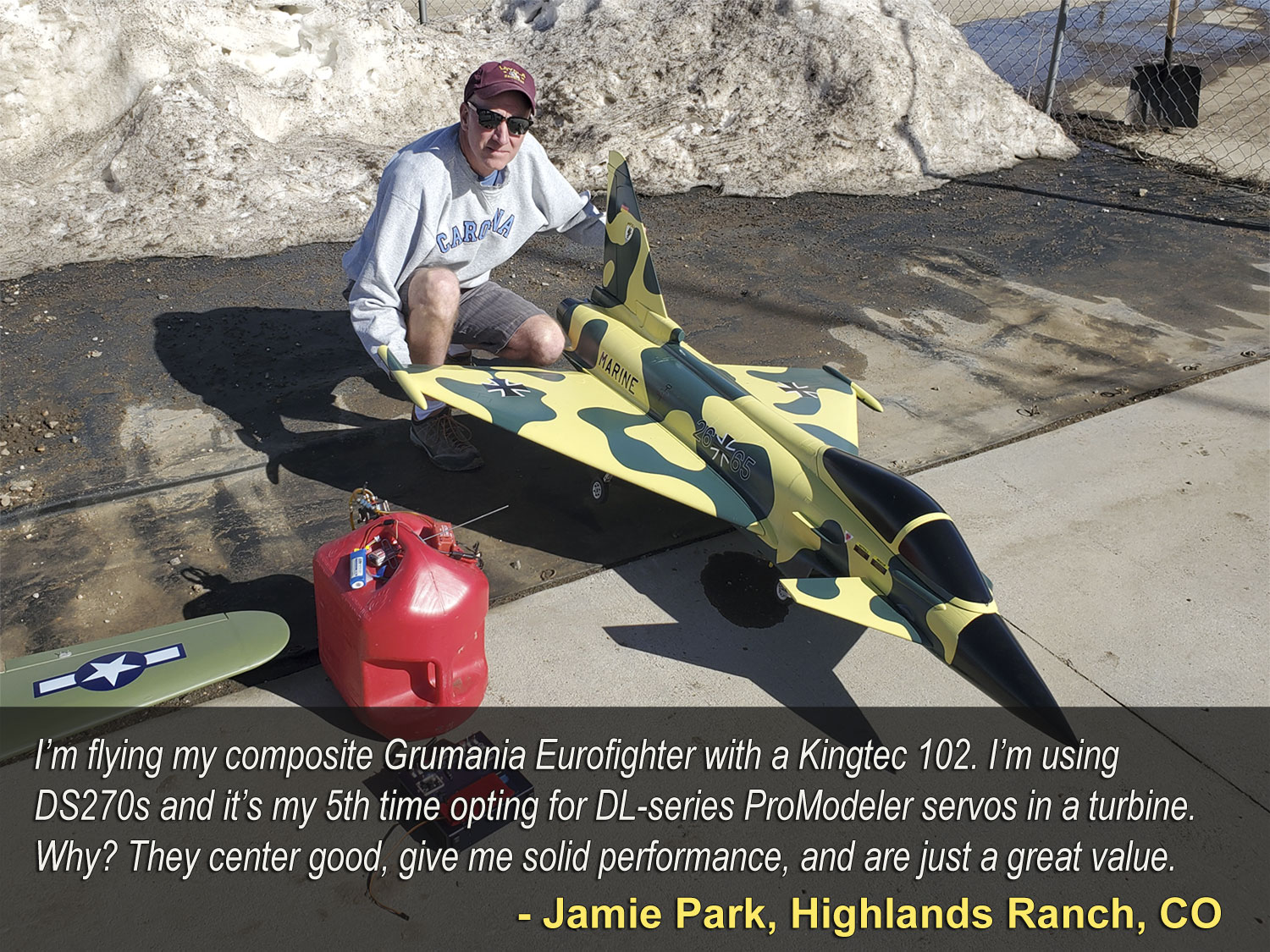
- Believe this guy . . . you absolutely do not have to drop big money on servos
The point we're trying to make is - only - buy fast servos if you need speed. Otherwise, buy the best DC-motor servos you can find because the mere fact the motors are inexpensive doesn't mean they're junk, or poor quality. It is principally an issue of ease of manufacturing that results in DC-motors costing less.
So for scale models, even a lot of 3D airplanes - but flown by sport pilots performing gentlemen aerobatics (loops, rolls, stall turns, Immelmann turns) - then opt for DL-series. Otherwise, for the Jason-wannabe trying their hand at terminators, rifle rolls, and Harriers, e.g. folks who actually need the fastest and most powerful servos (read this as expensive), then you should be looking at brushless if you're in the 500oz-in and up range. Otherwise, we have speedy in the 255-415oz-in range which won't break the bank.
Look, high performance models are the product for which coreless and brushless motor servos exist. Like when you're racing an 1/8th scale buggy or truck and it's important to hit the apex of a corner timed perfectly, there's no substitute for speed. Similarly, when performing a low altitude Harrier with rudder, aileron, and elevator servos in a synchronized dance, speed and power are everything!
Bottom line? When it comes to speed, coreless and brushless motor servos are the most popular answer for racing and XA pilots for a reason, they're fast!

- When only the the best will do, brushless is really the way to go!
Q. What happens when longevity factors in along with speed?
A. Then it's brushless - clearly. This, because the benefits outweigh the drawbacks (5X longer working life versus 10% price difference). The same holds true when 'the best' is part of the equation, e.g. where brushless motors are again the choice.
Note; knowing the motors are pricey, we tend to go for the whole enchilada when making these servos, e.g. an all-alloy case, stainless steel gears, etc. because when the choice of folks who are uncompromising in their pursuit of the best in every regard want the best motor, they also want the best gears, and the best case components. That's when our best sums it up in one word.
Closing
In the end, whether you're facing a budget, or the requirements of the model are guided by a single factor, perhaps torque, the iron-core DC-motor servo is probably all that's needed. Many national championships and world events have been won with DC-motor servos. They are a great choice for almost any model.
The major point is, most modelers can select a DC-motor servo based on torque requirements. And few modelers need to spend more than what one of our DS360DLHV servos will set you back. And yes, sometimes folks make the mistake of equating price with quality. Or purpose with need - but - if you look back just a few years, pilots were winning big time money with servos less powerful and slower than our DS360DLHV.

- Winning $50,000 with JR servos rated at <200oz-in and 0.18sec/60°
So buy brushless servos because your servo requirements include both loads of torque and a high speed parameter (XA maneuvers are being flown at much higher load levels than Chip required in the above photo). Competitors will fall into this category when performing difficult maneuvers. And while this often makes a coreless servo the best choice for some, for our part, we ditch coreless motors when making +500oz-in servos because the motor-prices are within 10% of each other.
To our engineer's way of thinking, this makes brushless a no-brainer. As for those of you for whom a brushless-motor servo are de rigueur, your needs dictate servos for which basically . . . basically, money is no object. You want the best and are willing to pony up for it! Make no mistake, brushless motor servos are the best money can buy.
If you've made it through this entire article then you're fully equipped to decide what motor is best for you based on what you've learned. We've offered this knowledge nearly for free (though because we've shown you some of our products, reading our propaganda is the cost). All this in hopes you opt for our servos next time - but - also in service of all modelers. E.g. educating you regarding the differences in all servos have, regardless of brand or models, for the common good.
Anyway, we offer you a solid selections using all three motor types without compromising quality.

- Experience dictated brushless for rudder, DL-series for throttle and mixture.
Last thoughts; the motor you select for your servos is serious business, choosing wisely now that you know a bit about the three types: iron-core, coreless, and brushless is easier after learning about how they're made, and why this affects performance, agreed? Ultimately, knowing what goes into them, how this factors into cost and performance means you're equipped to make better decisions - like those a pro makes - which is important because as the old saw goes . . . knowledge is power!


