
A servo matchUP (comparison article) comes about from time to time and nearly always in response to a question regarding a specific servo like; I’ve been using Hitec D645MW servos for years but a buddy said I should look at ProModeler, so what have you got to compare, and what recommends them?, or words to that effect.
The answer to the above is a ProModeler DS180DLHV and because we don’t hide from these questions, we buy a competing servo, take it apart and show what’s what using side-by-side photos. This, so you can suss out which side of the bread is buttered for yourself, because nobody likes being told what to do.
Note this example of the types of photos we take to share. This, so you better understand what's at stake before you spend your money. In this case, a Viton seal at the output shaft versus nothing at all. All-stainless steel gears versus brass and steel. Plus o-rings at the case sections versus nothing. Similar money for both, but one's a no brainer in the eyes of those who see what they really get. So we're going to do the same for the HPS-A703 versus our contender.

- Finned aluminum center, 13 seals, plus all-stainless gears!

This brings us to this matchUP, which comes about in a unique fashion because a potential customer isn’t just inquiring about a Futaba HPS-A703 but is also describing a problem when using them with a Jeti Central Box 310, all whilst asking not only what we’ve got to compare, ‘but’ if he can expect the same issue with ours.
Thing is, the answer involves a 3rd party’s product, and sensing a cow patty in which I don’t want to step, strange doesn’t begin to describe a feeling akin to being asked if I’m still beating my wife!
Unfortunately, an honest response is unlikely to win friends and influence people (e.g. persuade him to buy our servos). More likely, my response alienates him (and in making him unhappy, it means he won’t buy our servos). I really hate can’t win situations – sigh.
Unfortunately, I’m not wired to shy away from controversy, so because he asked, he’s going to learn what I think. You will, too.
Note; this article runs a bit longer than usual because an investment in such expensive servos deserves our best effort at guiding you. If you’d rather not clutter your brain, then just skip through eyeballing photos and reviewing captions.
Contents [hide]
- 1 Futaba A703 vs ProModeler DS930BLHV
- 2 HPS-A703 vs DS930
- 3 Wrapping things up
- 4 Servo arms
- 5 Further study
- 6 Final thoughts
Futaba A703 vs ProModeler DS930BLHV
Q1. I was hoping you may be able to help. A friend of mine (Steve Astlund) recommended your servos since he has had good luck with them in his IMAC planes. I am putting together a 40% Edge 116” and just purchased (8) Futaba A703’s. I am also switching over from Futaba to Jeti and trying to use their Central Box 310. I have been having an issue of the servos locking up after I put them through some motions. I think it has to do with the servos not liking the BEC within the Central Box.
I may end up changing out all the servos with something that has no compatibility issues with the Jeti Central Box. What servos within your lineup would you recommend, or would yours potentially have the same issue?
A1. We’re looking at two distinct questions, but first, we’re gratified whenever word of mouth sees someone wash up our shore, please extend our thanks to your friend, Steve.
In reverse order, there have been no reported problems with ProModeler servos and Jeti Control Box 310, so let’s get that out of the way from the get go. Nor have there been reported issues with PowerBox, AR, or any alternative power distribution systems.
So I suspect Futaba HPS-A703 specs (below) warning against BEC-use is why you bring up BECs when asking if you’ll experience the same issue with ours (graphic from Futaba’s website shared as fair use).

So here’s the thing, like Futaba, we also advise against BECs. But from our perspective, it’s because hairy servos like these can consume 5A each, and consumer grade BECs are not really meant to supply as many servos as this class of models carries. It's just physics. Anyway, this is why batteries are preferable since a battery has no issue delivering as much current as you need.
Also, we mention it because of model truck customers. Talking about guys with toy-grade ESC/BEC combos rated to deliver 5A, or even 8A but in practice incable of it. Note, also, Futaba warn against using dry cells. Same for us (and I suspect for the same reason), Alkaline batteries are unlikely to be capable of delivering enough current.
Anyway, and while I may be talking myself out of a potential sale, I don’t think Futaba are to blame for what you’re experiencing. Speaking of which, what did Futaba say when you asked them? Added to which, I wonder what the folks at Jeti have to say? Like could your Central Box 310 simply be defective? Wondering because we have tons of folks flying turbine models and using Jeti power distribution systems with our servos (and likely, so do Futaba). But back to your Central Box 310 issue, if I had it on the workbench connected to an oscilloscope, then maybe I could offer more insight.
Meanwhile, and in defense of my competitor, consider this; the HPS-A703 is Futaba’s top of the range standard class servo (and it’s not in me to toss my competitor under the bus to try and gain advantage). Especially because I believe we can beat them fair and square! Point being, I don’t think there’s any issue with your HPS-A703 servos and instead, if I were you, I’d seek elsewhere for the root cause of the problem.
Also, don’t forget this while you’re troubleshooting; your receiver(s) are also drawing power off the BEC circuit. Point being, if all the servos lock up, then ‘maybe’ you’re unjustly blaming the servos (thus, putting a final nail in my hopes of making a sale).
Anyway, I think you’re lucky your $5000 model was on the workbench when you discovered the issue because the condom of consequences isn’t usually lubed with good fortune . . . but I digress.
Next, to the part of your question important to me, what have we got to compare to Futaba’s A703 servos? Well, as it happens, we have more than one for your consideration, we have four suitable servos. So if you're still interested in what we have to offer, then keep reading to see how what we have matches up to theirs!
Disclosure
If anyone suspects we’re going to say an HPS-A703 is junk, they’ll be sadly mistaken – nothing could be further from the truth. It’s quite a finely made product. Do I think ProModeler is better? Well, yes as it happens, I do (as I should), and I also believe I can prove it to you.
But that's getting ahead of ourselves. Moreover, in what follows, please do not interpret anything said as derogatory of Futaba, or the company’s products. Instead, it’s my sincere belief they offer one of, if not the highest grade, RF-system available to the consumer market, and excellent servos to boot!
Added to which, in the interests of full disclosure, know this about your author (that would be me); following a few years with Orbit, and a 15 year stint with Kraft equipment, I’ve flown Futaba radio systems since 1989 (and continue to this day with an 18MZ). Saying, there’s a soft spot in my heart for Futaba, which colors my thinking.
However, this last doesn’t actually matter because it’s on you to suss out which servos best serve your interests. That, and my job right now isn’t to love on Futaba, but to show why your money is better spent with a servo-specialist versus those from an RF-specialist. Particularly when you’re equipping a seriously expensive RC model.
Introduction
Is anyone surprised at learning we’re been asked more than once what we have servo-wise to compete with Futaba’s finest servos? At the time of this writing, it’s their HPS-A703, but we’ve previously been asked about their HPS-A700 (then it was in regard to use in a XA-model, or extreme aerobatics aircraft). This means compared to this question – oriented toward an IMAC model – that guy got a different answer about which of our servos to use.
Facts are, we’re reasonably familiar with their line of wares so let me share this; we actually have four alternatives to an HPS-A703 for your consideration. Two BLS1 series, and two more within our BLS2 series.
What’s the difference? Torque, speed, and price . . . like, duh, what did you expect me to respond?
Lineup
The two on the far left are DS630 and DS930, an HPS-A703 in the middle, and DS845 and DS1155 arrayed to its right (note; these two sport huge 8mm spline shafts – there’s a reason). And with regard to all four of our servos? Their full part numbers end with BLHV for brushless, high voltage.

- L->R ProModeler BLS1 – DS630 & DS930, Futaba HPS-A703, and BLS2 – DS845 & DS1155
This brings up the question; what do these various letter/number designations actually mean? Well, you don’t need Cliff Notes because it’s actually easy to suss out the ProModeler parts-code;

So all the servos in the above photo are equipped with brushless motors. And you know this because of the BL within Futaba’s model description of HPBLS.
Heck, even if you don’t know jack about the motors inside your servos, just the fact their best (and ours) use brushless motors is a clue these are the best motors money can buy. Meanwhile, operating on the assumption you’re not a subject matter expert, then review this material because you may find it of use even if you end up buying someone else’s servos;
Note; we put this article together to help modelers learn about the differences between the 3 basic types of motors offered in the industry. These being iron-core, coreless, and brushless. This, in part, because nobody else does. How? By cutting them open with a lathe and then taking photos!

Look, everybody offering RC servos use three types of motors. This means whether you favor Futaba, Hitec, Spektrum, or ProModeler servos, our cutting motors open using a lathe to show you what’s what inside, and explain when to select which motor, means you benefit even if you end up buying Futaba servos!

- Internals of a brushless motor detailing Hall effect sensors
Anyway, along with close up photography, reading the article means also learning several reasons brushless motors are best. This, to include their place within the hierarchy of cost structures, which is reflected within this little graphic . . .

. . . which shows price'always' plays a role in sussing out best for you and your model. Of course, as a general rule, the more things cost, the better.
Anyway, and cutting to the chase; we have had enough folks inquiring about how our servos compare to the Futaba HPS-A703 that we bought a couple. This, so we could disassemble them and photographing what we found so we could show folks (e.g. put together this guide). We hope you find it useful because it's our opinion with photos to help, you don’t need to be an engineer to figure out what you like better. Yup, just rely on your eyeballs, Mark II (plus a few spare gray cells) and you'll suss out the lay of the land when buying high end servos. Brings up another question.
Against which servo?
Which ProModeler servos should we match the A703 against? As usual, the answer is . . . it depends! On what? On how you’re going to use the servos! What started this query was a fellow asking specifically about an IMAC-oriented model airplane. but the servos for it are different from those someone performing XA-oriented maneuvers. Ditton, a fellow flying scale has diferent needs asdoes a driver of an RC truck, or hydroplane with two screaming engines blasting across the water at 80mph.
Thing is, servos don't have a clue in what they're installed. Saying there's really no such thing as airplane servos vs truck servos. What does matter is torque, and speed (plus price, of course). Anyway, let's briefly touch on some differences that may play a role in your decision because we have four servos which could legitimately be put up against their contender for your money. We'll start with our baddest servos, our 1155oz-in model
DS1155BLHV
Since Futaba’s best is listed north of $300 it would be easy to assume we’d put up our most expensive standard class example; the DS1155BLHV. But we didn’t because it blows the HPS-A703 out of the water in terms of torque. Honestly? The DS1155BLHV matches up better against the HPS-A700, instead.

Added to which, at 0.10sec/60° vs. 0.12sec/60° the DS1155 is also about 20% quicker transit time-wise than the HPS-A703. And while ours is expensive, it's not as costly as theirs!
Anyway, its our opnion a DS1155BLHV is just more servo than you need to throw at an IMAC model. This, principally because the maneuver schedule isn't as abrupt as those flown for XA, which is where the DS1155BLHV excells.
Note; and FWIW, the DS1155BLHV is however, also an excellent choice for really heavy model trucks. Examples include the Traxxas X-Maxx, which often goes north of 30 pounds and hits speeds well over 50mph (this rig desperately needs a servo with balls).

DS845BLHV
Moving on, we could also have reasonably put our 2nd most costly standard class into the fray. Putting the DS845BLHV against the HPS-A703 is not crazy if you’re into XA because of it's stupid speed adavanatge. But once again, overkill for IMAC.
How do the DS845BLHV specs match up against the HPS-A703? Well, they're actually fairly closely torque-wise (theirs makes 9% more torque, which we can measure in the lab but you'd never feel in the air). However, at 0.06sec/60° vs. 0.12sec/60° ours is 200% quicker. An XA-pilot kills for this difference because it means the difference in stopping the blender when they want versus overrotating, but even those an average pilot can easily feel the difference in speed, thing is, speed is of no consequence for IMAC.

So ponying up for our DS845BLHV is only right for you (in our opinion) if you're flying XA-maneuvers. There, then yes, the DS845 outclasses the HPS-A703 by a country mile (it's is in a whole other league speed-wise - think Usain Bolt vs high school sprinter). So while the the torque is close, the speed of the DS845BLHV makes it an unfair comparison, again, this is just our opinion.
Recapping, the DS845BLHV is fantastic for IMACwith some XA throtwn in, but where it shines is perfoming aggressive XA maneuvers because speed is a major consideration. But for IMAC use? Honestly, there’s really no real need to spend for the speed.
Anyway, once again, we felt this wouldn’t be our best match up against the Futaba HPS-A703 (not for IMAC-use). So what about our DS630BLHV, instead?
DS630BLHV
On first blush some would say we're crazy pitching our DS630BLHV for your consideration. This, based simply on the specs because ours only makes 630oz-in against theirs at 916oz-in. On the flip side, ours transits in 0.10sec/60° versus the Futaba HPS-A703 at 0.12sec/60°.

Do these differences in specs matter to you? No clue, but for IMAC-duty many find the DS630BLHV to be a reasonable contender - but - it depends on how you fly. By this meaning iIf your maneuvers include XA-type, you probably want more torque with a 40% but with a 33% you'll appreciate our speed. Nevertheless, and once again, this decision depends on the schedule of maneuvers you favor.
Still, for many it's a solid contender. And note; they're using them in both 33% and 40% models. Proof? Witness this experienced IMAC-pilot’s thoughts regarding the DS630BLHV installed within his Dalton 330SP.

Anyway, at 630oz-in vs. 916oz-in, the DS630BLHV is down 31% torque-wise to the Futaba HPS-A703. And whilst 20% quicker than theirs at 0.10sec/60° vs 0.12sec/60°, the torque disadvantage is significant in the eyes of those who want lots of grunt.
Honestly? Many/most modelers have a marked general tendency to focus on torque instead of a speed advantage. Thus, they would dismiss the DS630 out of hand. And as it turns out, we don’t believe it’s a reasonable comparison to the Futaba, either.
So let's look at the 4th ProModeler contender to take theirs on. The one we think matches up best.
DS930BLHV
Ultimately, we selected our 3rd most expensive servo as our best to put up against Futaba’s HPS-A703 for an IMAC application within a 40% model. It’s the ProModeler DS930BLHV.
And no, servos don’t know in what they’re installed. And yes, this is a judgement call based on how IMAC-maneuvers are flown versus XA-maneuvers.
Why the DS930? It’s because torque-wise 930oz-in vs 916oz-in is a wash (a mere 1.5% difference). And speed-wise? Both are rated at the same 0.12sec/60°, so the speed-specs are a wash, also. So like the little girl in the 3 bears story, a DS930 is just right for IMAC duty!
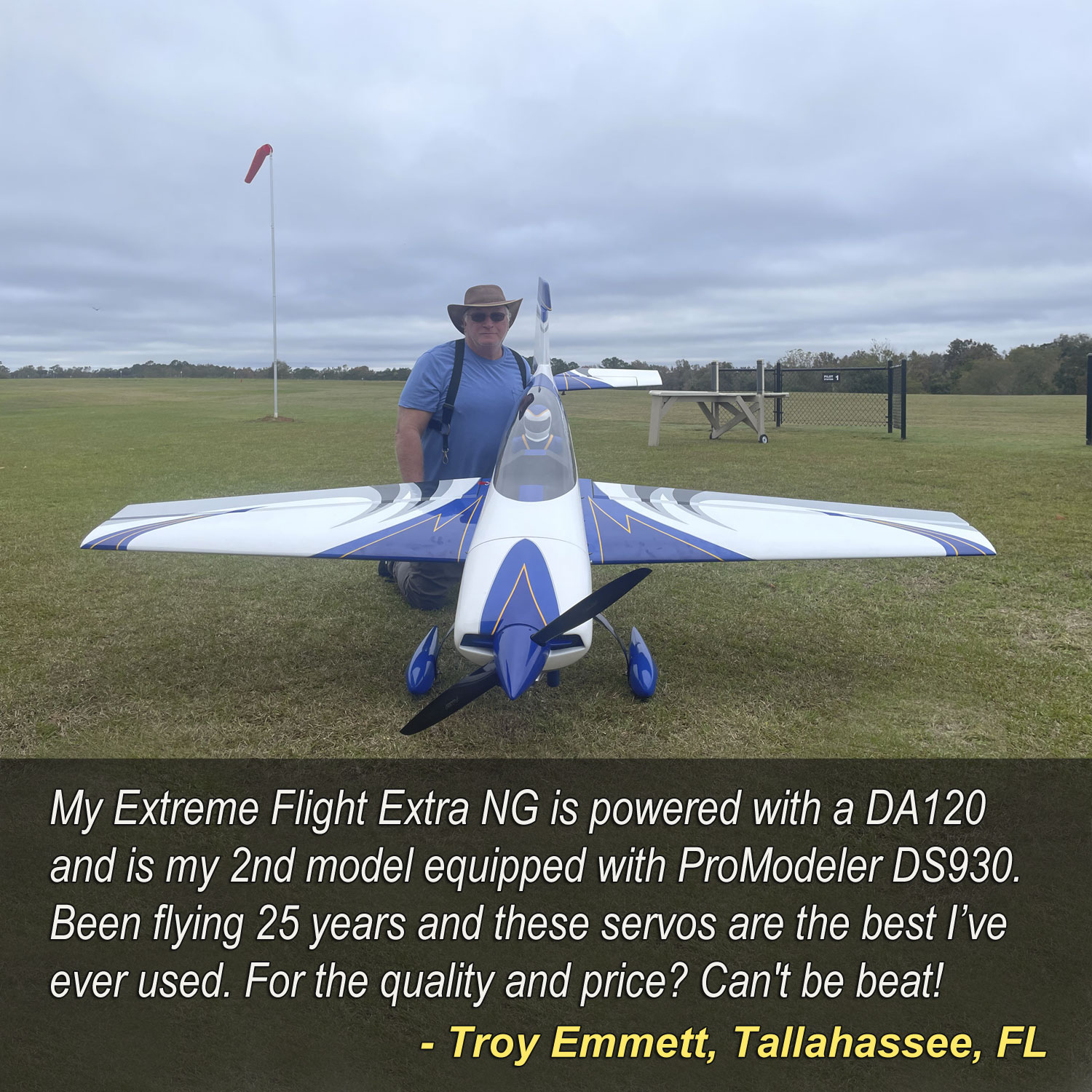
This next fellow (photo below) is coincidentally also flying a Dalton (like the previous photo), but this time an Extra 260 version. He has this to say about a set of DS930BLHV within his 40% class competition aircraft . . .

Disclaimer
So why this interest in pitting the servos spec-to-spec as closely as possible? For the same reason heavyweights aren’t put in the ring with welterweights. So while the title of this entry is matchUP, I’m no fool, either (meaning I know money plays a role in everything).
So even if you’ve got more money than God himself, despite our feeling we beat the HPS-A703 in many important categories, adding a price advantage is just smart business! Basically you can pretty much buy 'two' DS930BLHV servos for the price of one Futaba HPS-A703. Why? Principally due to the difference in our business models. With us, you cut out the middlemen to include the importer, distributor, and hobby dealer. Yes, they all have to eat - but - you don't have to be who feeds them. And on top of that, we believe we give you more bang for the buck. Big words? Yes, but it's said it ain't bragging if you can back it up. Here goes!
So now let’s dive deeper because most modelers participating in the sport with 40% aircraft (and large turbine jets) are, and I mean no offense, in a whole other league compared to the average club pilots. Saying guys who can afford $280 servos tend to also look beyond the price simply because they can afford to. Club pilots, on the other hand focus solely on price (hence the rise of off brand east Asian imports).
And competition IMAC pilots are a whole different breed altogether! They don’t give two flips about cheaper, they’re 100% about better. Better what? Better anything! Basically, they’ll kill for a 1% improvement.
Saying what floats a competitor’s boat is better performance, better durability, better quality, better cooling, and pretty much better anything! In a word, competitors are seeking more than just value. But it’s within that word – value – where ProModeler really tells its story.
We’re saying the Futaba HPS-A703 is a very fine servo but the ProModeler DS930BLHV is better – and – we believe we can prove it.
By the way, if you’re short of time, then just scanning the photos (and the captions) is enough to get the gist.
HPS-A703 vs DS930
First up, the servos placed in close proximity. In boxing it’s called the tale of the tape, but here it’s the side-by-side photo. The idea is to give a sense of scale – basically they’re same size.
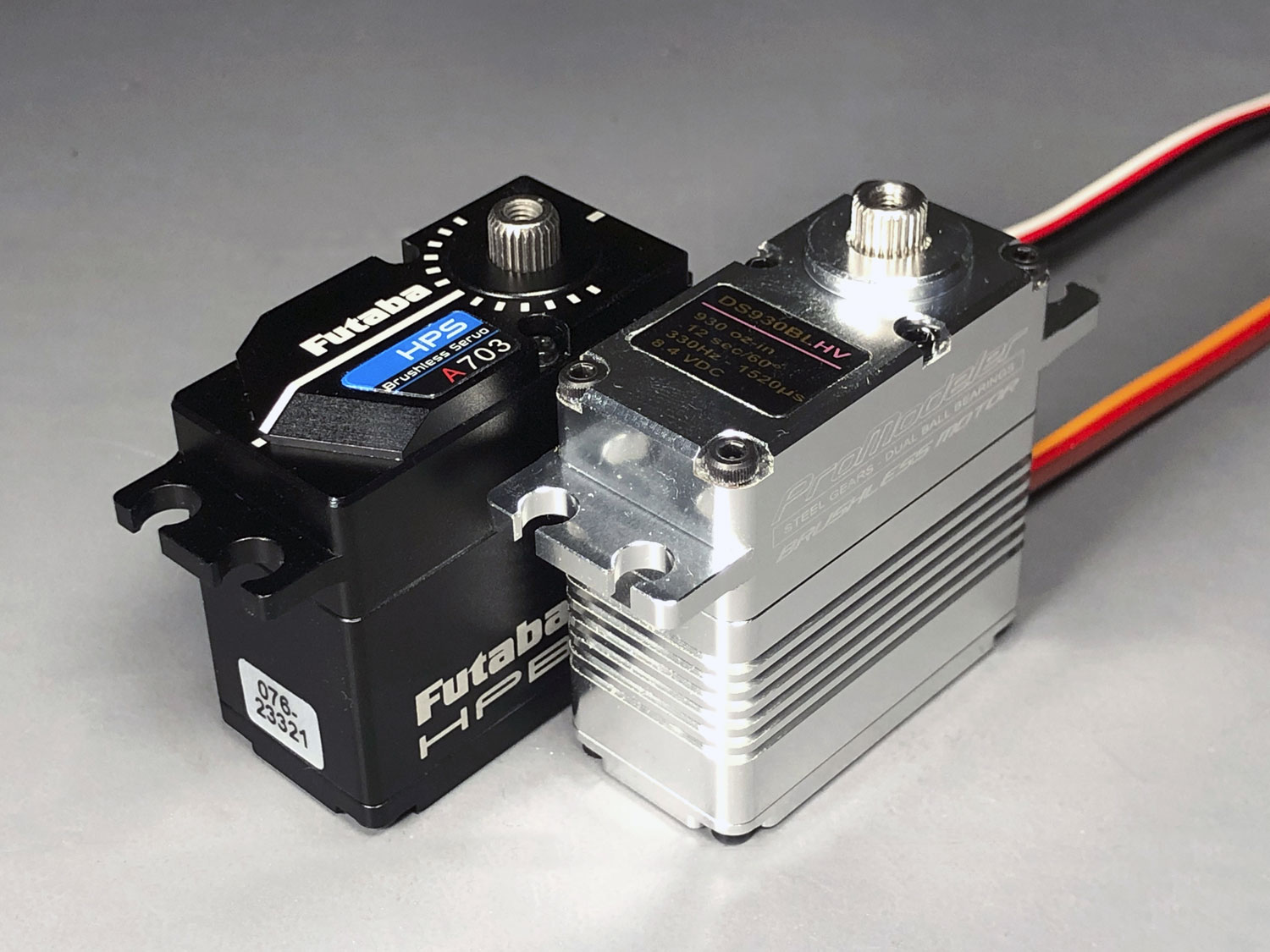
- Futaba HPS-A703 dressed to the nines vs plain looking DS930BLHV
We’re speaking of a pair of standard-class servos (possessed of a 40x20mm footprint). There’s also 10mm between the mounting screws on each beam. They’re basically drop ins for each other into any model.
This means swapping in one for the other leads to no mechanical compatibility drama. This is a good thing since we hope folks will be buying our servos, or as this fellow did, ditch their Futaba in favor of a set of our servos (yes, it happens).
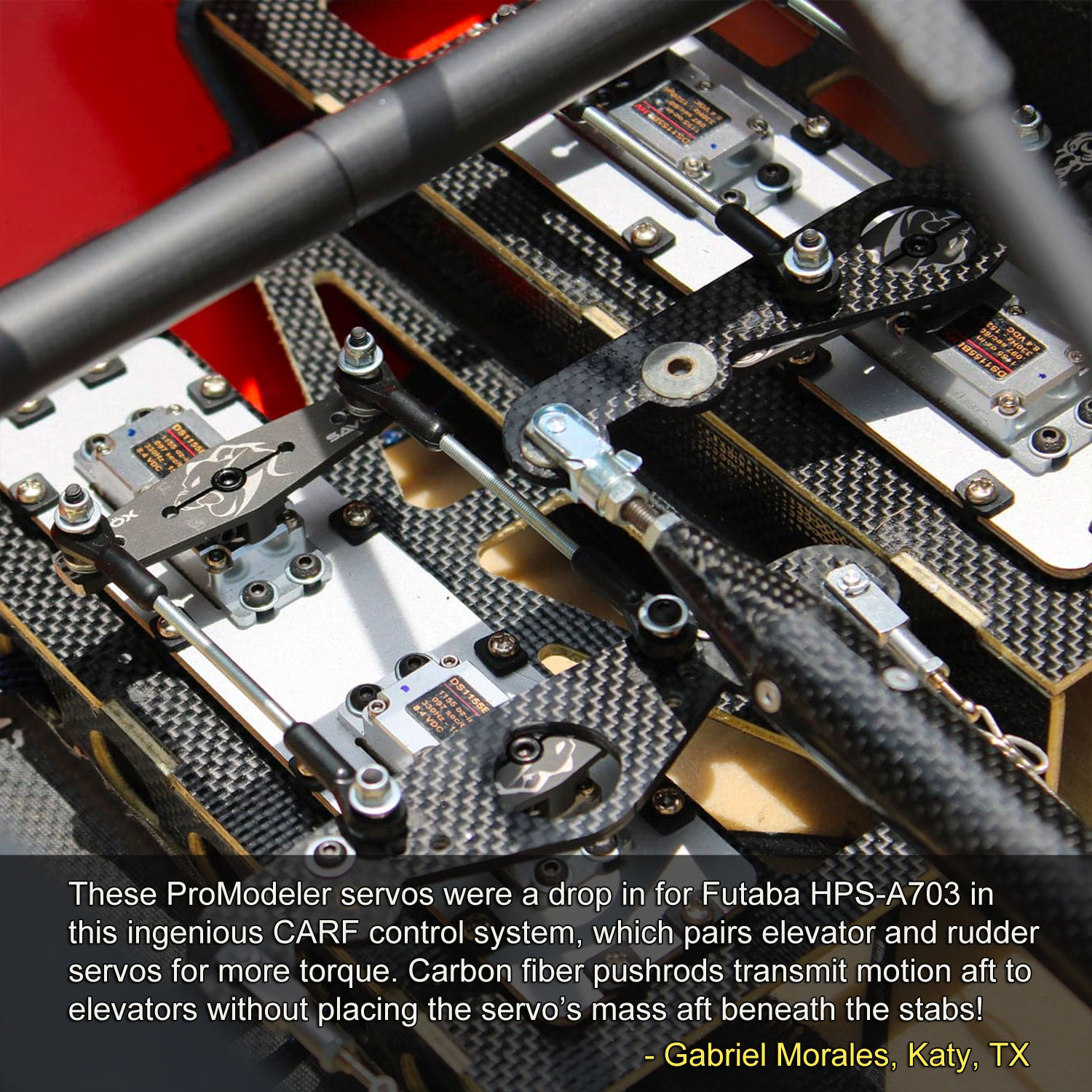
Note; these days, if I had the ear of CARF's owner I'd recommend he look to our low profile giant servos, the DS1505BLHV as a substitute for using two servos. Even saves money if you feel 1500oz-in is enough (and I net it is). Would require making a new carbon fiber mounting plate but that's easy enough.
This is it in this next photo (to clue you in about what we're talking about). This setup is expressly for pull-pull rudder control and the savvy use them in lieu of a tiller arm (what most folks default to using for reasons unknown). If you want to learn more, then review this article: Advantages of pull-pull via pulley
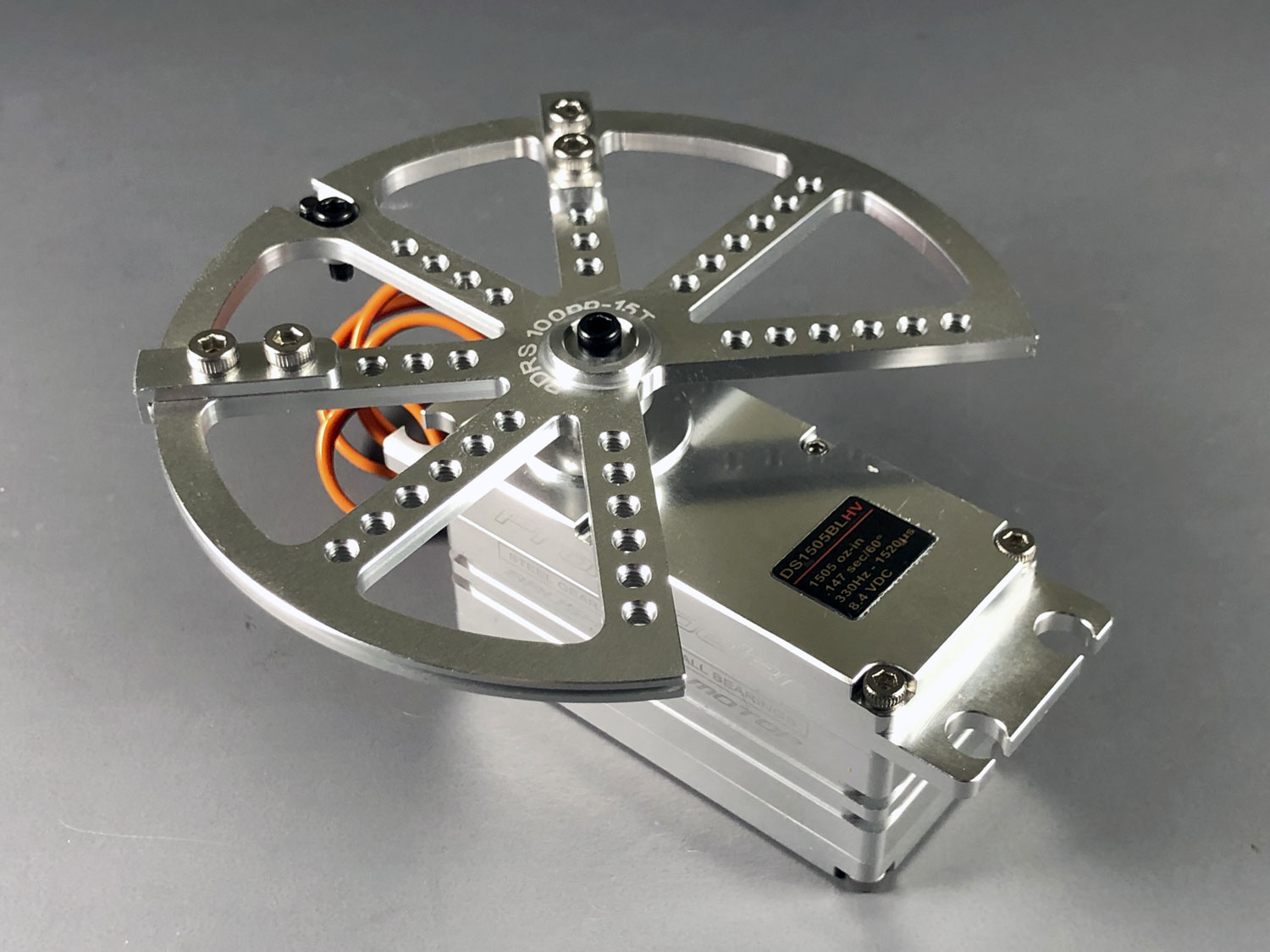
- Low profile giant outfitted with our PDRS100PP-15T pulley.
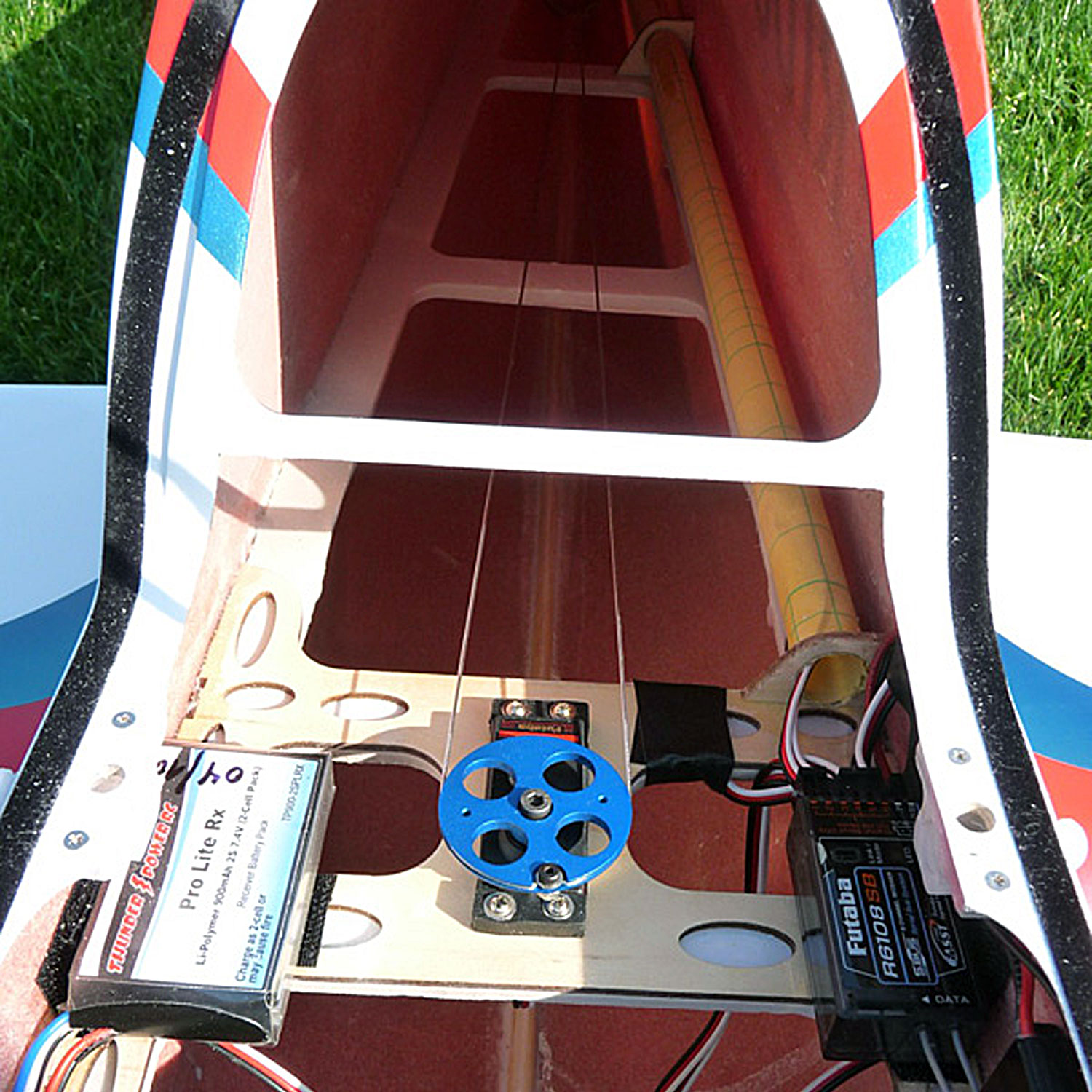
And for what it's worth, we developed the pulley system after stealing the idea from a guy name of Wolfgan Matt who used a similar setup. Those of you who know of whom I speak, know him as two time winner of the World Aerobatics Championships. Hailing from Lichtenstein, his influence on F3A is undeniable.
Anyway, this next photo is of the rudder setup within his Peridot model and dates back to 2011. This was taken whilst coaching the South African team before they competed in the world championships that year. He did as well (the 27th FAI-F3A World Championships were held in Muncie that same year).
Appearance
Anyway, looks-wise both the Futaba and the ProModeler servos are handsome in their own way. The ProModeler in a simple and understated sort of way, the Futaba being rather dressy in a stylish black tie and tails sense! And if we're being honest, the black anodized is finished off with striking bits of red and blue, along with 13 tick marks around the around the output shaft. This makes for a very sharp looking package. We simply cannot deny it!
Add laser etching and silk screening on the sides and bottom boldly proclaiming the Futaba brand identity, model number, etc. and it's attarctive. So while I hate to give it up, score a point for the Futaba’s great looks because we’ll admit, that’s one handsome rascal. This makes the score is 0-1 in their favor right out of the gate! And we get why, too. After all, appearance is everything to some.
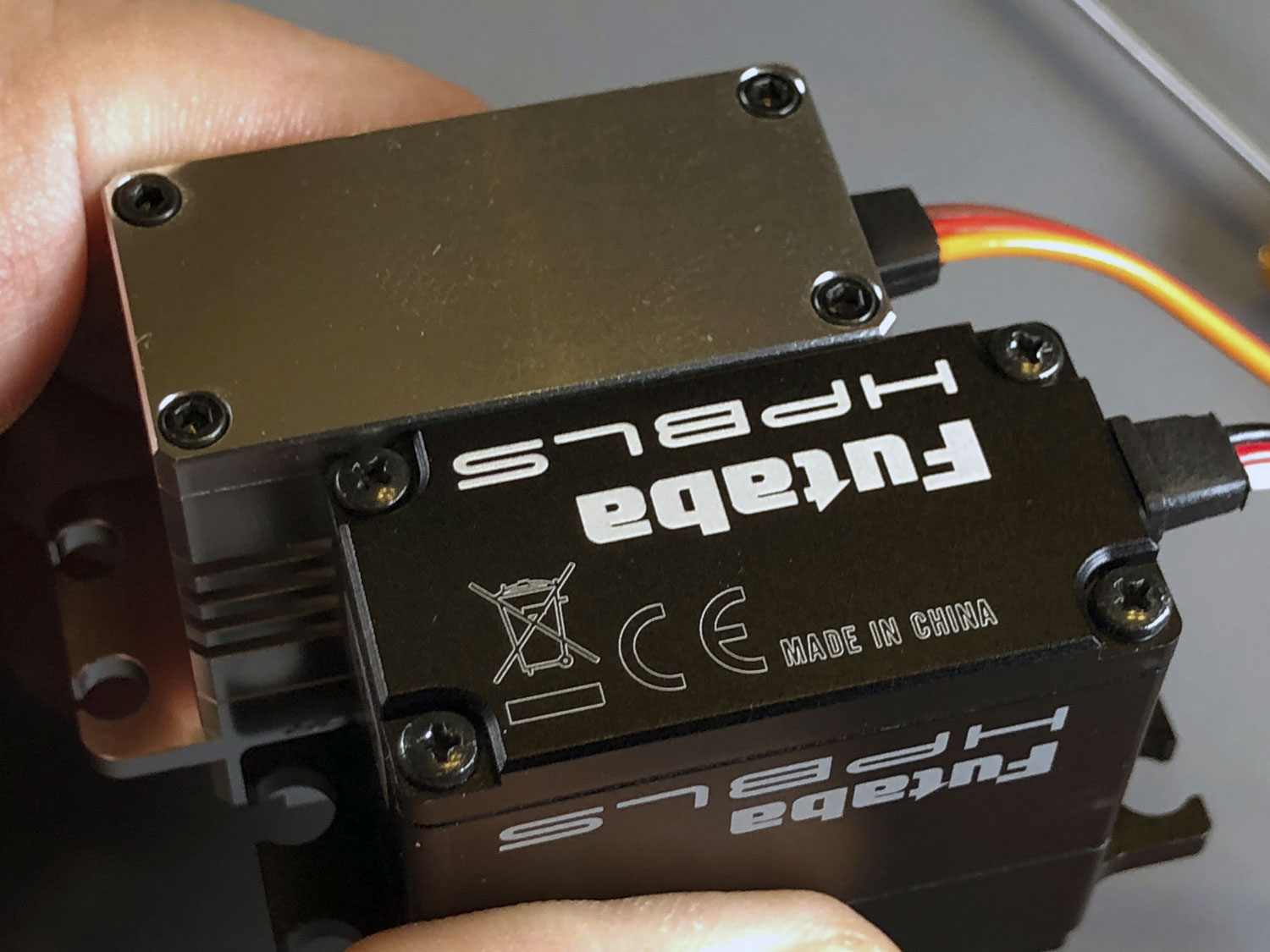
- Silkscreen and laser etching against black anodizing is strikingly effective
Facts are a lot of servos sell based on being pretty - else marketing companies wouldn’t waste time and money dressing them up, right? Thing is, we’re an altogether different breed. Instead of a marketing focus, our exterior sees an emphasis on engineering.
Then again, after you slobber over how pretty they are, once you install them, then you don't see the propaganda. Knowing this, we don't give appearance more weight than it deserves. Anyway, while some will consider this a low blow, but Phillips head screws . . . seriously?
Center case – cooling fins
Next, while we willingly sacrifice appearance (the immensely valuable promotion value of the laser-etched logos on the case sides), we do it in favor of hogging from the solid billet of 6061-T6 alloy center. So if you're a form follows function kind of guy, we score our own points over looks with better cooling performance.
Bluntly, since engineering is over marketing, then we're saying cooling is waaaay more important than looks – at least in our book. So this next photo is a porcupine center. We call it a porcupine because if you squint a bit, the case center with 10 bolts (each with tiny o-rings) sticking out kind of look like quills.
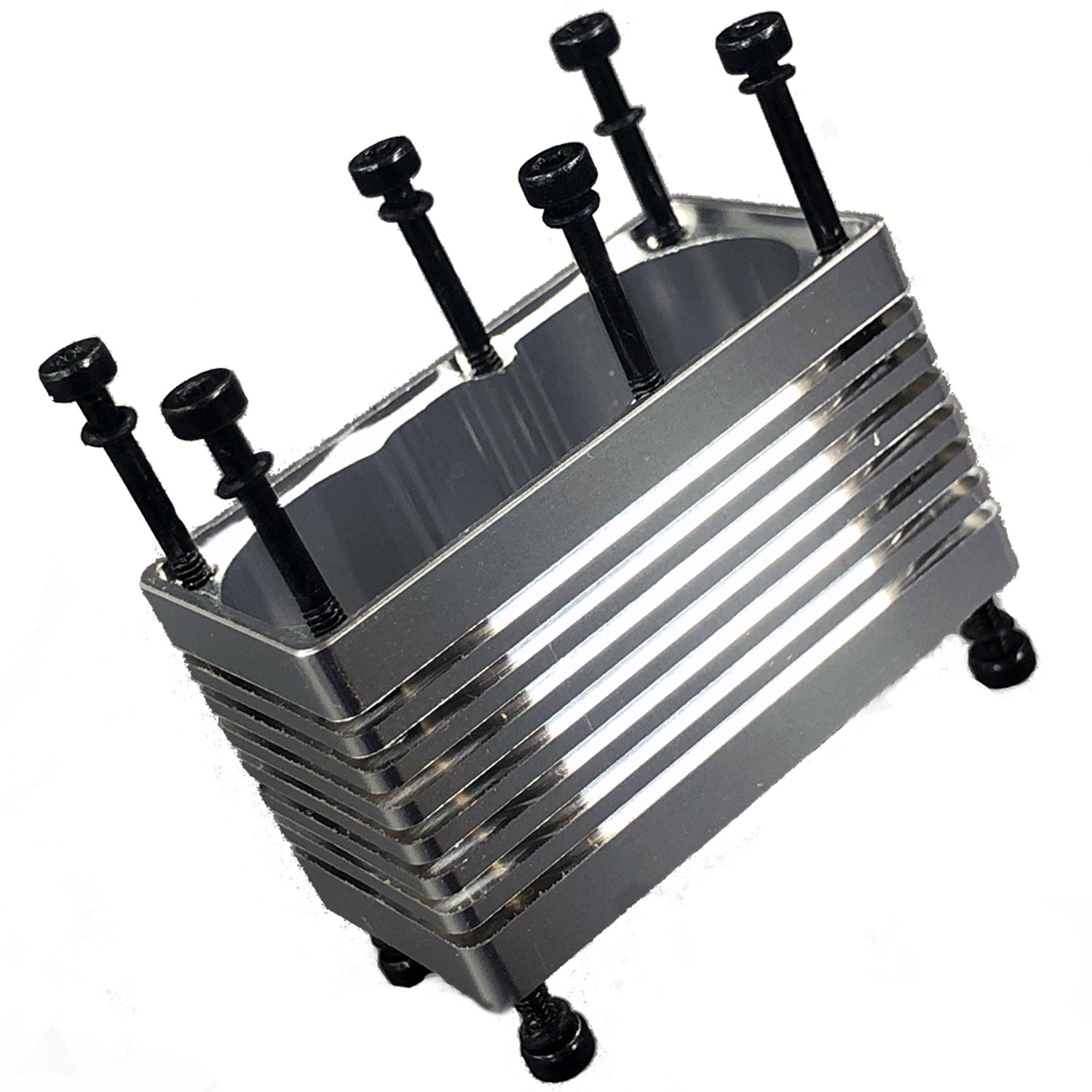
On the importance of cooling
So why do I keep banging on about cooling fins? Well, if you study specifications (all ProModeler servos have a spec sheet like this one below) and if you eyeball the 4th and 5th voltage columns . . .

. . . and specifically for the purpose of eyeballing current draw at stall (when servos make their rated torque), then you’ll note how it’s capable of drawing over 6A at full song (output depends on input voltage). Folks, that's serious current and you'd better believe this generates heat.
Basically, when servos are working, they NEED to shed heat. Meanwhile, despite not having the full specs for the Futaba HPS-A703, just using grade school math and Ohm’s Law for power, P=V*I (or W=V*A).
- P = Power (watts)
- V = Voltage
- I = Current (or amps)
And plugging in some numbers gives us 8.4*6.7=56.28 so we’re dealing with 50W devices with both theirs and ours. Which is about what you would expect as they perform similarly.
50W is a lot of heat to dissipate! Like have you ever tried changing a hot light bulb instead of waiting to let it cool? Burned the crap out of you, right? Major point being this; the cooling fins on ProModeler servos are 'not' decorative. Heat is the enemy of all electronics and if you want to prolong the working life of your servos, then you want ones that shed heat as effiectively as possible when you’re working your servos really hard.
Bottom line? There’s a butt load of heat to dissipate. And yes, smooth aluminum alloy will do the job, but significantly more slowly than a case section equipped with cooling fins. Reason fins work better has to do with the advantage of increased surface area from which heat can radiate! Simple physics!
So why doesn’t the HPS-A703 have cooling fins? Well, Futaba's engineers don't pick up the phone to keep us in the loop but as an educated guess, the amount of machine-time whilst a case is being machined is a critical factor toward overall cost. Speaking for ourselves, we know the amount of time during machining is about doubled due to fins (and man-time doubles also since the man tending the machine has to wait twice as long). So your getting cooling fins is down to money. Anyway, our working theory has to do with them figuring only a few pilots fly hard enough for this to matter so it's to do with reducing product cost.
Meanwhile, circling back around to the Futaba HPS-A703 and our not finding current draw information, if anybody finds this information, kindly share that we may update the article. Minor point being, since both output in the +900oz-in range (916oz-in vs 930oz-in can be measured in the lab but is for all practical matters the same). Point being, I believe it's reasonably to expect both to consume similar amounts of current (because you can’t produce torque out of thin air). Saying no matter which servo you select, both make a fair bit of heat, which needs dissipating.
Ultimately, cooling fins are functional instead of decorative. So ask yourself this; when you’re ponying up for your servos, would you rather your servos had smooth sides with logos, or cooling fins? Anyway, if you’re keeping score, we believe a reasonable man will score a point to the ProModeler side of the ledger for the cooling fins. Means the score is now tied 1-1.

Up next we remove the bottom covers, the part that conceals and protects the printed circuit board (the electronics section).
Electronics section
Let’s see what we’ll learn. One thing that’s striking is we’re finding more and more servo brands decorating with laser etched propaganda, or silk screen printing. Sending these out to be decorated (or doing it in house) constitutes another operation, and it is isn’t cheap so we don’t do much of it.
Reason we send them out instead of doing them ourselvesfor laser etching is because it’s hard to beat a man at his own craft – but – that said, we also keep laser etching to a minimum because of cost. After all, especially on the bottom electronics cover, what’s the purpose? Like once it’s installed, who is going to see it?
Anyway, next, let’s open them up.
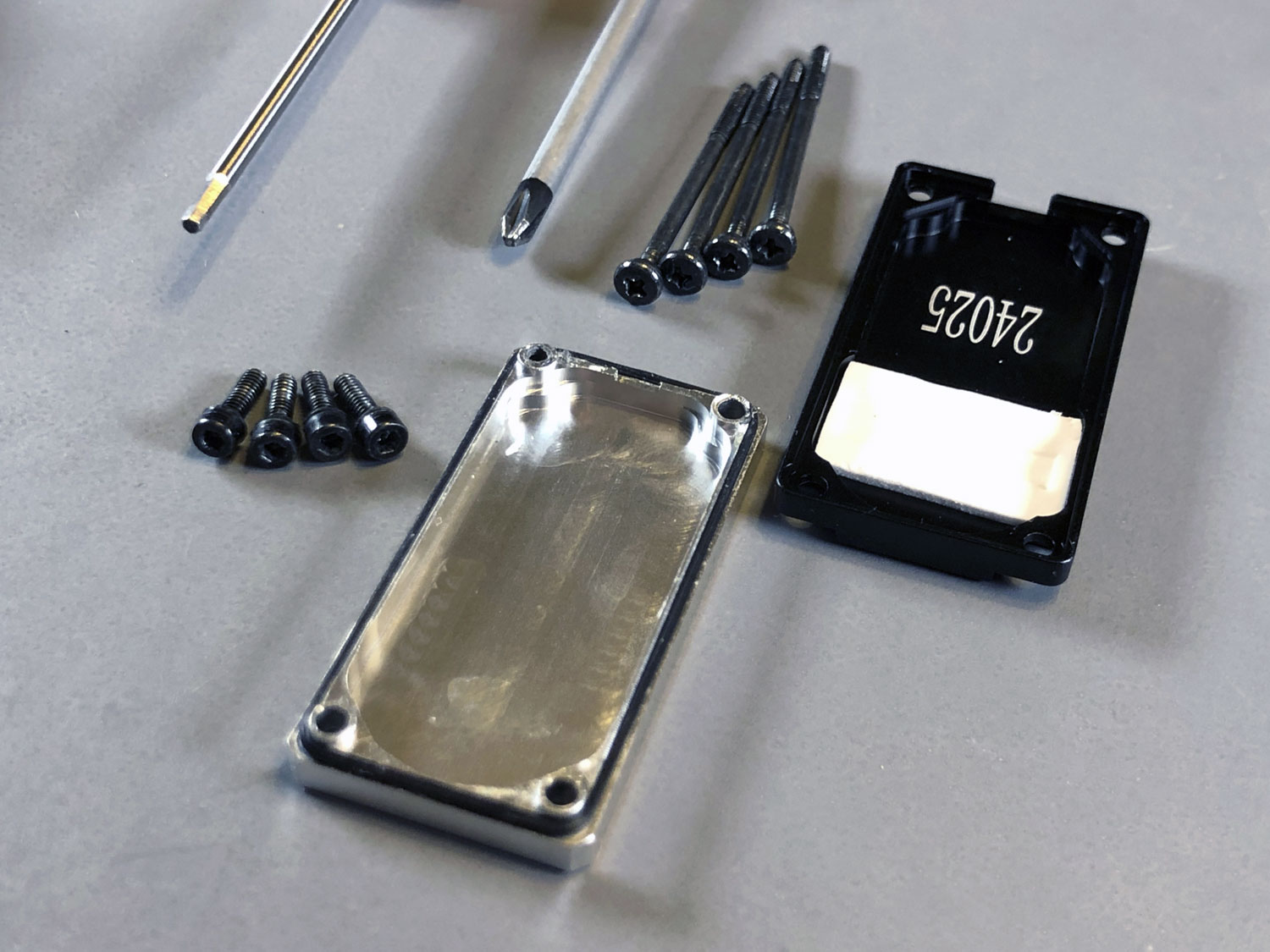
- Note the thin ProModeler o-ring rides on a lip machined into the case – this is important
So let’s skip past the covers themselves, both are alloy. Theirs is anodized black in keeping with the corporate identity. We don’t spend extra money on color anodizing. But eyeball the o-ring in the ProModeler cover.
See how it’s sitting within it’s own ridge or groove? This turns out to be important. For now we’re going to take a point for this little feature (and prove it’s better than how they do it, later), please trust us.
Score’s 3-1. Next up, the guts . . . the PCBs (printed circuit boards).
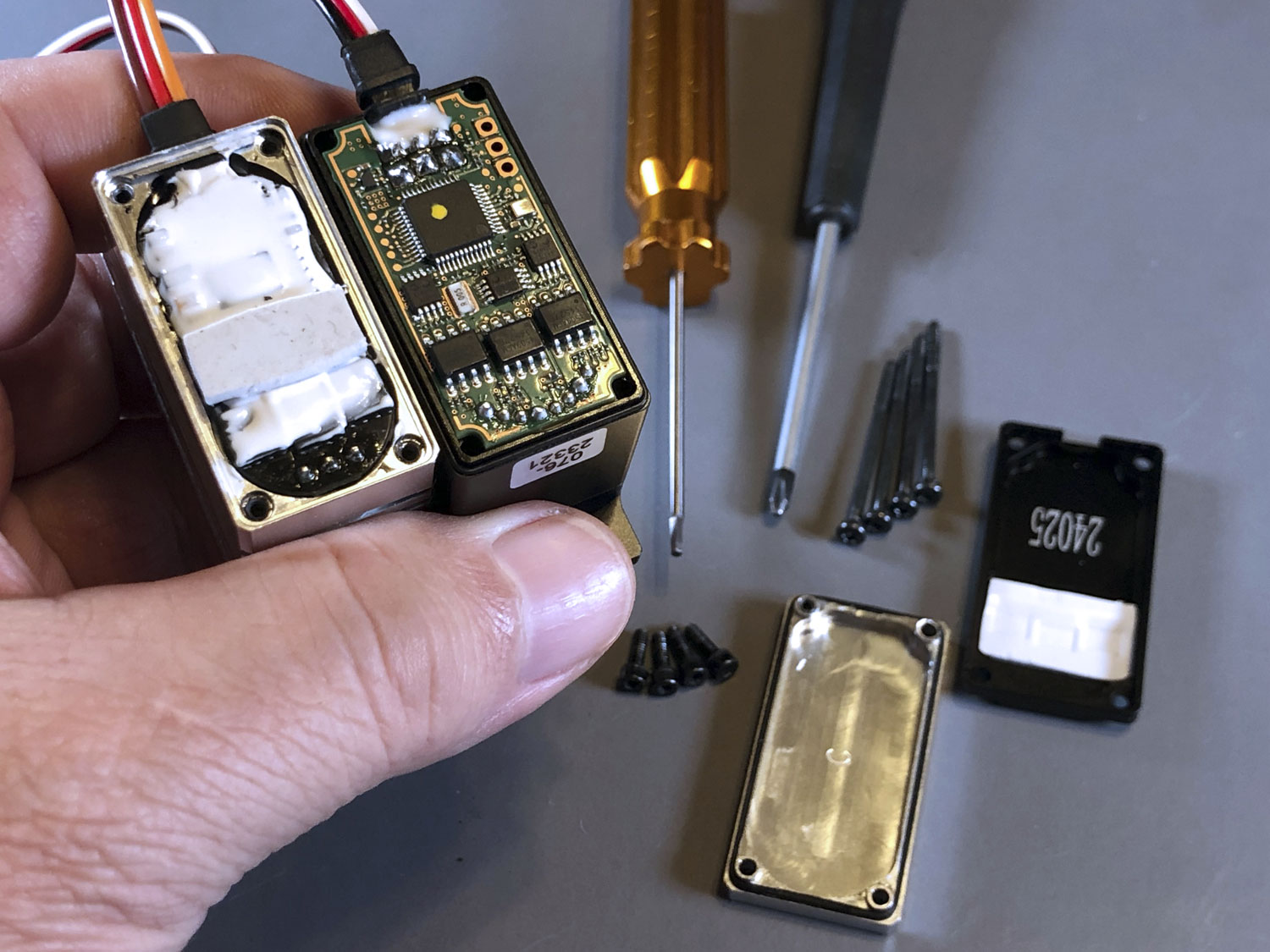
- Only the ProModeler PCB is protected with potting compound
Potting compound
Before moving on, take note of what is really quite important in the above PCB-photo – it’s the copious amounts of potting compound we slather on. That’s the white stuff that almost looks like icing on a cupcake!
Note; the color depends on vendor. It may be white, black, or translucent. The color doesn’t matter, and we use all three interchangeably depending on supplier.
Thing is, once applied to the PCB it flows – oozes – in between all the components (especially the thin solder joints for the legs of microcontroller and FETs. Then it sets up (hard, rubber-like). You can actually dig into it with a thumb nail, and leave a temporary mark, but it soon disappears. It’s tough stuff.
Its purpose? This stuff is what helps supports the components and protects them against shock and vibration.

Anyway, potting compound is not even overly expensive, and certainly not difficult to apply, but it does stink. However, where the exponse comes in (because time is money) is first, proper application is tedious (to apply neatly). So it's not only time consuming (and this really just speaks to the technician’s time, or what labor costs), but you also don’t want it on your hands (so the work is done with gloves). It’s sticky, stinky, and we refer to it as monkey snot! However, the real issue is you have to wait before proceeding with assembly so this means they're being handled twice. And labor costs are a huge driver of the servo's final's cost. I don't have proof but it stands to reason this is why hobby grade servos don't use it.
That, and I suspect the reason others don’t use it (or as much) is they don’t fret about earning government business. Not the way we have to. That, and time is money so applying monkey snot means higher labor costs. But believe me, potting compound is a big deal if you have any hopes of meeting MIL-STDS.
More regarding this, a little bit later, but next, let me show you how boards are made. This, in hopes you’ll grok why all this matters.
PCB – Printed Circuit Board
So the way a modern day servo works isn’t some big state secret. They feature a classical set up little changed from the 1970s. It comprises a motor, pot, transformers and an H-bridge. The capacitor in this photo is what helps get the motor going (movement) as directed by the potentiometer position.
Anyway, servo circuitry is absolutely not rocket science but these days, surface mounting means absolute accuracy in your pick and place machine. Eyeball the diode just below the socket where the servo motor connects. So small you could make 10 of them from one grain of rice, maybe more!
Anyway, this close up photo is of ProModeler DS930BLHV circuit board before potting compound is applied. Produced on a card like stamps in a sheet, they're individually cracked loose - one per servo.
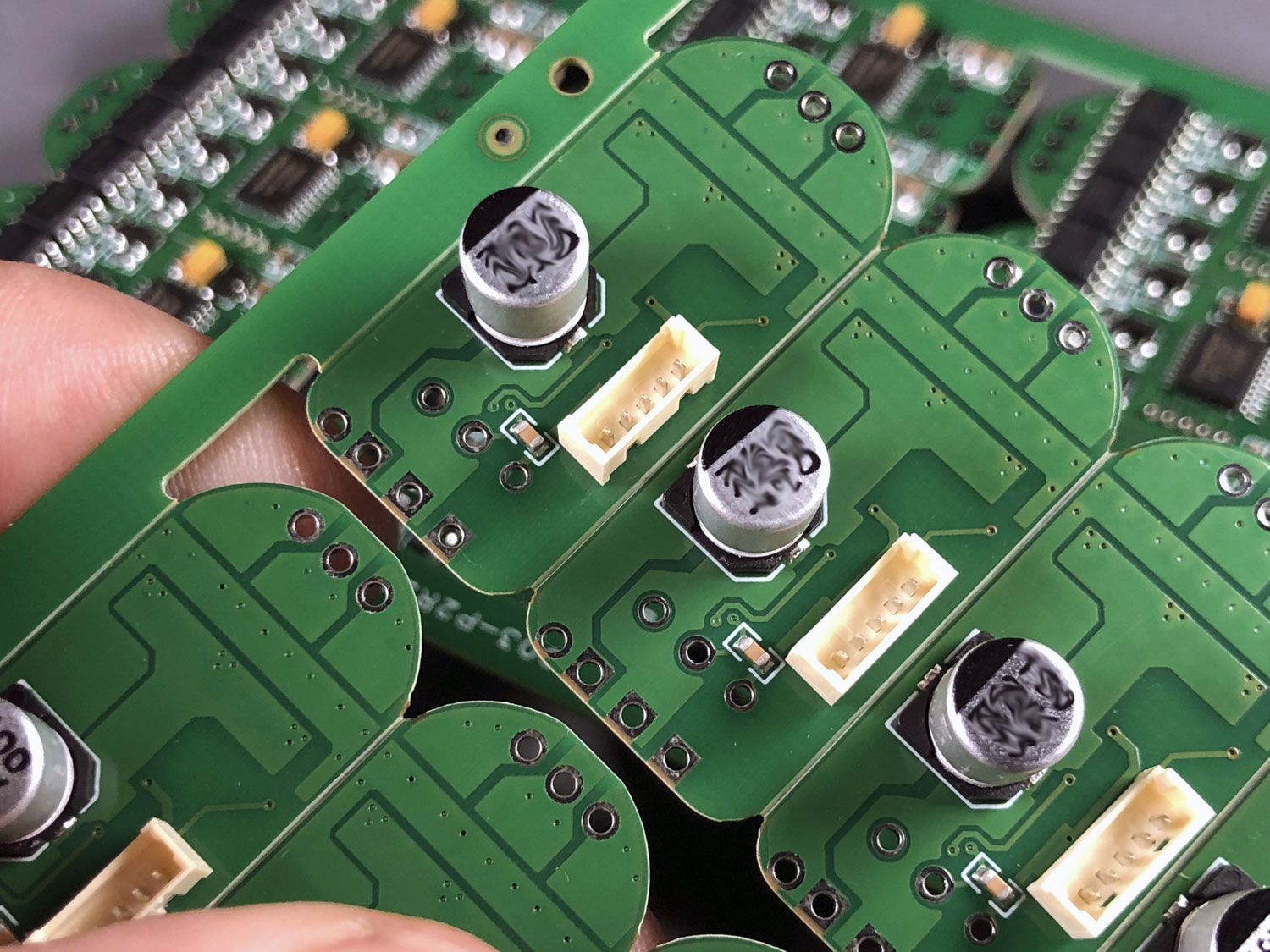
- Cap gooses the motor on startup (recharges when coasting down)
So the individual PCB are actually done as part of what’s called a card. Tiny creases, much like stamps have perforations within a sheet at the post office, delineate the actual boards.
We fold and crack them off into individual PCBs. It’s almost like tearing a stamp off a sheet, to get 20 individual pieces from a card. This close up photo of the circuit card of a ProModeler DS930BLHV servo is how it comes out of the reflow oven (how they're soldered together). This, before individual printed circuit boards are taken like stamps from a sheet.

- Individual PCBs are produced as part of a circuit card
The above photo is shared to give a sense of scale. Note the brushless motor with 5-pin connector. And while it’s hard to see, the motor has 3-pins for soldering to the board.
Shanging subjects, folks always want to know why ProModeler are so quiet. Basically, our servos don’t squeal and whine like competing digital servo designs. This is a big deal. We’re not going to tell you.
Why not? Honestly? We keep this kind of information close to the vest. You can't protect this stuff with patents, you keep your mouth shut the way Coke keeps the formula in a safe in Atlanta and never patented their secret. For us, the secret for their silence is akin to talking about the crown jewels, the less said the better! But it’s no surprise we (as does Futaba, and everybody else) rely on a design comprising micro controller and 3 FETs plus bits and bobs like tantalum capacitor, resistors and diodes.
So why do you care about any of this? You should because the real issue of concern is how very fragile and susceptible to damage (due to vibration the attachment of these components are to the board). Reason is, solder cracks easily.
Note; this is why servo lead connectors are more reliable when crimped versus soldered. Anyway, there’s a solution to solder being prone to cracking, which we’ll come to in a bit. Meanshile, this close up photo of a ProModeler DS930BLHV PCB shows the three FETs, one each for the 3-fields of the AC motor driving the servo.
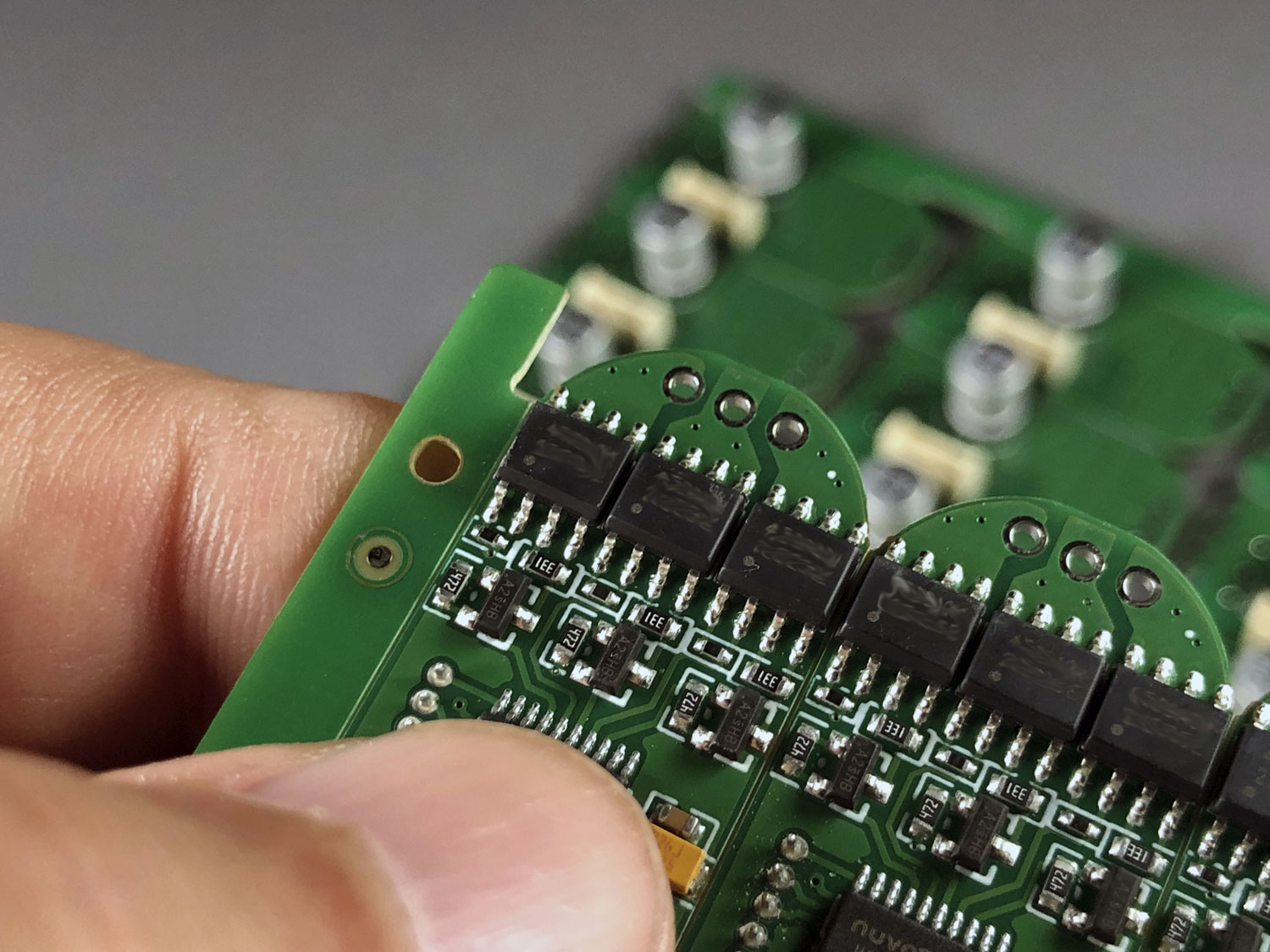
- Three surface mounted FETs, one each for the 3-fields of the AC motor driving the servo
So the microcontroller controls everything via a PID algorithm (almost like using a pair of SPDT relays to reverse the motor). The algorithm runs curves optimized through software controlled tuning based on the mass of the rotor. We’re only talking a few hundred lines of code. And we avoid using an external crystal for the purpose of making the servo more resistant to shock and vibration (both of which play Hell on components so the fewer, the better).
So people often ask about the process of making the circuit boards. We don’t do the production quantities, just the prototypes. This, because production quantities requires a huge facility with a butt load of pick and place machines like this one. This is a photo of components on the tape reel of the pick-and-place.
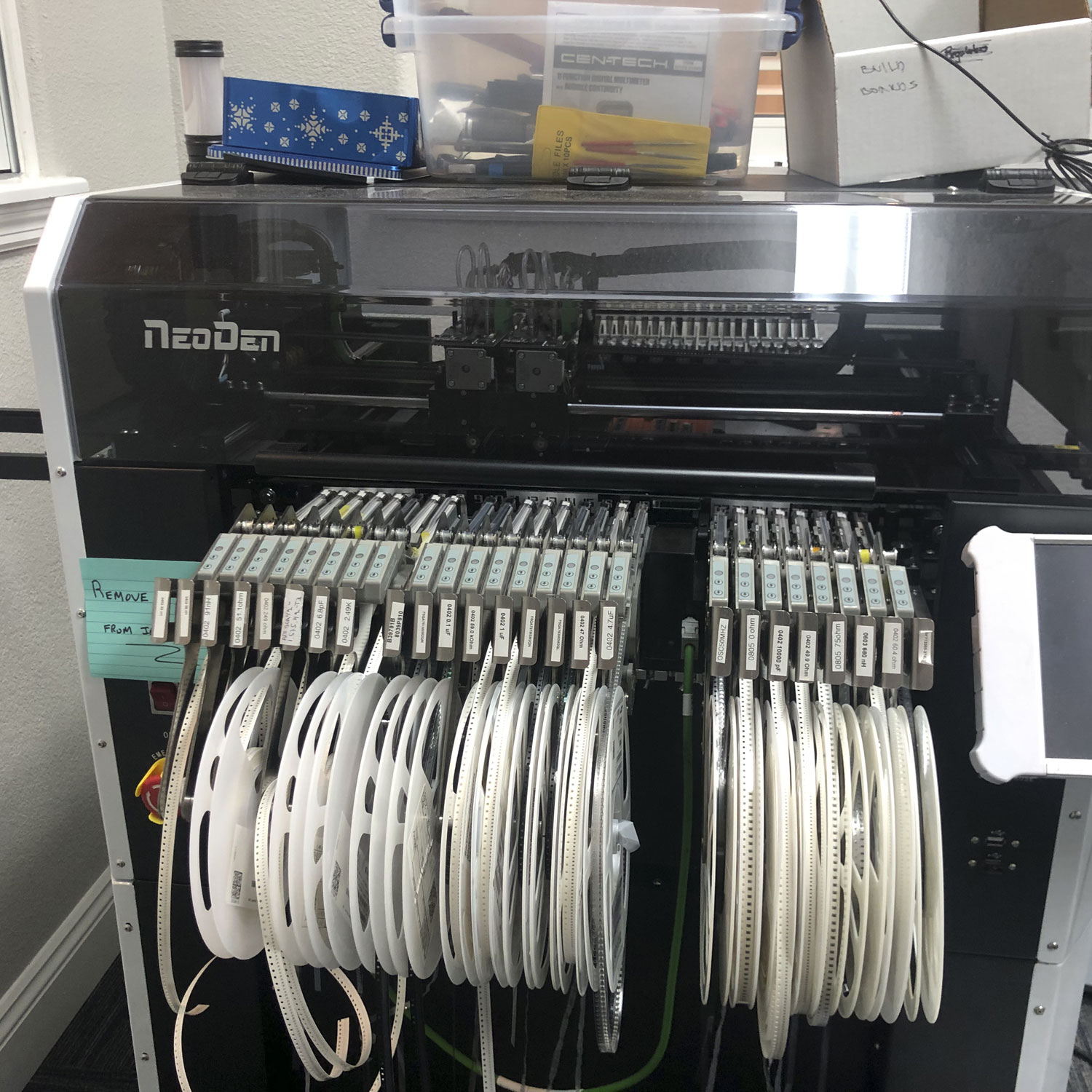
- Surface mount components preloaded on reels
Part of how you get a better price out to customer like you isn’t just from using suppliers of the lowest possible cost, but in being smart and using people who are genuine experts in their field. But you have to know what you’re doing so in-house prototyping let’s you figure it out.
Later, when it comes to production at scale, then there’s no sense in us replicating a huge building full of pick and place machines we can’t possibly keep busy when we can have them made by specialists. But only after we prove the board design! So one’s enough for our purposes.
Components
Next, those reels you saw in the above photo? Each is loaded with individual components on a tape. There are hundreds if not thousands on a reel, and each reel is loaded a different component.
What component? Whatever is required for the particular board being made – like duh! So these components can be FETs, resistors, microcontrollers, diodes . . . whatever!
And here’s the thing, if you’re willing to pay about 15% more, these component parts can be bought in MIL-SPEC (military specification), and we do. In fact, anything and everything that can be bought for a ProModeler servo is MIL-SPEC.
The other guys? More often than not, we see decisions made – in our opinion – by the marketing team instead of the engineering team. So this informs our opinion about their product line and who runs the place, but we won’t speculate in specifics since we don’t want to get sued. For now, let’s back to individual electronic components.
Here I'm holding feed stock for the boards, which are preloaded on what's called a tape. Basically a reel of components for a surface mount electronics pick and place machine. Look back at the phtoo above to see how many different components are involved.
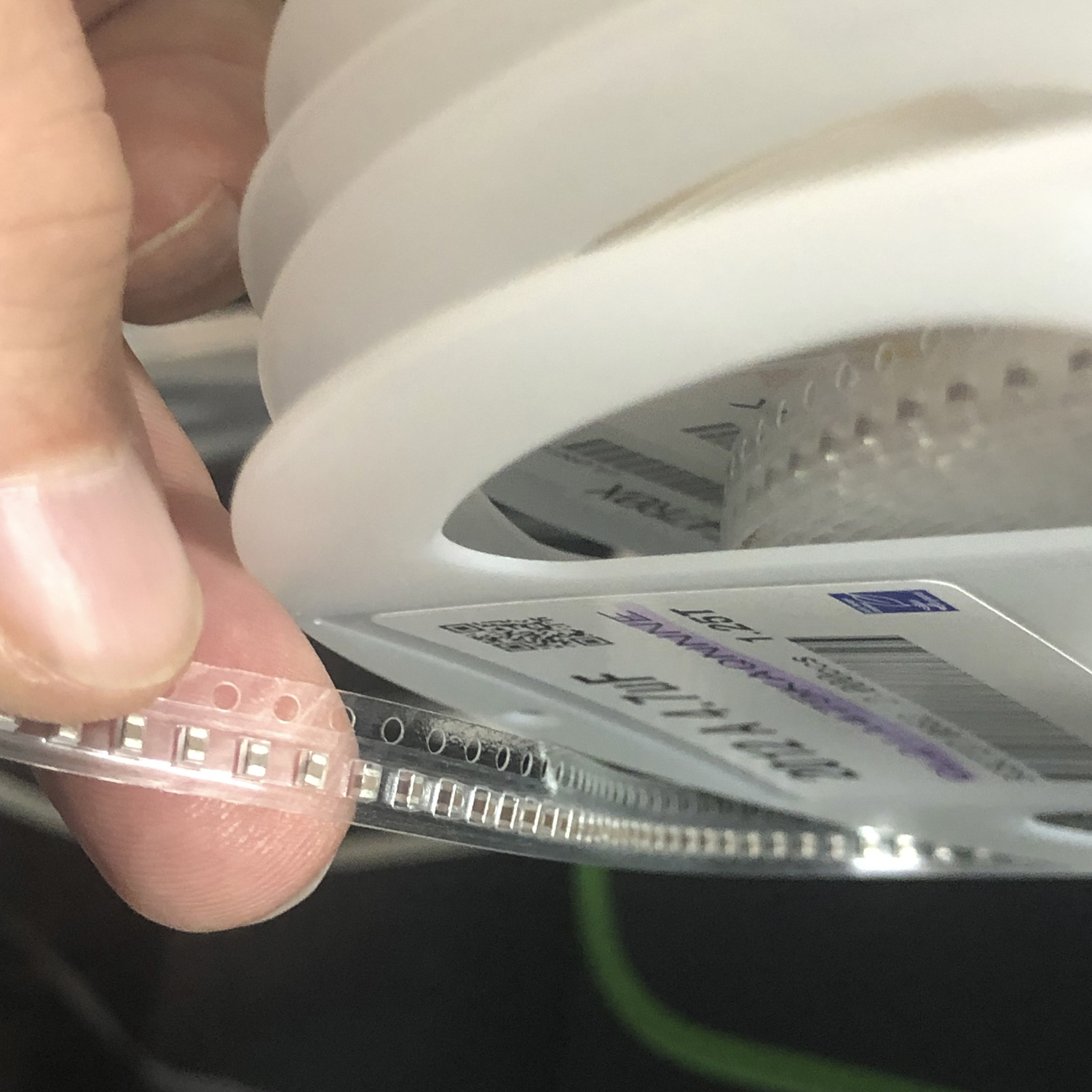
- Individual components are actually placed on the boards by robot arm using reels like this
Once placed on the board, the next step in the process is the reflow oven. These can have temperature zones so that components on one side aren’t melted off when the board goes back through to solder the components on the flip side.
That’s right, we use PCB with components on both sides to save space. Doesn’t make us geniuses, everybody does this because the inside of a servo – the space within – is precious because other stuff has to live there, too. Not just the PCB, but the pot, motor, we must even allow enough room for the wiring!
Anyway, the reflow oven is the last automated step in the process of producing a finished PCB card, from here it's done by hand.

- Reflow oven is the last automated step
Inside your servo
So if you feel like it, removing the four screws securing the bottom cover expose the electronics side. All you need is a 1.5mm Allen and you’re in business. Void the warranty? Nope! Taking a peek won’t hurt anything!
Yet if you look at the PCB of your servo, you’ll see very little. Why? It’s because of something you get with a ProModeler servo that you don’t get with hobby grade servos like you are typically offered by the marketplace. All meet a minimum of three MIL-STDS and these meet eight.
Do these matter to do? Dunno, they should because it’s your money. We’re just informing you what’s what because you decide what matters. So the reason you don’t see much is the PCB gets coated in potting compound.
Failures
This next photos shows why we apply potting compound and the consequences of an inadequate application . . . component failure! The thing about failure is what do you do about it?
Our view is failures are nothing to be ashamed of as long as they become an opportunity to learn with the purpose of overcoming. After all, it’s not like we had success from the very first beginning. Fundamentally, failure offers us knowledge of what to expect if nothing changes. So it’s an opportunity to make changes, e.g. incorporate what we’ve learned because like everything else, trial and error is involved in iterating our designs.
So these things take time to sort out but we’ve never been afraid of failure, or of showing what’s happened . . . badge of honor in a way. Like this close up of a SMT fracturing after running on the shaking table until it induced failure. Once well coated in potting compound, these failures halt. Its what it takes to earn MIL-STDs for shock and vibration. Our view is modelers benefit, also. Especially if you're flying models with paint shakers on the front, take my meaning?
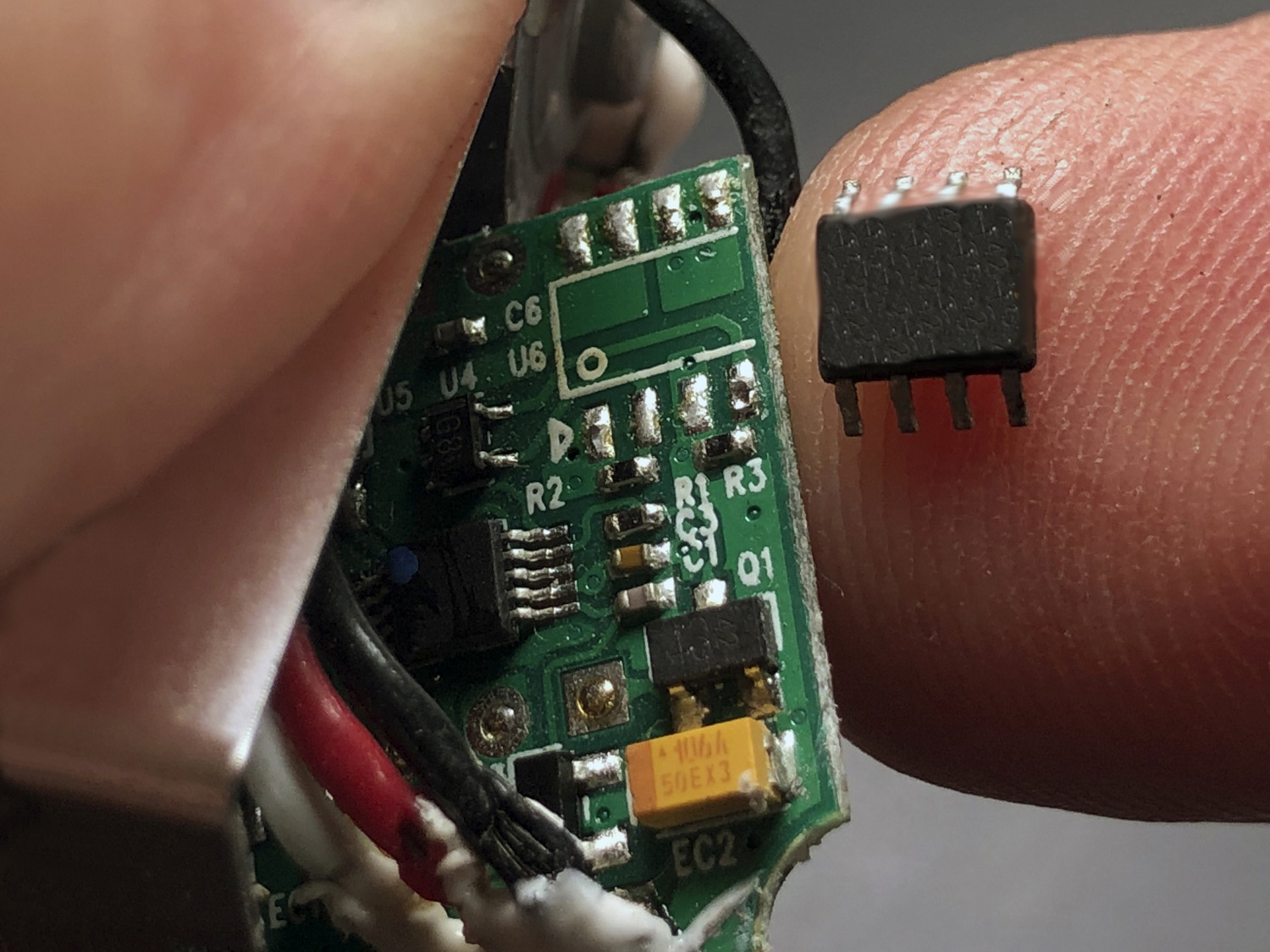
- An IC chip vibrated itself right off the board!
Purpose of this photo, however is to help convey why the application of potting compound is important for peace of mind. For example, instead of thinking like a modeler, put yourself in the shoes of a project engineer speccing servos for a military contracted UAS.
Ask yourself this, what’s more important, the value of the aircraft (perhaps more that $85,000), or the mission delivering ammo to soldiers under fire? Like I sometimes wonder how these guys sleep bearing such huge responsibilities. What don’t I ponder? Why they make a big deal of MIL-STDS.
So for your $5000 model, granted lives aren’t on the line, but would you rather PCB components of your servos be exposed to damaging shock and vibration just because someone chose to save a few bucks? Or would you rather one slathered in protective potting compound?
Anyway, I hate to belabor the point, but I have a theory for why competing brands don’t show the inside of their product. It’s to do with the ‘good enough’ theory. Since professional product photos plus specs have always been good enough for consumers to fork over the dough, then don’t rock the boat, or change.
Anyway, we show you the guts of our servos out of respect. Or put another way, we trust you to suss out what’s best for you.
A brief birdwalk; in 1972 when I was getting into the sport, Bill Norman of Homewood Toy & Hobby opened a servo up on the counter and showed me how it was made. These days that doesn’t happen. Of course, we’re also hoping to push your hot button because everybody loves quality.
So by showing you these things in intimate details, things like potting compound, we’re hoping to positively influence you because unlike the contracting officers who writes MIL-STDS into the specs, modelers aren’t exposed to why this matters. That, and we figure the more you know, the better our chances of earning your business!
Recapping, the fundamental reason for the potting compound is it mechanically locks the bits and bobs in place on the printed circuit board. Otherwise, the only thing that secures the individual surface mount component to the PCB are teeny-tiny spider-leg like solder joints. And when solder is all that’s holding things in place, vibration can play Hell with your servos. And this is a detail regarding just two of eight MIL-STDS for this servo.
Anyway, and while we can’t speak for hobby grade servos, with the DS930BLHV you get a servo meeting these eight MIL-STDS.
MIL-STD-810H
- Shock – Test Method 516.6
- Humidity -Test Method 507.5
- Vibration – Test Method 514.6
- Acceleration – Test Method 513.6
- Sand and Dust – Test Method 510.7
- Water Intrusion – Test Method 514.5
- Altitude <70,000’ – Test Method 500.6
- High Temperature – Test Method 501.5
Since MIL-STDS matter to the government . . . are they a reasonable proxy for you – meaning do you get better servos? We suspect the answer is yes.
Means it would also be reasonable to allocate another point to ProModeler about now, eh? This makes the score 4-1.
Transmission section
So let’s flip the servos over and look at the topside – at the transmission section. Honestly, both gear trains look pretty good.
Futaba mentions using stainless steel for the output gear, but not what grade and they remain schtum about the other gears. We think the others are a good grade of high carbon steel (but this is just an educated guess based on experience, nobody from Futaba has told us).
However, with ProModeler, the rest of the gears in your servo are also stainless. Stainless makes a big difference in the rest of the gear train. We feel it’s better because stainless is a more rugged steel than high carbon. Tougher.
So in the same way the old Timex commercials proclaimed, takes a lickin’ and keeps on tickin’, so do stainless gear trains – else Futaba wouldn’t take pride in mentioning they’re using a stainless output gear . . . make sense?
Anyway, and FYI, where other materials like high carbon steel or titanium will fracture, stainless steel being more rugged absorbs the blow and keeps on going. Moreover, that it’s more expensive is just part of the deal (but we save on cosmetics like color anodizing and laser etching to help make up for it). Saying we use stainless for a reason.
And since details count, take note; we use 303 stainless for the bull gears (the larger diameter gears), and 420 stainless (which can be hardened) for the smaller pinion gears. Note; the pinion gears are the ones which drive bull gears. Always, never the other way around. This close up photo shows off the geartrain of both a Futaba HPS A703 and a ProModeler DS930BLHV servos to save you the time of looking to see for yourself.
Honestly? They both look pretty good, as you'd expect from top of the range servos, agreed? Gearwise, nobody is taking shortcuts in this league. One detail, we ponied up with a custom molded sel made of Viton to update the DS930BLHV form an ordinary o-ring Futaba continues to rely on. This greatly helped attain MIL-STD Test Method 510.7 for protection - not against liquid - where it helped but really for sand and dust. Strange but true.

- Note the custom molded Viton seal on ours
Center case – intermediate
So now let’s look under the hood (so to speak). Let’s field strip the gear trains and eyeball the case components themselves. After all, the case is the foundation element that holds the gears in alignment. What I found was something of a surprise. And we’re about to really run up the score.
The Futaba uses a polymer intermediate case center fitted to the alloy main center. Ours is 100% alloy. Moreover, we only use poly intermediates with servos outputting below 400oz-in.
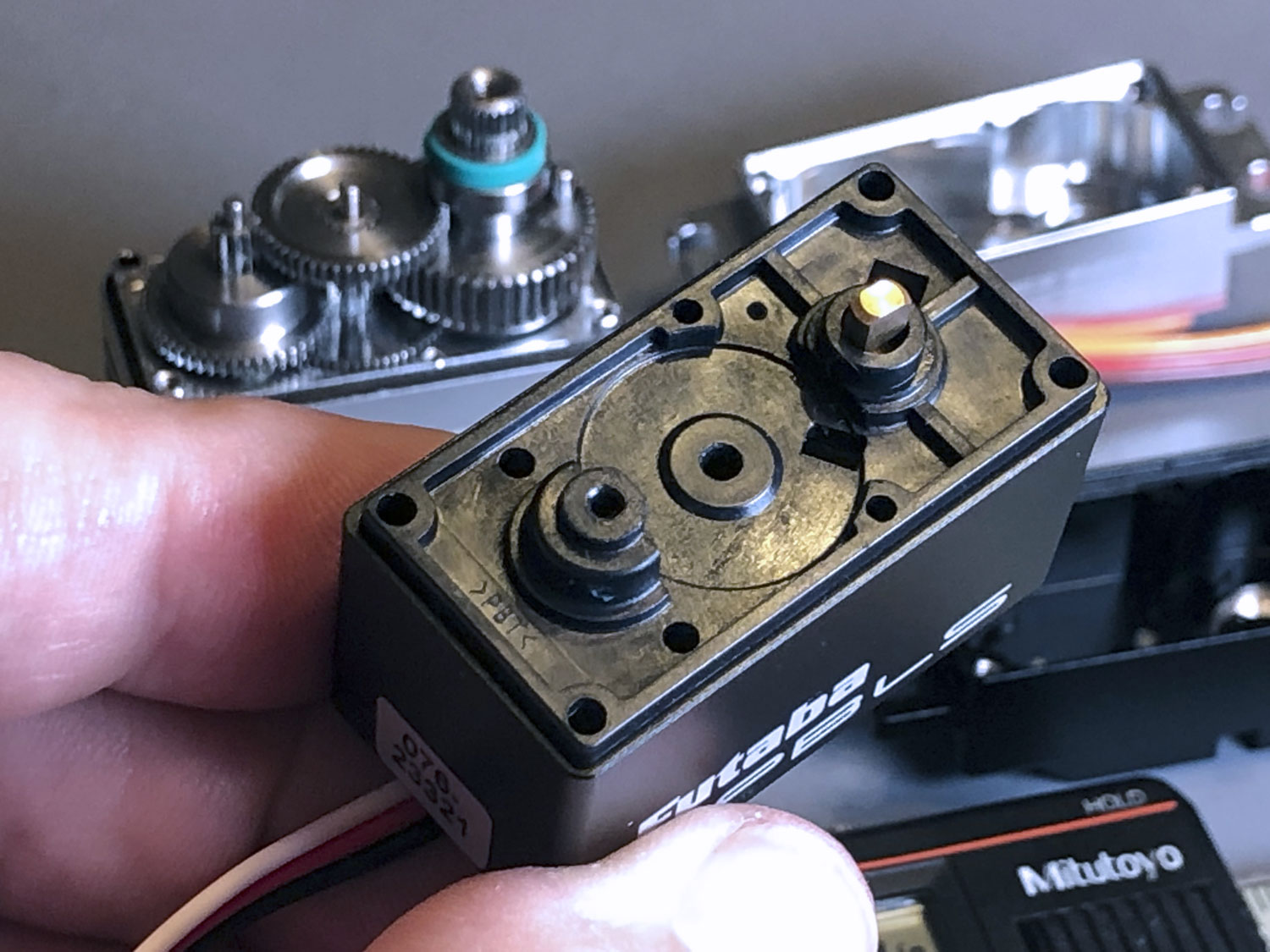
But even more importantly, they’re not doing anything to reinforce at the gear shaft, the bore is molded . . . straight plastic to support the steel gear shaft of the gear train. No, we're not kidding! This close shows how the Futaba HPS A703 servo anchors the entire gear train on the integrity, strngth, and durability of plastic within the intermediate section (between upper alloy case and center, alloy section. With ProModeler the gear train is secured in bronze reinforced aluminum,
 h
h
- Futaba HPS-A703 relies on molded plastic
Now this is something of a red flag in our opinion. Reason for adopting plastic is because it’s lighter and cheaper than alloy. But make no mistake, it’s also weaker. Means a crash that maybe doesn’t take out gears almost to a certainty damages this plastic piece. Means it begins to wear.
For us, the fundamental reason for a plastic intermediate case section is lowering cost (and to some extent, weight, but mostly cost). We know this because we do it for some of our servos (before switching to alloy when we go north of 450oz-in).
But there’s a major difference because when we opt to use a plastic intermediate section, we press in a bronze bushing. Its purpose it to reinforce the plastic where the steel gear shaft is fitted to support the transmission gears.
Note; we do this for all ProModeler servos. Even entry level servos like the ProModeler DS90DLHV depicted, below as this llose up shows. At ProModeler, we reinforce the intermediate section with bronze for even more economically built servos.
Honestly, we find it inconceiveable this isn't being done within the HPS-A703, but your eyes don't lie.
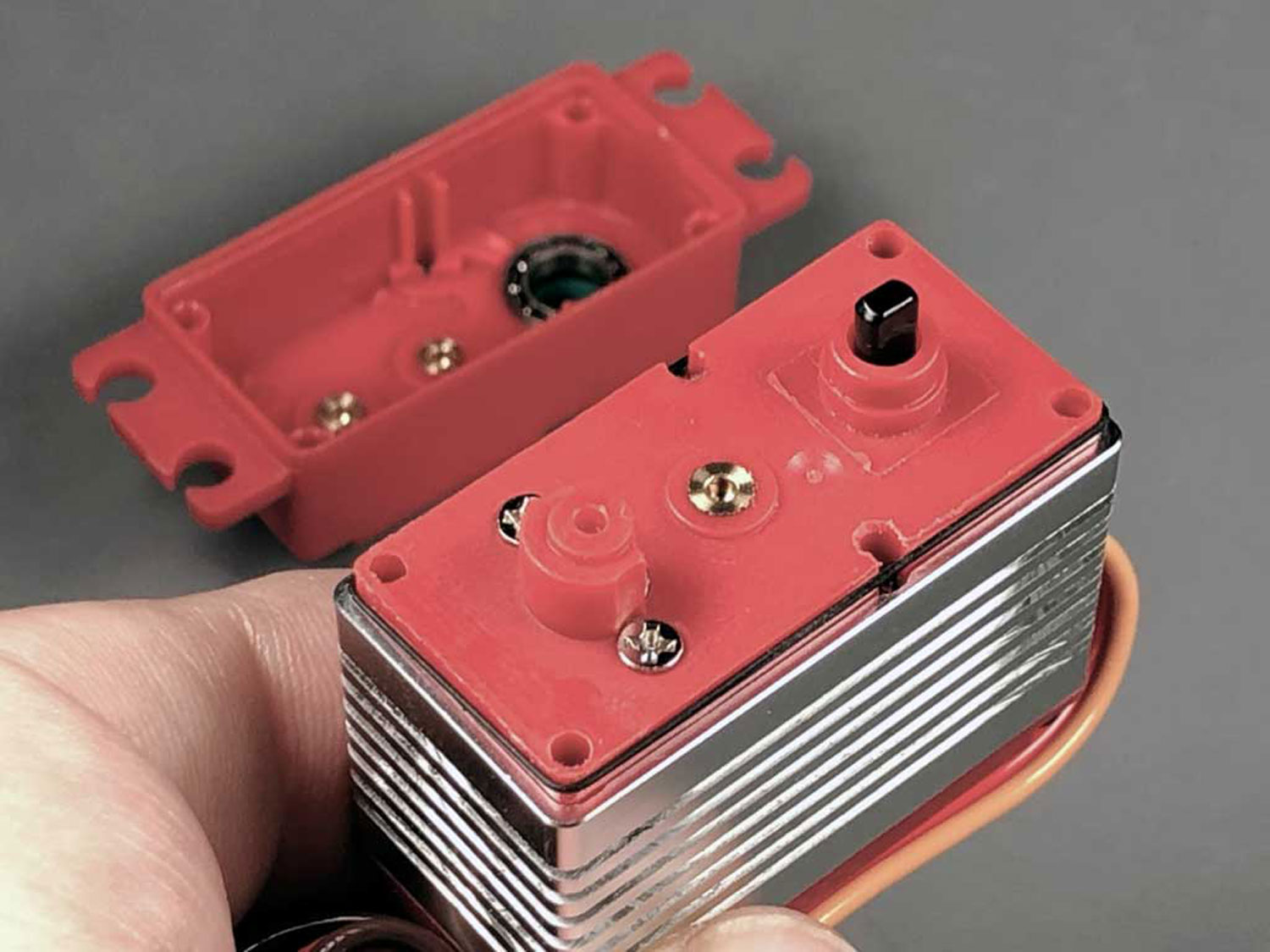
- Bronze bushing reinforces ProModeler plastic intermediate
Reinforcement
Look closely at the above photo of the ProModeler intermediatre section; do you see the small bronze bushing? Now look back at the Futaba HPS-A703 intermediate. Do you see the difference? Honestly? This is a big deal in my opinion (and should be a big deal in yours, also).
Anyway, that shiny bit of bronze in the center of the red plastic (where the intermediate gear-shaft is fitted) anchors the center gear shaft. The case becomes enormously stronger as a result and rivals the strength of an alloy section! So it’s present in every ProModeler beginning from our least expensive 90-oz-in servo because we don’t take shortcuts.
Even teeny-tiny servos like our 9-gram class DS75CLHV has them to reinforce the plastic case. However, for Futaba’s top-of-the-range HPS-A703 (a servo outputting north of 900oz-in) to have bupkis and rely instead just on relatively soft plastic gives us pause for the first time.

Problem with this are the internal loads (as the servo operates normally) will, over time, force the shafts to walk. By this meaning the bore will stretch out of shape (elongate). Then these normally perfectly round bores become egg-shape. Remember, plastic comes from the Greek platikos which means flow.
So this plastic *will* deform under load, it’s just a matter of time. Especially with a servo outputting 900oz-in. Like we’re talking about a butt load of force being developed, take my meaning? And on impact? Then all bets are off because shit happens.
And when the round bore become egg-shaped (and it will), then guess what happens to gear mesh? Yup, goes to Hell. This then accelerates gear wear because gear mesh becomes shit (profane engineering term for no longer within precise alignment).

- Involute gear shape is lever with fulcrum at center of gear
When they’re working against each other, the involute (a special curve that describes the gear surfaces) slide smoothly one face against the other. Perfect alignment is critical. Shaft position is what determines this! It’s our view the hardpoints (bushings) are critical.
Upper gear case
What’s next? Let’s look at how the gears are anchored topside. Obviously, the shafts upon which the gears rotate have to be anchored at both ends, right? We looked at the bottom, so now let’s look at the top.
Note; we refer to this section as the top-side. Here’s what we found top-side, the upper case (whose job it is is to anchor the steel gear shafts upon which gears spin) shows another lack of bore reinforcements in the Futaba HPS-A703 example in our possession.
As this chis close up details, there are two stainless steel bushings fitted to a ProModeler DS930BLHV upper transmission case section as reinforcement versus nothing, just straight aluminum, for the shafts fitted to the Futaba HPS-A703 brushless servo. Red flag? Dunno, your call.
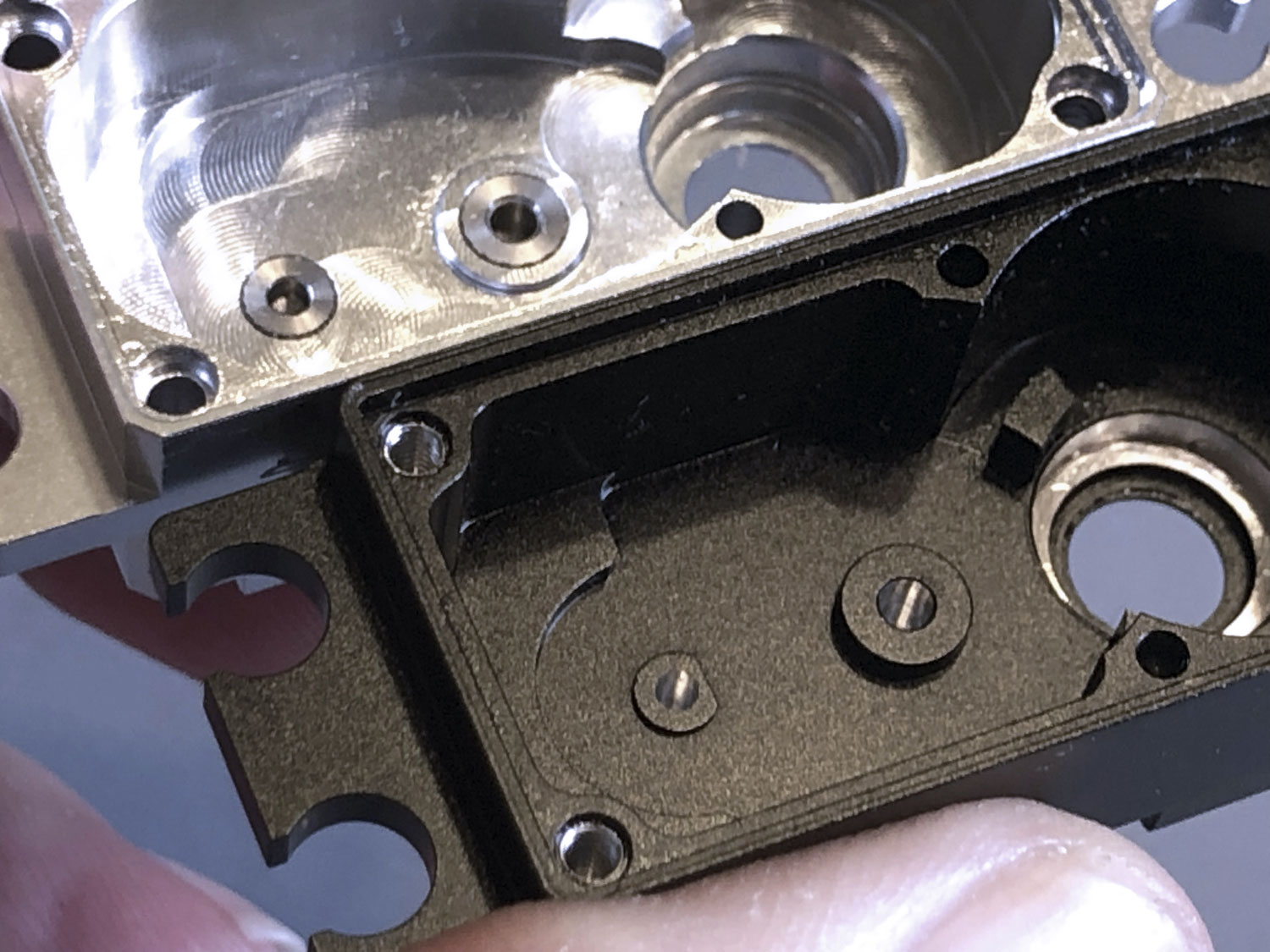
- Steel inserts reinforce ProModeler 6061-T6 alloy vs. nothing whatsoever in the HPS-A703
In common with ours, their upper case is also an aluminum alloy and in keeping with their style manual, it’s anodized black. But as you can readily see when you look into the depth of the bores where the shafts are fitted, the soft gleam of the raw aluminum means no bushings here, either. The raw aluminum readily contrasts with the black anodizing so it’s obvious.
Meanwhile, the ProModeler upper is reinforced with steel bushings. We refer to these as hardpoints.
And FWIW, these bits (hardpoints) are turned on what’s called a Swiss lathe and knurled. The purpose of which is to help anchor them, like teeth biting a steak, when pressed into the alloy of the case section.
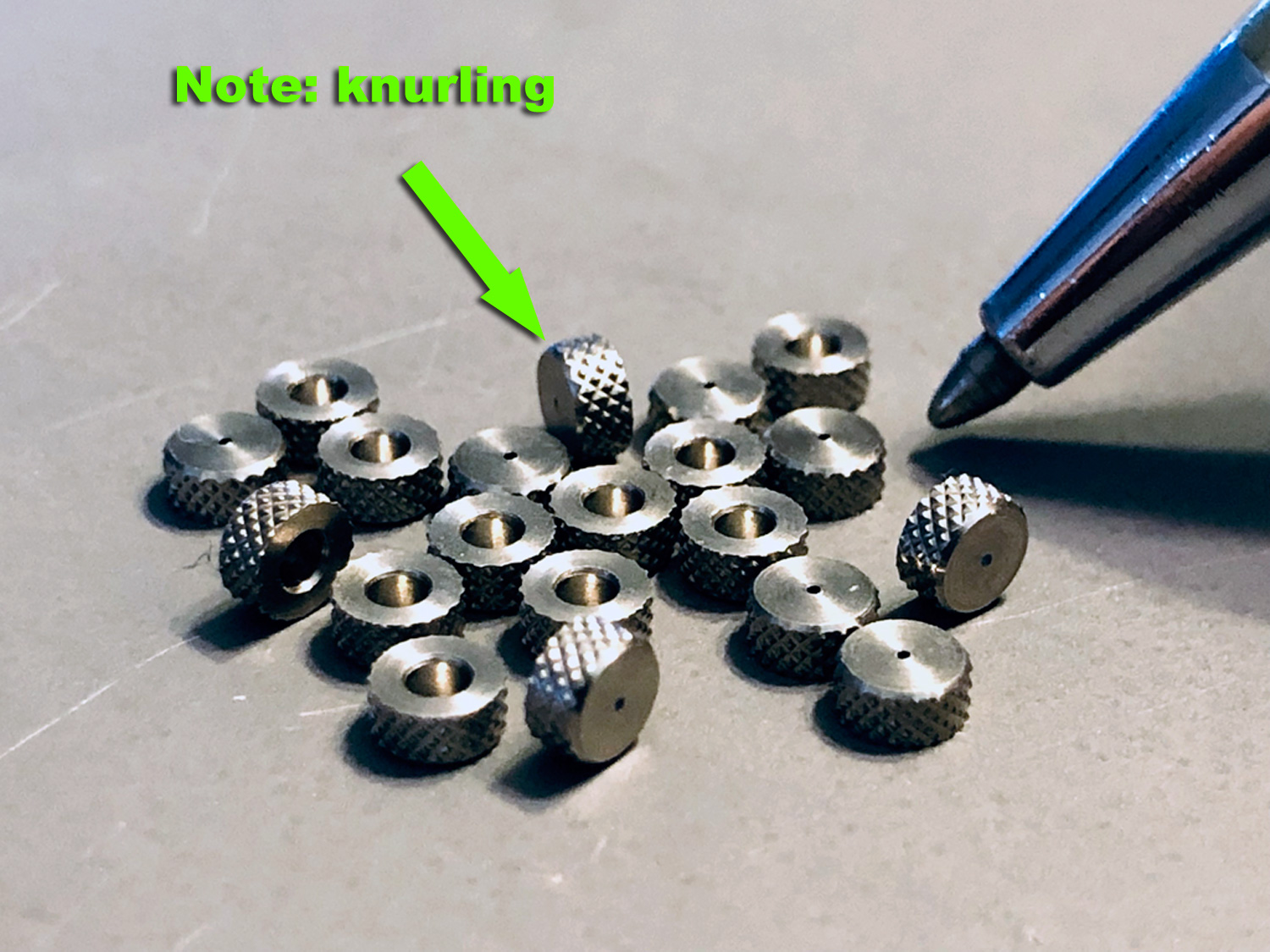
- Tiny bits of steel reinforcement turned on a Swiss lathe
OK, now we’re scoring at will, call it 6-1 because of the unreinforced case. We kind of feel like we’re beginning to kill them, and because we’ve made our point regarding the differences in the two products, let’s wrap this up.
Bottom line? It’s our opinion, for virtually any IMAC competitor, the DS930 is a great offering. Guys flying hard XA-maneuvers will want something faster so if that’s you, consider harder hitting servos, instead.
When it comes to faster servos, we have two on offer, the DS845BLHV and DS1155BLHV. Being a BLS2 design they’re built a bit different in that instead of being in-line 3-shaft design like BLS1 servos (and the Futaba HPS-A703), they’re a S-curve, 5-shaft design.
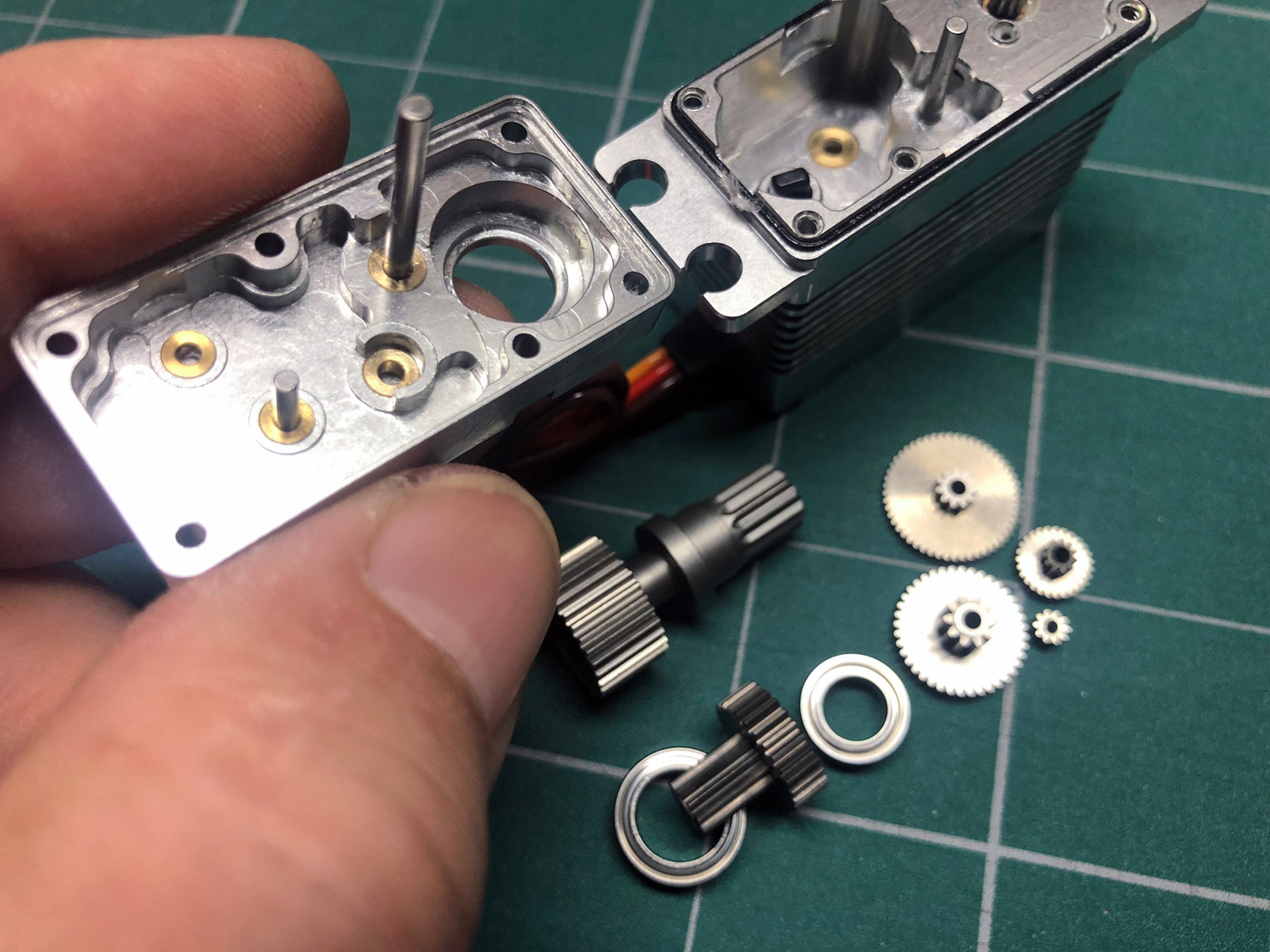
- As S-shape results when fitting more gears within the confines of a nominally 3-shaft case.
Regardless of which servo you select, we feel we give you a lot of bang for the buck. Especially with the DS930BLHV if you’ve been budgeting for the Futaba HPS-A703 because they’re like two-for-one.
Finally, remember that point I took for the o-ring at the beginning of the electronics cover section? That wasn’t us just stealing an unearned point. We took that point because when you eyeball the servo cases closely – observe – don’t look, you’ll see hidden seals.
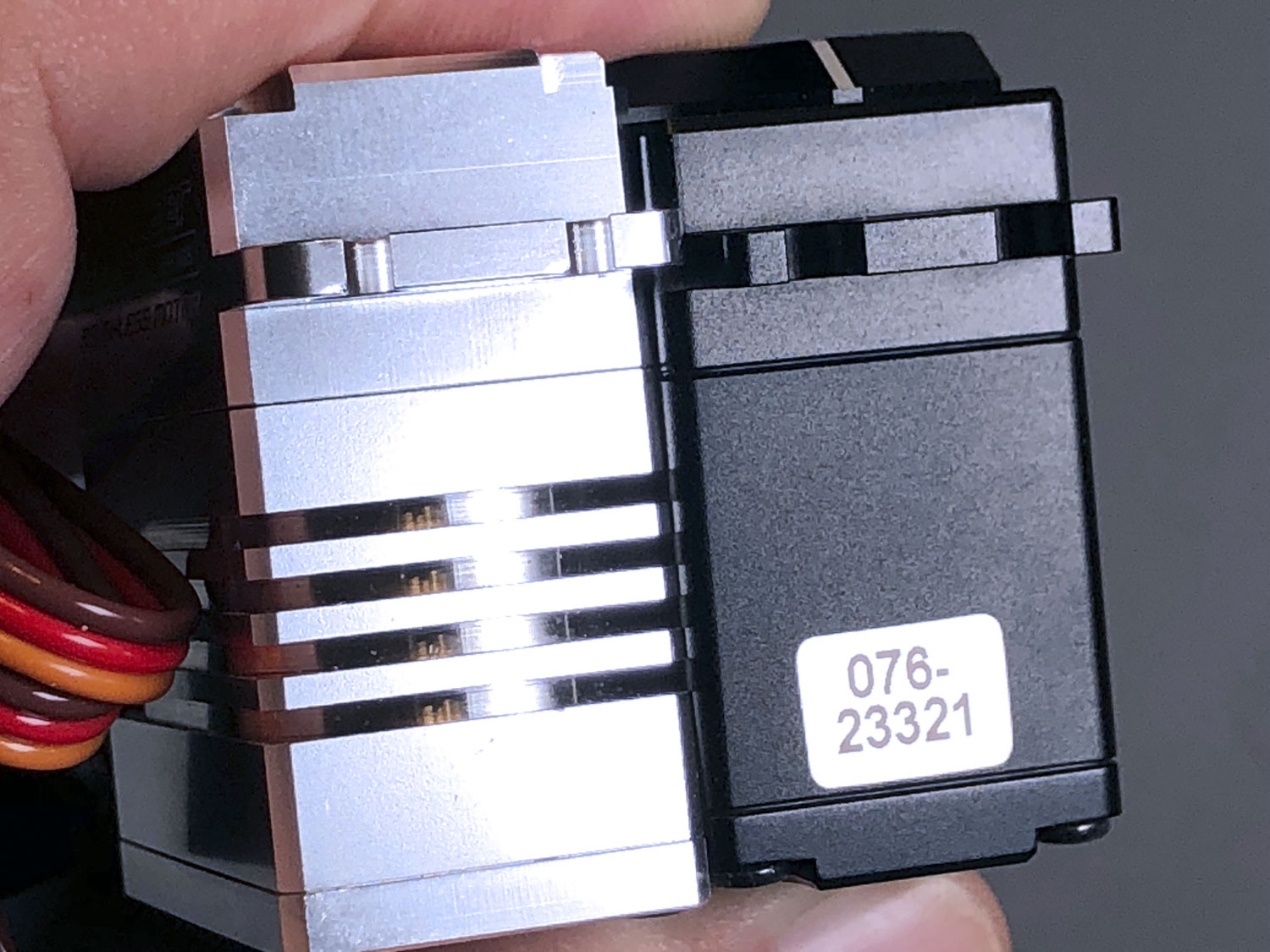
- Fully captured vs exposed o-rings
Their o-rings are visible, exposed to damage. Unlikely? Nope, not when you go for a MIL-STD involving dust intrusion because sand and dust are abrasive. Over time (24-hr test cycle), blowing sand will readily wear the tiny diameter of the rubber down and gain entry.
The o-rings of a ProModeler servo are invisible to the eye after assembly by design. They are fully encased expressly to protect them from sharp object damage. These things are very, very thin!
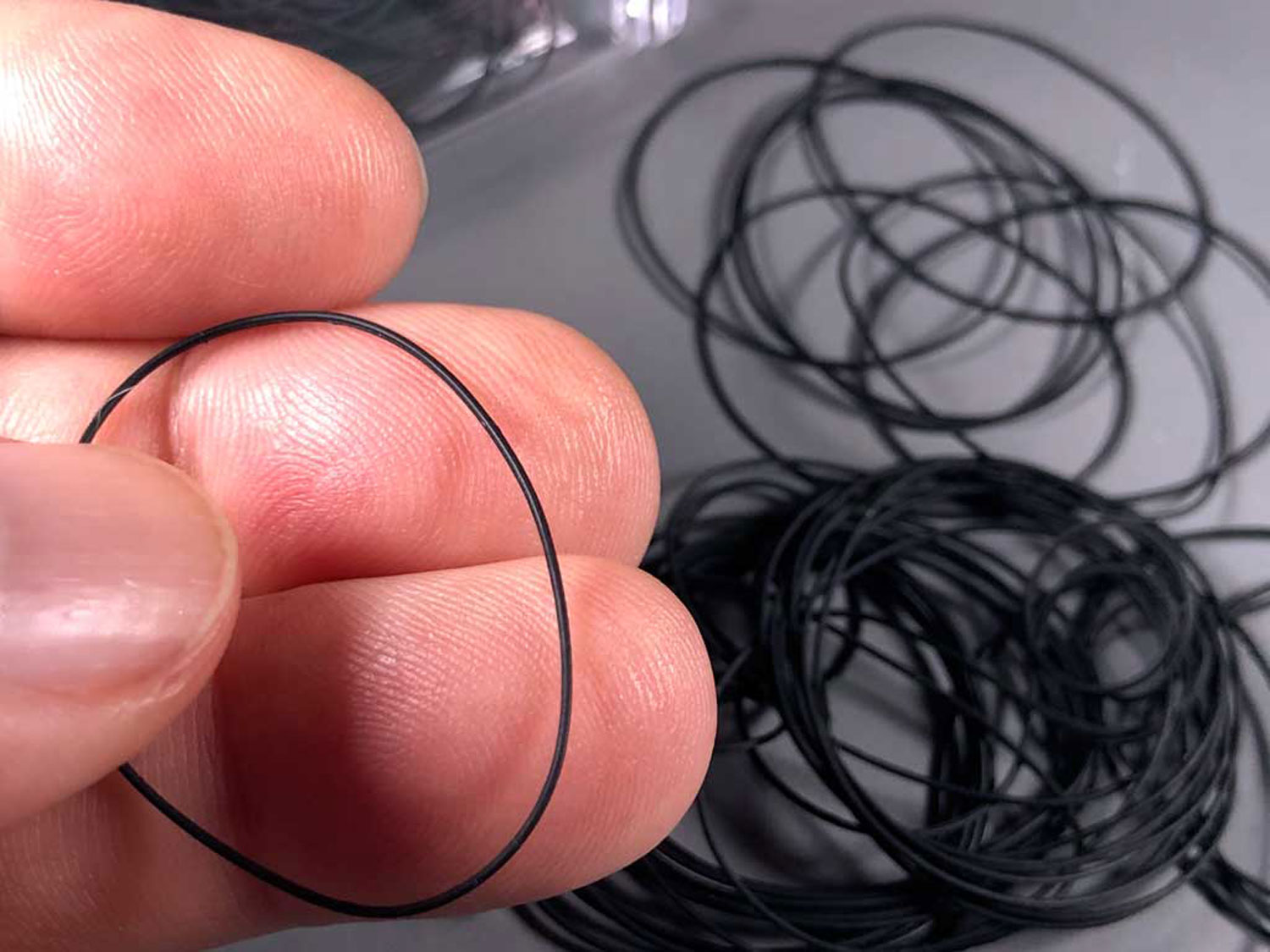
- Fine ProModeler o-ring vs fine fingerprint whorls
Protecting the delicate case-section o-rings is a really is a big deal because unless fully armored (meaning encased by metal), then the delicate rubber o-ring becomes vulnerable to external damage.
This is how we earn;
- Sand and Dust – Test Method 510.7
. . . because that stuff is pernicious and will wear down the rubber and allow ingress of contaminants. What’s more, we don’t go the extra mile for the sheer joy of it (actually, we do), but because these are requirements of our prime customer.
And it’s you who also benefits from all this attention to detail. Think I’m kidding? Not if you fly in the desert southwest of the United States, we’re not because dust’s part and parcel with the experience!
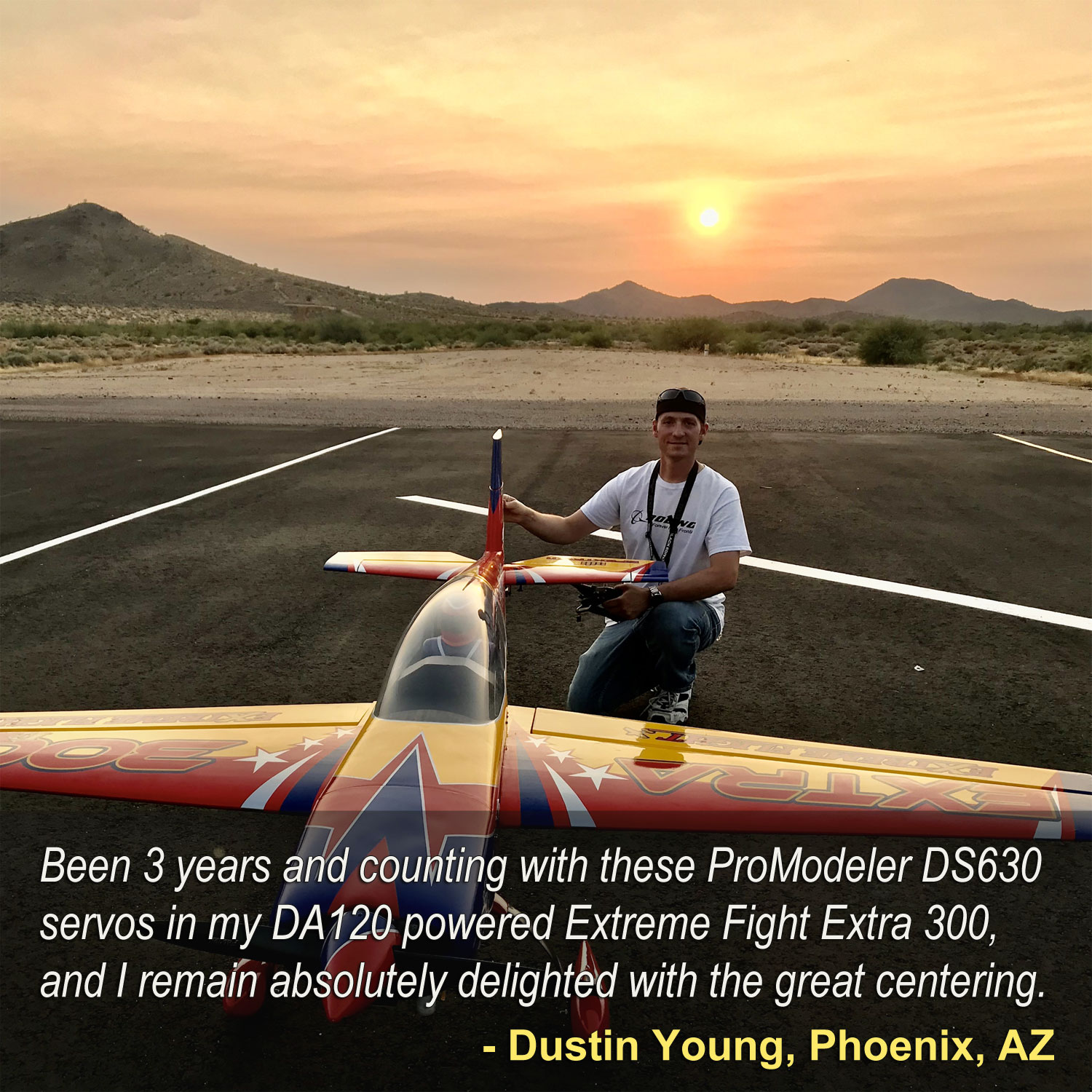
Added to which, servos mounted eternally beneath the tend to get a bit of exhaust or smoke oil, right? Combine dust and oil and over time, it’s bad juju.
So if you’re thinking our using so many o-rings plus an enclosed design is unimportant, maybe you haven’t been thinking it through. But maybe now that you have more information, is sealing the servos up nice and tight a bad thing? Or have we just run up the score, further?
Wrapping things up
Bottom line, some folks will buy the Futaba HPS-A703 because it’s always worked for them. We get it, and respect it because we have long respected Futaba as the very best from the days of servos like the venerable S148, S9102, and more!
But if you’re going to be the king, you have to kill the king. And thus, we can’t hide from their best, we have to take them on and lock horns. This, despite the high esteem in which we hold them, and their products. With the DS930BHV we’ve given it our best shot.
We feel we’ve shown you a servo with similar performance to the HPS-A703, which offers you MIL-STDS for shock, vibration, water and dust intrusion, and more.
A servo that also operates cooler because of fins CNC-machined into the center case. Fins, which increase surface area to better radiate heat away.
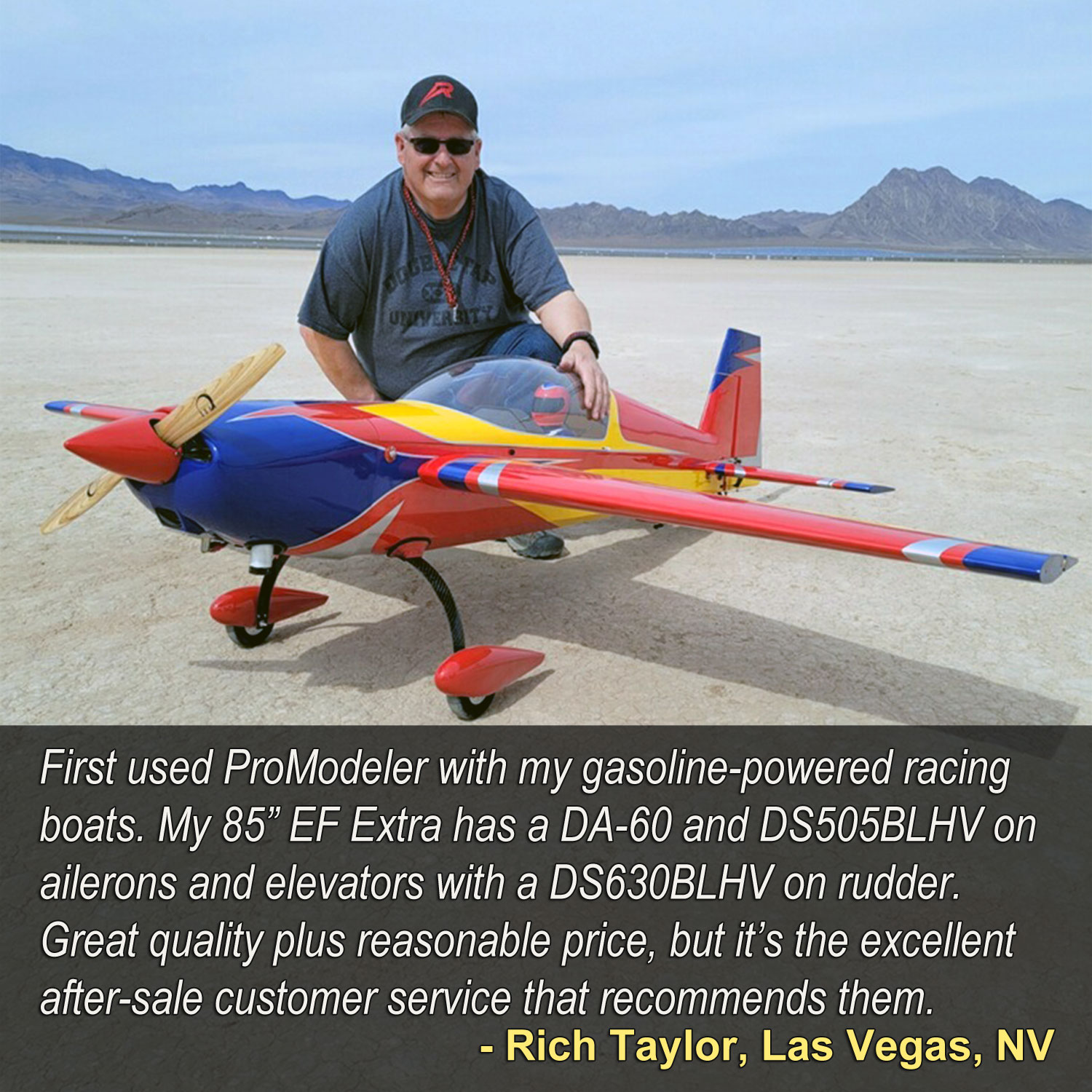
Ultimately, we believe your investment will also last longer because we fitted it with an all-stainless gear train. And because we took the trouble to reinforcing shaft bores for the gear shafts upon which gears rotate using steel bushings. Speaking of more durable hardpoints.
Then there are details regarding the use of a polymer intermediate section – sans bushings – which leads to questions about the long term durability of our competitor’s wares versus the immensely stronger DS903 with an all-alloy case. This can’t be glossed over. It’s important when you’re dealing with ~900oz-in of torque.
Added to which, there are little touches like using Allen head socket cap screws instead of Phillips. And don’t forget how instead of three o-rings the DS930 uses 13 seals to protect your investment. And, how instead of some being exposed to external damage, they are 100% fully captured (hidden), thus protecting them against external damage.
Honestly? If the DS930BHV were merely as good as the Futaba HPS-A703, then we’d have wasted your time. But we think it’s better, and believe we’ve proved it.
But, of course, the only thing that counts is your opinion. So what do you think? Is it time to add a set to your cart? If so, then also consider our servo arms.
Servo arms
These range in length from 15-60mm. We CNC machine them from a solid billet of 7075-T6 alloy and they include a backlash compensating, clamp design. This means in addition to an axial screw securing them to the output spline shaft, you can also snug them up radially against any possible lash between the parts.
We mill and broach these, then drill and tap for M3 mounting hardware (on 5mm centers). They’re a really nice bit of kit and add that finishing touch to a special aircraft – yours.
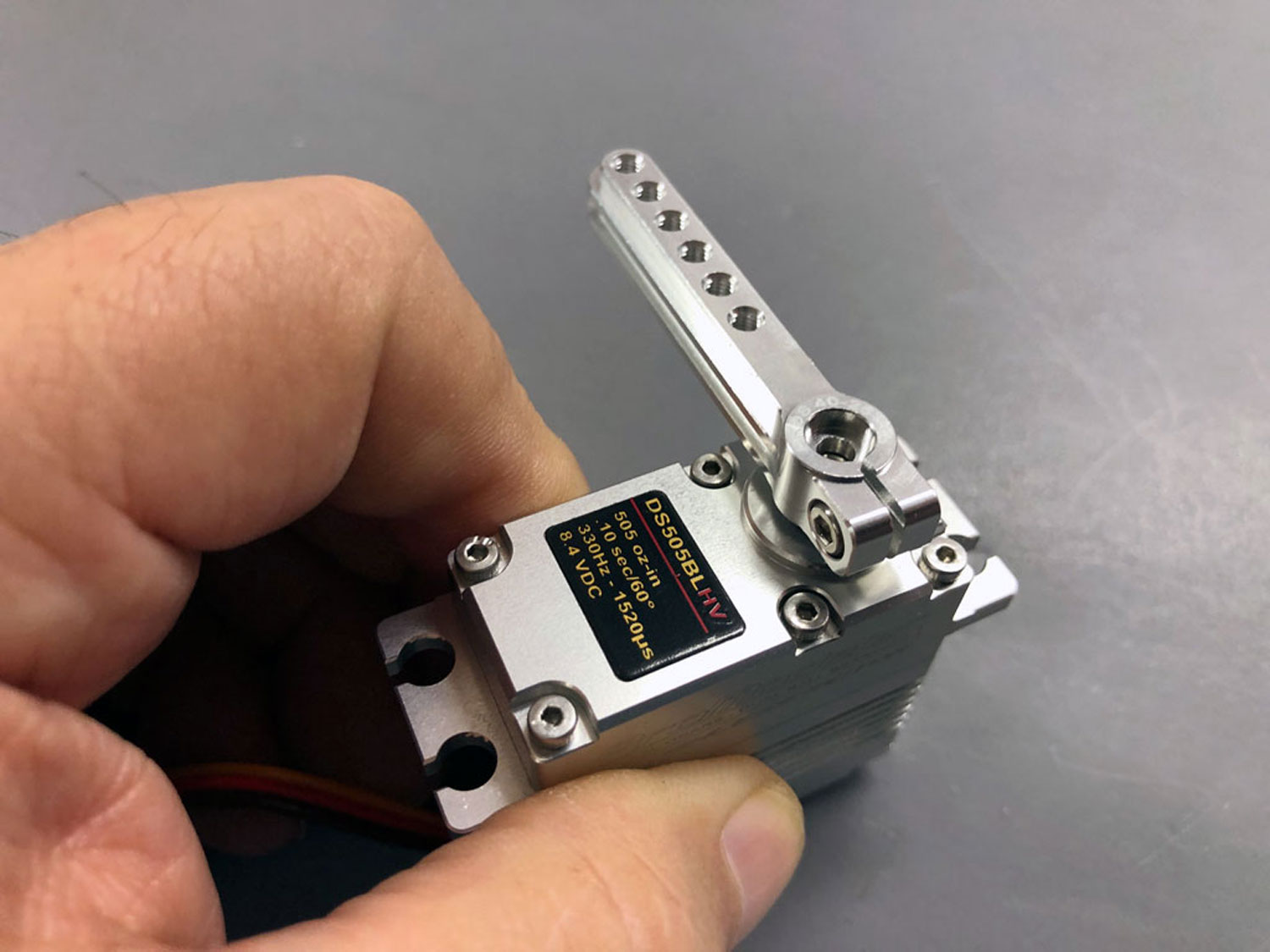
- H-beam profile, machined from a solid billet of 7075-T6, six M3 mounts on 5mm centers.
And note; these servos aren’t just for IMAC use. Scale and sport modelers value them also. This, because power and great centering never goes out of style.

Further study
You may find it a profitable use of your time to review this material;
- BEC or dedicated pack?
- Will ProModeler servos work with NiCds?
- On the batteries John prefers using
- Why’s my pack got two JR-connectors?
- Will a Hobbywing Max6 run my servo?
- How to determine flight time for a 2S850 LiIon
- How many Amps can the servo connector handle?
Q2. Am I better off with DS1155 or DS930 for my 40% IMAC model?
A2. Remember what it says in the Bible (Matthew 6:24) . . .
‘no one can serve two masters.’
Put into modern day parlance, either you set up like a 3D-god (think Jason Dusia), or for smooth IMAC performance. One – or – the other, but not both.
This, because the setups are polar opposites. One is lightning quick with enormous control throws to enable post stall maneuvering. The other is all about precision, meaning juuuust enough throw for the maneuver, and not one iota more!
The idea of the latter is to retain 100% of the resolution, which the RF-system offers. But an XA, or 3D setup, tosses resolution out the window. These models use the longest possible arms. The downside is this shows up as huge amounts of free play at the trailing edge of the control surface.
Meanwhile, an IMAC model is set up with the shortest possible link position and grabbing the end of a surface shows a lot less free throw . . . even though the servos are identical. So leverage for huge throw (long arms) magnifies the inherent backlash between the gears. It can’t be helped because zero backlash doesn’t exist.
So fundamentally, a model set up for XA stuff loses all semblance of precision. I’m sorry, but you have to choose, which is what we learned as kids at Bible study! Bottom line? If you’re the 2nd coming of a Dusia, then you must equip your model for that. And from ProModeler, this means DS1155 with 55mm arms.
Conversely, if you’re a smooth IMAC-type pilot, then spending your money for such fast and powerful servos as the DS1155 just helps you, a) mentally masturbate, and b) eat a hole in your wallet, but you’re actually better off with the DS930BLHV, instead. Or maybe our DS630BLHV. Depends.
And opt for PDRS35-25T or maybe PDRS40-25T servo arms.

So turning now to quote from the bard, when Polonius said to his son Laertes in Hamlet, ‘to thine own self be true‘, this is what he meant, and for you, it means pick either an XA-setup or an IMAC-setup!
Finally if money is important and you’re a shrewd judge of your needs, the facts are we offer servos costing just $100 that may satisfy you perfectly in both 33% and 40% models. This, because the answer to which are the best servos? As usual, it depends!

Final thoughts
In closing, let me offer a few final thoughts. Begin with perhaps reviewing this article because it may further influence your thinking when it comes to spending big money on servos:
Bottom line? The right servo for you is a reflection of your innate talent, your goals, your willingness to practice, and your budget. While we proudly put the ProModeler DS930BHV up against the Futaba HPS-A703, facts are you may not need to spend so much money. For example, the DS505BLHV Cam is flying his 40% Sbach with are plenty for his purpose, and similarly, there are loads of IMAC fuys flying 40% models with our DS630BLHV, also. Yes, the DS930BLHV is going to be better if you sprinkle your routine with some XA stuff in which case if you're considering the Futaba servo, now you know you have options, which because of our direct business model mean you don't give up performance, and gain durability and better protection against vibration and environmetal intrusion without breaking the bank. Will you mates give you a hard time? Possibly. Then again, maybe you'll be the one showing them the light.
Finally, thanks for giving us an opportunity to show you what we offer in gerater detail. A servo is comprised of three basic parts, the motor/electronics, the geartrain which is how we make use of the motor to drive a linkage, plus the case that holds everything together. We feel the motors are a wash but we do a better job ofprotecting the electronics against shock and vibration. The gear trains are so similar it doesn't warrant further discussion except as how the case enters the equation and our use of bushings to reinforce the case mean you're going to get a longer working life as it's much stronger than bare aluminum. So two out of the three fundamental parts are better than theirs. Gives rise to our sloga.

Last thing; not sure which servo is best for you? Feel free to reach out for a chinwag, I try to be readily available;
- Telephone: 407-302-3361
- Email:
This email address is being protected from spambots. You need JavaScript enabled to view it.
. . . and let’s see what we can suss out if we put our heads together!


