
Introduction
The Goldwing RC 106-inch model of the Yak-55M has been around since 2010. And sadly, since their domain is for sale, it looks like Goldwing RC is out of business. Yes, there's someone in China trading on a similar name but they are not the same outfit. Shame really because they produced nice model airplanes. And yes, a bit expensive, but as the old saw goes, you really do get what you pay for . . . and here I go, digressing already!
Incidentally, models spanning 103-108" are considered to be 33% scale. This, because they are approximately 1:3, or 4-inches-to-the-foot compared to the full-scale aircraft. Grade school math proves this because the full-scale spans 26-feet, 7-inches, or 319-inches. Then with either multiplication (319 x 0.33) or division (319 ÷ 3), we calculate a 105.27-inch wingspan.
And in the real world, since 105.27 vs 106-inches is a difference that makes no difference, then we're dealing with a 1/3rd scale. Or as they're more commonly known . . . a 33% class scale-model airplane!
Note; speaking to these 33% designs in general, they are suitable for both IMAC and XA-type use (as well as sport). This, depending principally on how you equip it servo-wise. Say what! Why do servos matter?
And just like that, servos now enter the picture.
So in what follows, quite honestly? I'd sooner kill myself than have to write the same thing about servos for different uses-cases - over and over again - for each model. So instead, I serve up a bit of boilerplate whenever we're dealing with dual-use models (like this one). And by dual-use meaning aircraft well suited for either IMAC or XA-type maneuvers.
Fortunately, if you've read this before, then it's basically the same tired spiel about how you can't serve two masters. Point being, you may skip the first few sections.
However, if you've never read it, then the bliss of ignorance will be ripped away!

Incidentally, to make navigating easier, I'm using what's termed an accordion within the web development world. These are widespread for organizing information (Google uses them) and they work a lot like an expanding accordion for paper documents.

Easy too, just click to open, click again, to close. And skip what doesn't interest you!
Servos - setting expectations
So it's a given you're interested in good servos (else you're not here). Thing is, when equipping your 33% model, the real question is . . . do you want servos for sport, IMAC, or XA?
And be careful regarding you response because the answer determines how much you pay. Also, just as you can't be a little bit pregnant, if you say both IMAC and XA, then you should equip it for XA. Why?
It's because on the one hand, servos and mechanical setups optimized for IMAC perform poorly at XA-maneuvers (too slow and insufficient throw). And on the other hand, servos and mechanical-setups optimized for XA do poorly in IMAC (principally lacking resolution due to dialing back throw electronically with dual rates and thus, precision goes out the window). But we'll get to all this later.
Right now I want to bring this to your attention by way of heads up so you're not surprised at what's coming. Basically, just as the more powerful the servo, the more it costs, it's the same with speed. E.g. the faster the servo, the more it costs!
Point being, unless your money grows on trees, we're working on the assumption you don't want to spend more than is strictly necessary. And for why it matters then next, let's touch on what you want servo-wise for an IMAC model.

So now let's touch on an IMAC-setup but before continuing, IMAC is an acronym for International Miniature Aerobatics Club. And not just model aerobatics but specifically, aerobatics with scale models. Of what?
Full scale aerobatic aircraft. As for the above link, it's that you may visit and poke around their site. If you're into performing maneuvers with scale acrobatic aircraft, then I recommend you join these like minded modelers!
Note; for IMAC, the models must have competed in an IAC event (International Aerobatics Club). No exceptions.
IMAC
So when it comes to selecting servos, a model equipped for IMAC is optimized to achieve high precision. Fast servo, slow servo? This doesn't really matter! Why not? Because precision maneuvers generally don't involve stick banging!
Also, when optimizing for high precision, this means short servo arms. The shorter the better, like maybe 1-1/2" long (with the control ball at perhaps 1-1/4" or 1-3/8" from center). This, versus 2-inches with an XA-setup for the exact same model.
And when I say the shorter the better, if you can get the control surface travel you need for your schedule of maneuvers with the ball at 1-inch, then an IMAC pilot will opt for the ball closer to center 100% of time. Why?
Simple, because it delivers better resolution (meaning 100% of steps available whilst the servo transits) versus a longer servo arm, which you dial back electronically with rates (means maybe using 80% of the available steps, or fewer).
This graphic shows this; red is ball position for IMAC-throw, and blue is the longer ball position typical of XA-throw.

Recapping; an IMAC mechanical setup optimizes to use the shortest servo arm possible consistent with delivering juuuust enough throw to perform the maneuvers on the schedule of maneuvers - but - this typically means insufficient throw to perform XA-maneuvers. Why? Because it gives you the best possible use of the servo-resolution you're paying for.
In fact, IMAC pilots maximize precision by - always - using the shortest servo arm possible! Why? Simple, it's because in the real world excessive control throw means the risk of bobbling whilst executing the maneuver. Or put another way, of creating the risk of a downgrade from the judge.
So just as lawyers always know the answer to the question before they ask it, IMAC pilots plan ahead to ensure their mechanical setup gives them smooth control.
Know what doesn't enter into the IMAC-servos conversation? Transit speed.
This is because these guys are all about precision (versus stick-bangers obsessed with maximizing control surface deflection as quickly as possible). So because the IMAC schedule of maneuvers is 100% about exacting control repeatedly (meaning the same every time), then these guys don't give a flip about how fast the servos are because it's largely immaterial.
Next let's touch on an XA-setup.
XA (extreme aerobatics)
So inherently, an IMAC setup is the total opposite of how XA-guys set up a model. An XA-setup uses a much longer servo arm (perhaps 2" vs 1-3/8"). Then to get the rapid control travel needed to flick the control surface and effect an instant stall (because don't fool yourself, the XA-guys want to start and stop maneuvers on demand, not depend on luck), then the XA-pilot pays through the nose for really, really, really fast servos.
So because IMAC doesn't call for speedy servos, these pilots don't pony up for the fast servos used by XA-pilots. No, not talking about wannabes flying builder grade servos, but the real deal who buy air frames and servos separately.
For example, in our lineup, both of these servos give you about the same amount of torque - but - for our really fast servos, you're going to pay more. Let's put numbers to this and see how it plays out;
Why does the DS635 cost so much more than the DS630? For the same reason old hot rodders say; Speed costs, how fast do you want to go? So the DS635BLHV is more expensive because there's nothing we don't do component-wise to deliver speed.
Note; ignore the difference in torque because nobody on God's green earth could discern the difference between 630oz-in and 635oz-in during flight (like we can in the lab). All you're really paying through the nose for is the difference in transit speed.
Control throw
Throw from a rotating source (servo's output shaft) is dictated by the angle of rotation and the distance from center at which you place the control ball. Pure physic determines this.
Basically, the more rotation (number of degrees), the longer it takes to go from one extreme of travel to the other. Makes sense too, that it takes twice as long to rotate 120° versus 60°, agreed?
Distance refers to distance from the center of the output shaft. The further form center the control ball is mounted, the more throw you can get out of the servo. Proof comes from visualizing the path the ball transits as it rotates, the further out, the larger the diameter and thus, the circumference. Since the balls travels further, so does anything connected to it!
This graphic shows control surface deflection, one with the ball at 1-3/8" and the other mounted at 2-inches with 30° of rotation from the servo in each direction, or 60° total. The blue linkage is mounted further out and the result is more control surface deflection angle.

Interestingly, both IMAC and XA-pilots will crank up the ATV from 100% to 120%, or higher to get more control surface deflection. However, the IMAC pilot only wants the deflection needed and will progressively move the control ball inward (thus reducing throw), until he can no longer perform the maneuvers. The he moves out one more hole and begins to fine tune the ATV to reduce travel by cranking is down electronically. This conserves resolution.
What ATV does
Per OSHA 1910.25(c)(2), walking up a flight of stairs involves a standard step, which in the USA has a rise of 9-1/2". So what if instead of 13-steps between flights, you had 17 steps? Short answer? You'd actually climb higher than one floor!
So reviewing the specs for our servos reveals two different specs regarding the number of steps in our digital servos. This is in the first column, the lines labeled Max Travel and Travel. For servos, the steps are labeled ms (milliseconds).

So for this particular servo, the range for 90° is about 1000 steps (2000ms-1000ms=1000ms). We label this Travel. And taking 1000ms and dividing by 90° gives us the number of ms/step. Simple math, 1000ms÷90°=11.1ms/°. Is there a term for the 1000ms? yes, there is but we don't use it because we don't determine it, the RF manufacturers do and they refer to this as Volume.
Turns out you can expand the number of steps coming from your transmitter using a function called ATV (Adjustable Travel Volume). The typical range is from 800ms to 2200ms, or 1400ms total. And dividing 1400ms÷11.1ms/°=125°, which is how we get to Max Travel.
Note; 1000÷90 isn't actually 11.1ms.° is 11.1111111111111 to infinity. So 1400÷11.1 equals 127°, divide by a number with more trailing 1s, e.g. 11.1 with 13 trailing 1s get 126 degrees, and the more 1s, you eventually get to 125°, which is what we state in the specs. Of course, this is another one of those differences that makes no difference in the real world.
But as regards the size of the steps themselves? They don't get larger, or smaller, they're 1ms each. So why does this matter? Simple, to get more control surface travel what folks do is use a long ass arm and make the servo swing to may rotation. This next drawing shows you 45° of travel in each direction, or 90° total.
Note; increasing ATV is like increases the depth of each steps, which results in greater precision. In the USA, the standard rise for a stairs is 9-1/2", or 24cm. So when you're climbing to the 2nd floor, you have maybe 13-steps. So imagine smaller steps, 8cm instead of 24, or 3X as many smaller steps, so you step 39X instead of 13X t climb the same floor. This is what happens when you crank up ATV and for IMAC, this means greater precision for smoother maneuvers.
And it
It's expressly why we offer BLS1-series servos ranging around 0.10sec/60° of travel - and - BLS2-series servos, which get down into the 0.042sec/60° range for stupid fast transit speed. Problem is, BLS2-series are a fair bit more expensive than BLS1. Can't be helped because speed costs money.
So if IMAC is your thang then don't pay up to buy XA-class servos! And if you are an XA-pilot, then be glad we offer our BLS2 servos because they're faster than what the other guys offer you.
So what's the problem? It's the wannabe who says he does both IMAC and XA. What's the real problem? The wannabe doesn't understand real XA-pilots use fast servos. Basically, we wants to pay for IMAC transit speeds thinking he can just fit long ass arms to get the required huge control surface deflection. And he can, but this doesn't work. Why not?
The servos are too slow. Sure, they're fast enough for basic XA-maneuvers like the elevator because the surface deflects to 45° to initiate the descent, but isn't deflected very much otherwise during the rest of the maneuver. But these servos are nowhere near fast enough for reversing rifle-rolls, crankshafts, and walls. Maneuvers, which need fast control surface deflections to time the entry. Look, this isn't my opinion, it's down to physics!
In summary, an XA setup calls for the fast servos while an IMAC pilot doesn't care a flip about speedy servos. Nor should he because precision doesn't call for the same kind of speed. And knowing this, we offer servos optimized for speed, but they cost a whole lot more than servos optimized for IMAC work (and they cost a lot also), they don't cost as much as the stupid fast servos.
Of course, if your money grows on trees, buy XA-class fast servos (our BLS2 series), and fit them with XA-type arms (2-inches), and then use dual rates to cut down the throw. Of course, we can't repeal physics so this means you instantly give away half the system resolution! Put another way, there goes any hope of achieving precision. It's really true what it says in the Bible about serving two masters.
If you want competitive level precision, you don't need to pay for fast servos. And you fit the shortest arm needed. If you want to fly XA, then you do pay for fast servos, you fit long arms, and you don't give a flip about precision.
And if an IMAC model is fitted with long ass arms to get the required throw, then the servos created for an IMAC model aren't really quick enough for aggressive maneuvers so just using long arms isn't the solution when the servos are slow. True, unless you're fitting XA-class servos (really fast) in an IMAC model. Obvious downside, of course, is fast servos costs a lot of money and fast is otherwise wasted on an IMAC model where the goal is precision instead of a lot of throw.
Anyway, when equipped for XA, the servos are faster than you need to pony up for IMAC-maneuvers and worse, because the arms are really, really long (this, to develop the required control surface throw of 45° in each direction), then the flight controls are so freakin' sensitive, you have to dial the control throw down to fly (and then, this is bad for precision).
Like it's one thing if you take an XA setup and reduce throw mechanically (by installing shorter arms), but that's a lot of work. So what most guys do, instead, is opt to do a mechanical setup for XA, then use dual rates (or ATV) to tame the model down enough to fly (with at least with some semblance of precision). Problem with this is now you're giving away all the resolution you paid through the nose to get! To say nothing of having forked over big bucks for fast servos.
Like mental masturbation is real, I get it. And with enough time online, some guys can convince themselves of anything. But I don't really care, you're not paying me to stroke you. These are the facts. And this means it's time for the talk
No, not regarding the birds and the bees, but the one regarding IMAC vs XA servos (and setups).
IMAC vs XA spiel
This aircraft is well suited for either IMAC - or - XA-type maneuvers. but in a nutshell, I'm saying you're fooling only yourself if you believe you can set your model up to do both good IMAC and good XA. This, because an XA model will be for shit at IMAC due to poor resolution (because you have to dial it back with dual rates to stop it veering wildly all over the sky due to the long ass servo arms), or if setup for IMAC, then it's utterly incapable of hard-XA because an IMAC-setup simply won't have enough control throw (or servo speed) for the harder maneuvers.
Servo speed? Yes, servos for IMAC aren't fast enough to do hard-XA, and the über fast servos optimized for hard-XA are way too expensive to be pissed away on an IMAC model. Unless, that is, you're selling airplanes. In this case, your agenda is totally different from that of the customer. This, because (obviously) you want to maximize aircraft sales. So if you told them the truth, then you might sell fewer package deals, which would be totally counterproductive!
Remember, you have to know where the guy selling you something is coming from to be sure your mission goals and theirs are in alignment! Otherwise, you're setting yourself up to get screwed. And to be clear, I have an agenda also, to sell you our servos.
That said, I suspect with this warning, you'll be on the alert and suss out if I'm full of shit, or not, quickly enough!
The way of the world
So the way it works is like this; the savvy pilots only buy the airframe and go elsewhere for servos. Meanwhile, the ignorant are offered builder-grade servos and go off happy with a package deal. Typically, these are shiny servos offered at a great price expressly for those who don't know any better. Anyway, the bottom line is this; it takes different servos for XA vs IMAC. If this is news to you, then I'm sorry.
Note; this isn't unique to modeling because it's pretty much the same issue a football coach faces when deciding does he have the quarterback hand the ball off to the halfback who can dance through the defensive line, or the fullback who can plow through it. This is why the coach has two different players! Same with golfers, does he use an iron or a wood?
So while we're fortunate in that the same aircraft can be set up for IMAC or XA, you're not getting the best from either set of servos and arms if you try to do both. And for what it's worth, these aircraft are so finely balanced aerodynamically, they fly great for sport pilots, too!
This brings us to . . . who are you pilot-wise? And what about your budget for this build?
Budget and speed
First up is budget. Then we'll touch on speed. And in support, we'll share three very brief videos.
Budget
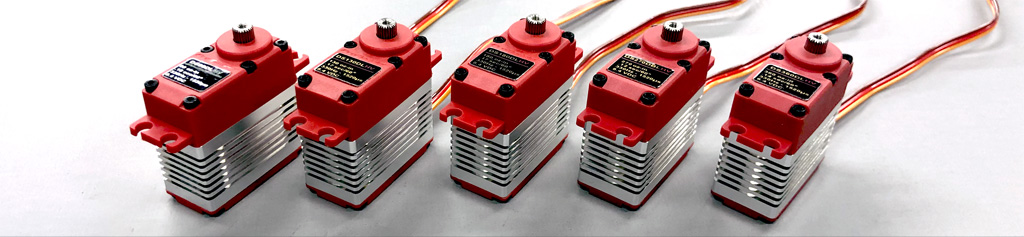
Money matters. Anyone says it doesn't is lying. We're going to introduce you to some of our servos. One is our DS360DLHV servo.
It's one of five budget friendly servos in the DL-series. While they're a solid product, they're not particularly fast. And while they range from 90oz-in, and top out at 360oz-in, they make up the vast majority of standard class sales. Why?
In a word, it's because they're so good. And for sporting use, because the DS360DLHV is in the same league as the JR DS8611s speed-wise, whilst offering a touch more torque, then it's both strong enough and plenty fast enough for this model. But true, only depending on who you are as a pilot and what your performance expectations are.
But again, I'm getting ahead of myself. More in a bit. Meanwhile, meet the DL-series.
Speed
Now, let's talk speed. While we can talk until we're blue in the face, seeing is believing. These three videos are very brief.
This first one is of the DS360DLHV side-by-side with a SAVÖX SV1280SGP. Why this servo? Simple, it's because the sole purpose of the video is to show the difference in transit speed between one of our sport-oriented budget servos versus a very popular servo. One offered up by well known airframe vendors expressly for XA-models ranging in size from 85-inches to 105-inches of wingspan.
- 5-SEC VIDEO DS360DLHV-vs-SV1280SGP
This next video is of one of our IMAC-oriented servos. This time it's our DS505BLHV versus the same SV1280SGP.
Now our purpose is to show the transit speed difference between our idea regarding a good servo for the purpose of flying IMAC maneuvers. This, versus a servo often touted by air frame dealers whose goal is selling package deals.
- 5-SEC VIDEO DS505BLHV-vs-SV1280SGP
Obviously, the ProModeler versus this east Asian import showed ours has better speed. But when the goal is a good set of IMAC-oriented servos and maybe some light XA, then the added speed is a big deal.
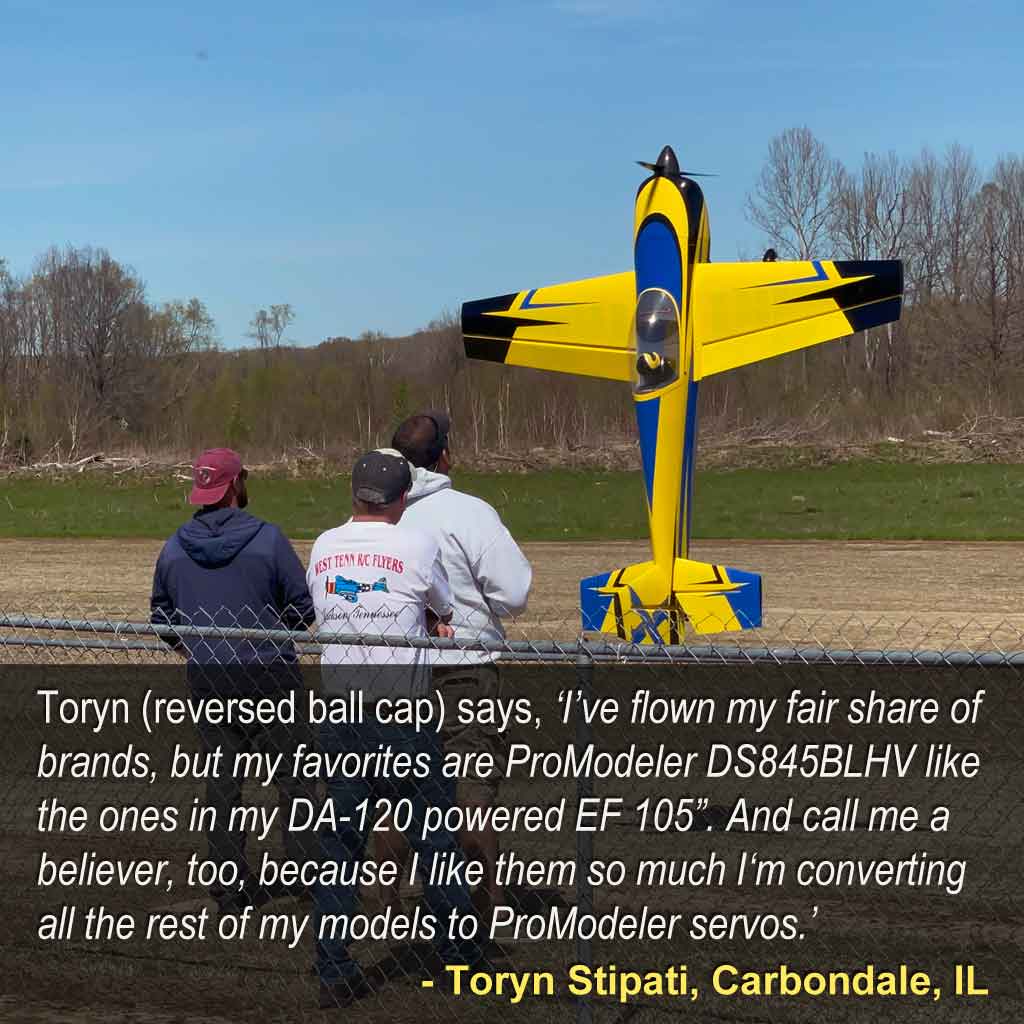
And in support of the DS505BLHV servo for IMAC, allow me to share the thoughts of a customer on the subject. And remember, this isn't a sponsored pilot we can pay to put our words in their mouth and say these things, it's form a paying customer.
Put another way, their words of praise can't be bought and thus, are priceless!

Finally, this video matches up one of our XA-oriented servos, our DS845BLHV, against the same SAVOX SV1280SGP. This time the purpose is to show the transit speed difference when you pony up for a real set of XA-servos.
- 5-SEC VIDEO DS845BLHV-vs-SV1260SGP
Why put these two head to head? Simple, it's because this servo features in our recommendation for XA-oriented pilots. Add to which, it's especially worth showing because we feel ours is the better built servo, and we can prove it.
- matchUP: SAVÖX SV1280SGP versus DS845BLHV
Look, if you're really into XA, then you'd be an idiot if you didn't appreciate the incredible transit speed difference in our BLS2 servos. Problem is, a set of these will gonna cost you about 50% more dough. Against . . .
- $1600 for the air frame (plus $250 for freight)
- $1100 for an east Asian engine with mufflers, prop and spinner (and more for a European engine)
. . . plus receiver, switches, batteries, smoke system, etc. This, on your way to a $3500-4000 build. Saying only you can do the math - but - know this, just like with hot rodding . . . speed costs How fast do you want to go? And what's the real cost of going cheap on the servos and discovering you can't perform the maneuvers you dreamed of simply because the response is too slow? Just saying.
And not to put too fine a point on it, but this is where the rubber hits the road. If you're doing crankshafts and walls, then you have to get off your wallet. But if these maneuvers aren't really in the frame because you're more into smooth versus harsh, then don't be stupid, buy a set of our BLS1 servos, instead. This way you get a really fine set of servos whilst saving some serious dough.
Also, if you're a club pilot doing loops, rolls, stall turns, the odd snap roll on take off, etc. then know this, the DL360DLHV outperforms the JR8611 with which this model was flown for more than a decade! How good are these?
Eyeball this matchUP-article where we tore down a JR DS8711, the next step up from the DS8611a, and where we put them head-to-head with our DS360DLHV. Don't wonder, use your own eyes and judge for yourself!
Summary
So what I'm really saying is this . . . be realistic with your expectations and don't set up your model with long ass servo arms to have big time XA-throw just to flash the surfaces at the peanut gallery and hear them go Oooooh! This, before flipping the dual rates to low in order to throttle up and fly.
Your money, I won't ever know, just saying, watch out for your best interests. Next, how to know which servos are right for you. So let's touch on types of pilots.
Note; this is yet another bit of boilerplate you may have seen before.
Sport vs IMAC vs XA-pilots
Who you are as a pilot is a big deal. It matters far more than you might imagine when selecting your servos. So who you are also touches on; what are your expectations for the model? Do you intend to fly it for sport? IMAC competition? Or extreme attitude, or XA? Basically what I am asking is this; what do you expect performance-wise from the model?
For example, if you're a club pilot and love the size and look - but - have no intention of practicing slow rolls three times a week, then you simply don't have to pay big bucks to equip the model. But if you really go out and practice several times a week, then a budget set of servos may not have the required torque to perform IMAC level competition maneuvers. So if you don't compete in regional and national IMAC events, then you can save some serious money on our servo recommendation for sporting use.
Similarly, if you're gonzo nuts for performing aggressive XA maneuvers like crankshafts and walls, then your servos are totally different (speed-wise) from what suits an IMAC-pilot perfectly. And no, I am not saying one or the other has better servos, saying we create servos for totally different purposes!
Note; if you say, I fly both IMAC and XA, then I'll respond with . . . remember what it says in the Bible about serving two masters (Matthew 6:24). Basically, you can't.
What do I mean? It's the same as the coach deciding to whom the QB will hand off the football because which is better, the fullback or the halfback depends on how the offensive and defensive lines are responding. Same with modeling! Just as a fullback dances poorly, doing both IMAC and XA requires a compromise between speed and precision. And the answer to which is best for you is . . . it depends! On what? On you!
So to get the reduced throws from an XA-setup to make the model manageable in precision maneuvers, and because the setup uses extremely long servo arms to pitch control surfaces to 45°, then you're forced to throw away nearly half the resolution you've paid dearly for by dialing back the ATV (electronically reduce the throw, or or degrees of travel).
Conversely, when set up for precision maneuvers, the arms aren't long enough to get XA-type travel, and even if you fit long ass arms to this set of servos, they're nowhere near quick enough for aggressive XA-maneuvers!
What I'm saying is this; you should know what the real price is of trying to serve the IMAC-master and XA-master with the same set of servos and arms in the aerobatic world. Oh, and I hope you noticed the decision doesn't just involve the servos because the servo arms are part of the equation also because it relates to throw and resolution! But more later.
Anyway, and depending on who you are as a pilot, whether you're primarily into sport, IMAC, or XA pretty much determines the servos and arms you should select to equip the model.
So with three basic pilot types, are you surprised we have three servo recommendations? And while we can refer to them as good, better, and best - in no universe - is one set of of these servo built better, or to a higher standard than any other in our lineup. I know this is going to sound like corporate bullshit, but they really are all built to the same standard.
Major point being, we offer a great set of servos for this model, which are perfectly suited for sport pilots. Plus a different set of servos optimized for IMAC-oriented precision pilots. And a third set, whose existence is expressly for those of you who live and breathe XA and are willing to pay for the transit speed.
Oh, and the one thing you can count on is there's zero difference in quality . . . just in the price. However by mentioning money, we're getting ahead of ourselves, again. More in a bit. But next let's delve a little into engines because believe it or not, this also matters when it comes to selecting servos.
Engines - and how this affects servos
So back in the day, this class of model was typically equipped with a DA85, or maybe a DA100 twin if you had deep pockets. These days, for sport (or sportsman-level IMAC), while the DA85 (or DLE85) engines are still decent candidates for the airframe, they're a bit shy of power for 27-30lbs. Moreover, these are great big single-cylinder thumpers (a.k.a. paint shakers). This, due to the high vibration of a largely unbalanced single. Point being, they're hard on both airframes and servos.
And for context regarding an 85cc single, when I was 13, my first motorcycle was a Suzuki Gaucho. Equipped with a 50cc engine, on weekends when the work crew weren't there, I'd go for a full throttle blast on a stretch of highway under construction to see how fast I could go.
So there I was - the very definition of young and stupid - throttle pegged, prone on the seat and peering over the gas cap to reduce drag. And utterly thrilled at getting this puppy up to 65mph with the 50cc engine screaming its guts out, and creating enough vibration for the mirrors to be useless (and for my hands to go numb on the bars).
Point being, an 85cc thumper on a <30lb airframe will vibrate hard! Hard enough to eat hinges and servos. Heads up.

Anyway, these days the real engine-contenders for this class of model are mostly 120cc twins. These boxer configuration engines fire the opposing cylinder simultaneously and thus, are much smoother in operation. They also develop way more horsepower, which is what really relegates the 85cc to light IMAC duty, and sport use.
Saying if you think you're going to perform XA-maneuvers and you're using an 85, you technically can because performing an elevator-maneuver, technically is XA because it needs 45° of throw, makes no demands on the engine but no way in Hell do you climb out with authority from a torque roll with a DA85. Ain't happening!
In a nutshell, engines for XA and IMAC are most likely coming from DLE, Desert Aircraft, 3W, and MVVVS. But don't be surprised at the number of Sukhoi and YAK models being equipped with radial engines to properly fill that big round cowl.
Why does this matter? Some guys fancy themselves so good they can tell the difference in flight between a standard-class servo and a mini-class servo. This, due to the weight savings, which amount to maybe an ounce. This, for an airframe going well north of 400oz. Whatever. Where am I going with this?
The throttle servo comes into play with sport, IMAC, and XA. It's real simple, for sport and almost all IMAC, the transit speed doesn't matter. For XA, that's all the matters. For some IMAC pilots, it sort of matters. If you think it matters to you, then know this; prepare to get off your wallet to the tune of 2X (or better) versus the price of a throttle servo for sport.
And where I'm going with this is the so-called God's gift to piloting who thinks he can tell a difference in an ounce of weight will look at the prices of fast mini-class servos and go, aha! So let me clue you in about vibration and the effect on servo gears and say . . . don't. Stick to standard class servos. Trust me.
So now let's delve a bit into servos.
Servo - what size, how many, and why us?
Servo-wise, 33% models are universally outfitted with standard-size servos throughout the air frame. Standard size or standard-class means a footprint of about 20mm x 40mm. And they'll got about 2-3 ounces a pop. These include a throttle servo (plus maybe one for choke).
On the flight controls, there's one servo per elevator surface, so two servos. On aileron, back then (and still the case today), 33% models use two servos per aileron, so two ailerons means four servos. And on rudder, because readily available servos back in the day often topped out between 250-350oz-in, then because you needed more grunt than was offered by a single servo, top modelers resorted to more than one servo.
Often there would be two rudder servos ganged together using tiller arms . . . like this.
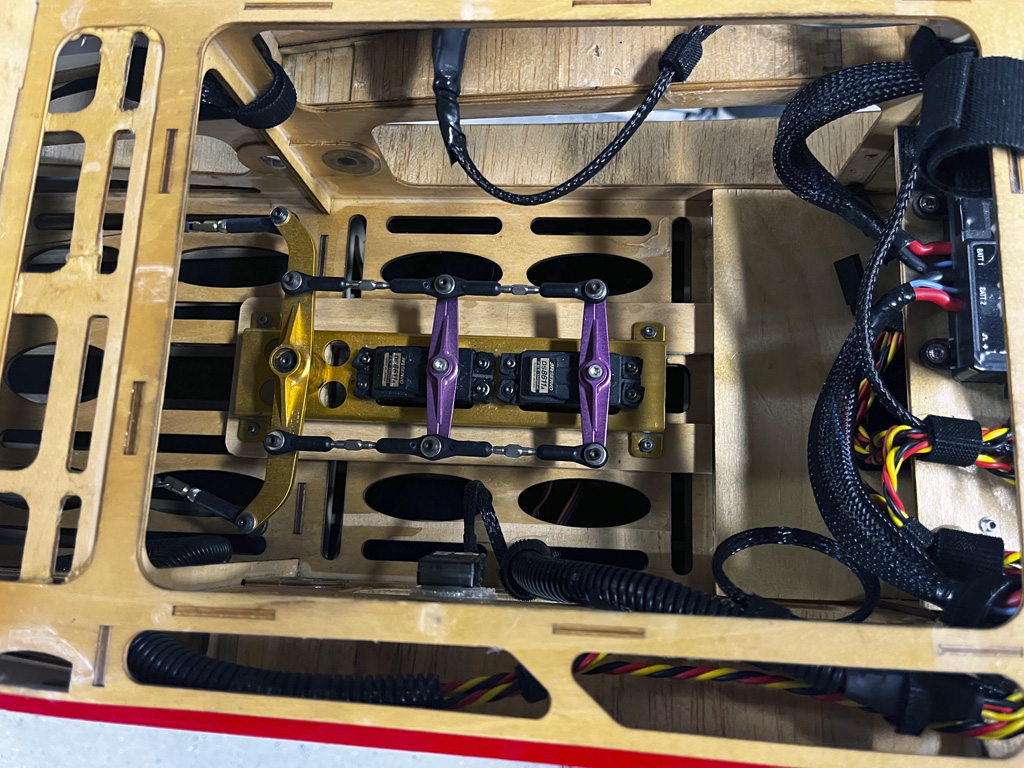
- Now long in tooth, JR DS8611 (260oz-in at 0.15sec/60) were the heat once upon a time
Note; ganging servos was also common for 40% models where as many as four rudders servos would be ganged together in pretty much the same way, but now I digress.
Y-Harness
Also, and this is important, whether it's two servos for each aileron, or a pair ganged together for rudder, they're never combined together via a Y-Harness. Not ours, not anybody's when we're talking about servos, which collectively may exceed 3.5A of current draw (the current rating in amps for the single connection of two servos via a Y-Harness to the receiver).
This is important!

Basically, instead of using a Y-Harness, each servo has it's own channel. Then using master->slave relationships within transmitter programming, they're ganged together electronically instead of mechanically. Why is this?
And briefly birdwalking, the reason for this is is due entirely with the current flow required for each servo. What happens is when added up the loads (like the example below for a DS360DLHV servo), a Y-harness because it makes a single connection to the receiver will almost to a certainty exceeds the 3.5A continuous current rating of the servo connector.
So let's see some numbers for a DS360DLHV servo. It's rated at 360oz-in and anything else we'll discuss will consume a lot more juice. So this is a best case scenario (and it's still bad), take my meaning.
Basically, at any given voltage, max current for each servo (multiplied X2 for two servos) easily exceeds 3.5A.
Of course, this is routine stuff covered in the RF-manuals and thus, beyond the scope of this article. Just bear it in mind because the very real risk is the receiver port (for example, channel 6) at which this widget is connected gets hot and suddenly, something goes poof and releases the magic smoke.
This is considered bad juju for the airplane, capisce?
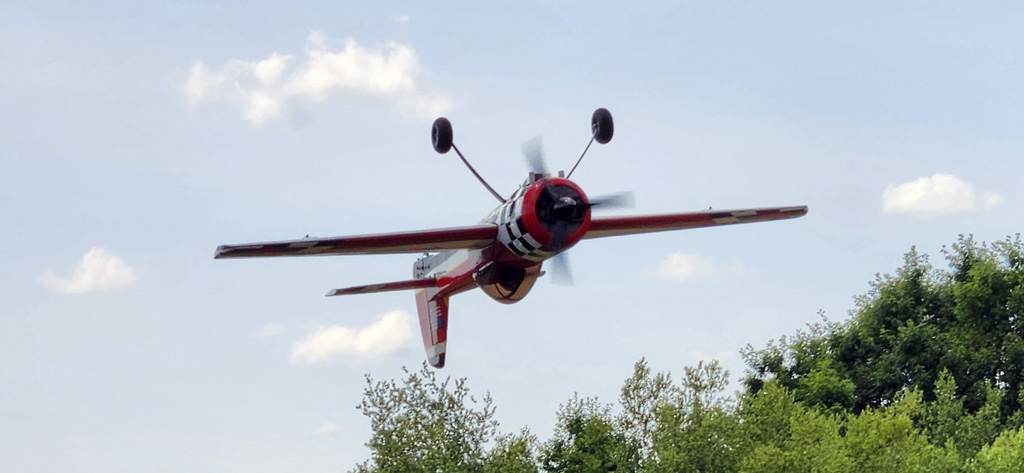
- Inverted and steady as a rock, the YAK-55M is a sweetheart
So next let's touch on a little bit of background regarding the YAK-55M and what brought this article about before we jump into the meat of the article, the recommended equipment for sport, IMAC, and XA.
Background info
Most often, these reduced scale examples of IAC civilian acrobatic models represent aircraft powered by Lycoming's 540 cubic inch flat 6-cylinder engine. Examples include German designer Walter Extra's various model like EA-260 and EA-300, Oklahoma-based Zivkov Aeronautics Edge 540 (as used in Red Bull competitions), Czechoslovak Zlin Z-50, as well as the South African Slick design.
But then there are the Russian design bureaus, Sukhoi and Yakovlev. Their entrants include the agile Su-31 and über capable Yak-55M, respectively. And both favor the Vedeneyev MP-14 9-cylinder radial. This, incidentally, is the same air cooled engine as used on the Pitts Model 12.
Note; what differentiates the 55 from the 55M is the latter's shorter span allowing a more rapid roll rate. This 3-view shows what we're discussing. Take note of how short the nose is.
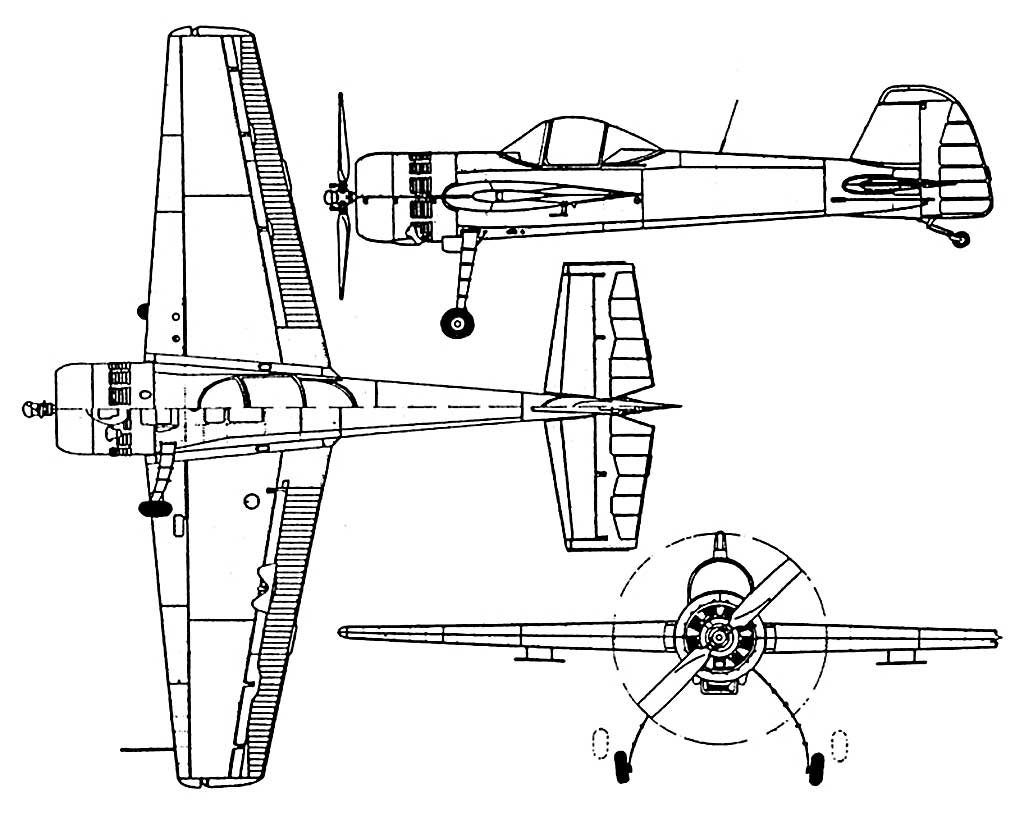
- The very short nose is a reflection of the weight of the engine
Why our focus on the Goldwing RC 106-inch YAKK-55M, a rather long in tooth model whose manufacturer is no longer in business? Simple, it's because a fellow name of Mike Maljanian of West Boylston, MA (the fellow in the hero photo leading of the article) reached out for advice regarding servos for his.
Thing is, I figure there may be others out there looking to either refurbish one these, or possibly even equip a NIB example from scratch. After all, folks buy models with the best of intentions only to get busy. So it gets put on a shelf and never gets built. That, and/or these very capable aircraft are flown a few years, then eventually fall out of favor, and it's time for them to find a new home.
Major point being, if it's not brand new, these warriors are typically owned by a class of pilot who aren't your typical balsa buster. In a nutshell this translate as well cared for airframes. So occasionally, one comes on the market - either new or used - so our idea with this article is that it will serve as a template for setting up yours!
And as for how it came about, quite often it's a phone call. Or as happened in this instance, Mike emailed . . .
I've an older 106” Goldwing Yak55M which I've been flying in IMAC with
for 5-6 years. It weighs 28-29 lbs. This weekend one of the right
aileron servos locked up. Fortunately, I was able to land the plane
without an issue. Plane has JR DS8611a throughout. Two on the pull/pull
rudder, two on each aileron and one on each elevator. What would you
recommend for a replacement in a ProModeler? A plastic case is fine.
It’s what the 8611a have and they are original to the airplane which
is from back in 2011.
. . . so we chatted a while and I got a feel for his skill level and intentions for the aircraft. Then I shared my thoughts in terms of an sport setup, servos for an IMAC-oriented build, and then an XA-build although my sense of things is this was not his area of interest.
Anyway, up next are my recommendations for this 33% model based on if your intent is sport, IMAC, or XA.
Note; this is going to be the same-same equipment list as for a similar size, similar powered airframe by other manufacturers like Pilot RC, Extreme Flight, Apex Aerotech, Skywing, AJ Models, or Flex Innovations.
Sport - servos and arms
- 1) DS90DLHV - throttle (plus another for choke)
- 4) DS360DLHV - ailerons
- 2) DS360DLHV - elevators
- 2) DS360DLHV - rudder (if you prefer to gang two servos, one if you don't perform knife edge loops)
- 1) PDRS105 - Anti-vibration throttle arm
- 6) PDRS35-25T - flight controls (flight controls, less rudder)
- 1) PDRS40D-25T - when ganging two rudder servos, otherwise for a single servo, get
- 1) PDRS50PP-25T - Pull-Pull (rudder using cables)
As a reminder, these DL-series servos we're guiding you to are offered in a range rated between 90-360oz-in of torque. If there's one thing folks especially appreciate it's the finned aluminum center case because they run cooler on hot summer days than all-plastic designs.
Another detail folks appreciate about the DL-series servos are the durable stainless steel gears. How can we offer stainless in a sport servo? Simple, we agreed to our gear hobber's demand we use them across our entire lineup in exchange for a great price. So you win with better gears, we win because they cost less, and they won because it increased their sales volume of stainless gearsets!
What this means for you is getting the same-same more durable heavy duty stainless steel gear sets as in our top-of-the-range all-alloy brushless servos (like we recommend for IMAC and XA duty). Best part? It comes without breaking the bank.
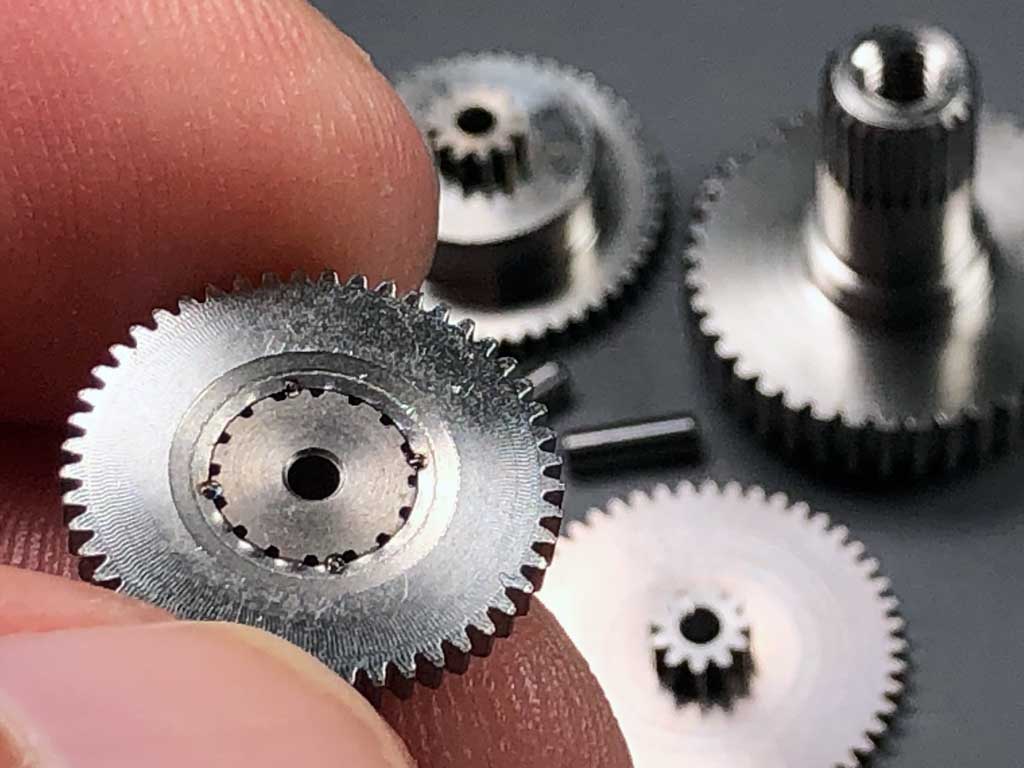
- Look close to see the teen-tiny spot welds between bull and pinions gears
IMAC - servos and arms
- 1) DS255BLHV - throttle
- 1) DS90DLHV - choke
- 4) DS505BLHV - ailerons
- 2) DS505BLHV - elevators
- 1) DS630BLHV - rudder
- 1) PDRS105 - Anti-vibration throttle arm (plus another if using choke)
- 6) PDRS45-25T - flight controls (less rudder)
- 1) PDRS75PP-25T - Pull-pull rudder
XA - servos and arms
- 1) DS255BLHV - throttle
- 1) DS90DLHV - choke
- 4) DS635BLHV - ailerons
- 2) DS845BLHV - elevators
- 1) DS1155BLHV - rudder
- 1) PDRS105 - Anti-vibration throttle arm (plus another if using choke)
- 6) PDRS55-25T - flight controls (less rudder)
- 1) PDRS100PP-25T - Pull-pull rudder
So in this servo group we take you into some of our all-alloy servos. This is how they compare when placed side-by-side with a hybrid case servo (hybrid meaning the case is comprised of both engineering polymer and aircraft aluminum).
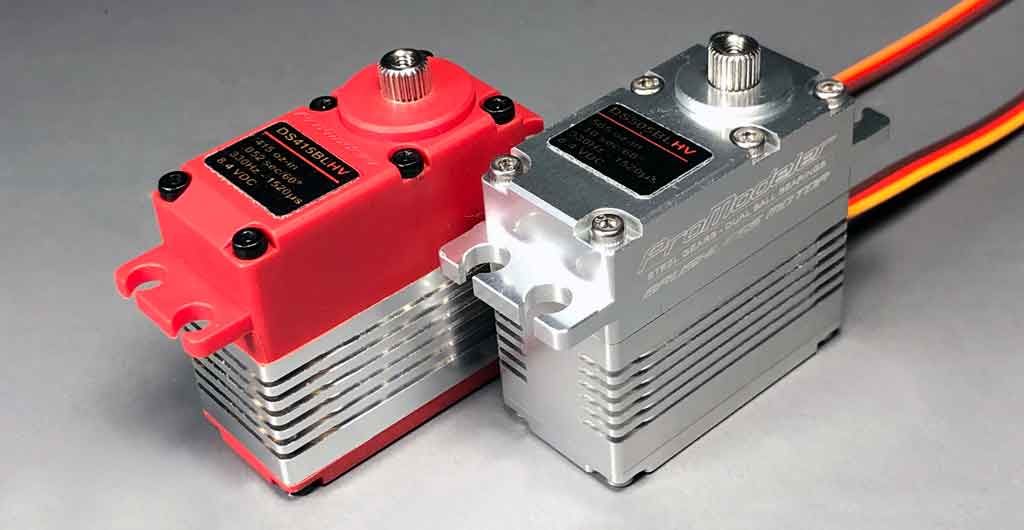
Other stuff
- 4) 8" extensions (at receiver to mate wing)
- 2) 12" extensions - inner aileron
- 2) 18" extensions - outer ailerons
- 2) 36" extensions - elevators
- 2) B2S2600 LiIon battery pack - one each for avionics and ignition
- 1) 20A Dual Illuminated Rocker Switch
- 1) 5A slide switch - ignition
- 1) RCEXL Opto-Kill Switch
So as you may have noticed, while I was at it, besides making a recommendation about servos and arms, I've also mentioned what you'd want in the way of other stuff. E.g. servo arms, extensions, batteries, radio switches, plus a slide switch and an Opto-Kill.
These last two - specifically - so you have the means to shut the engine off both manually from outside the model 'and' via the radio in the event the throttle servo goes teats up. And of course, we know we make the best servos possible and we hope our throttle servo never fails but only God is perfect. For the rest of us, what General Baden-Powell wrote in the Boy Scout handbook will suffice . . . be prepared!
Extensions - details
Let's touch on servo extensions. They're three-strands twisted together and made up of 20AWG wire. Basically, they're the thickest wire leads we can get crimped into the DuPont housing.
Twisted
Why twisted? To more strongly resist stray RFI (radio frequency interference). And this is a big deal. In fact, it's our advice to don't ever use flat extensions with ignition engines. Why not?
Simple, it's because 'if' the module or high tension leads begin to fail, then the ignition noise (these things are sending 40,000 volts to the plugs) basically swamps the receiver because it's act like a broadcast transmitter of pure noise. And the noise feeds straight into the receiver through the leads 'unless' they are twisted. Airplanes are expensive, right?
Anyway, you're the customer and thus, always right - but - our opinion is a few bucks saved on flat thin extensions is false economy. So heads up whether you add extensions to a servo order or get them someone else because these are basics! And it's not opinion, but physics.
Insulation
Speaking to the insulation, while there are several materials we could have select for the insulation, we opted for silicone (which is pretty much the same stuff used for fuel lines) because it's silky soft and supple, which makes it great for resisting abrasion as you pull it through wing ribs and such. Combine with high strand copper wire and you get a super flexible extension that's easier to route and doesn't get stiff when it gets cold.
Thickness
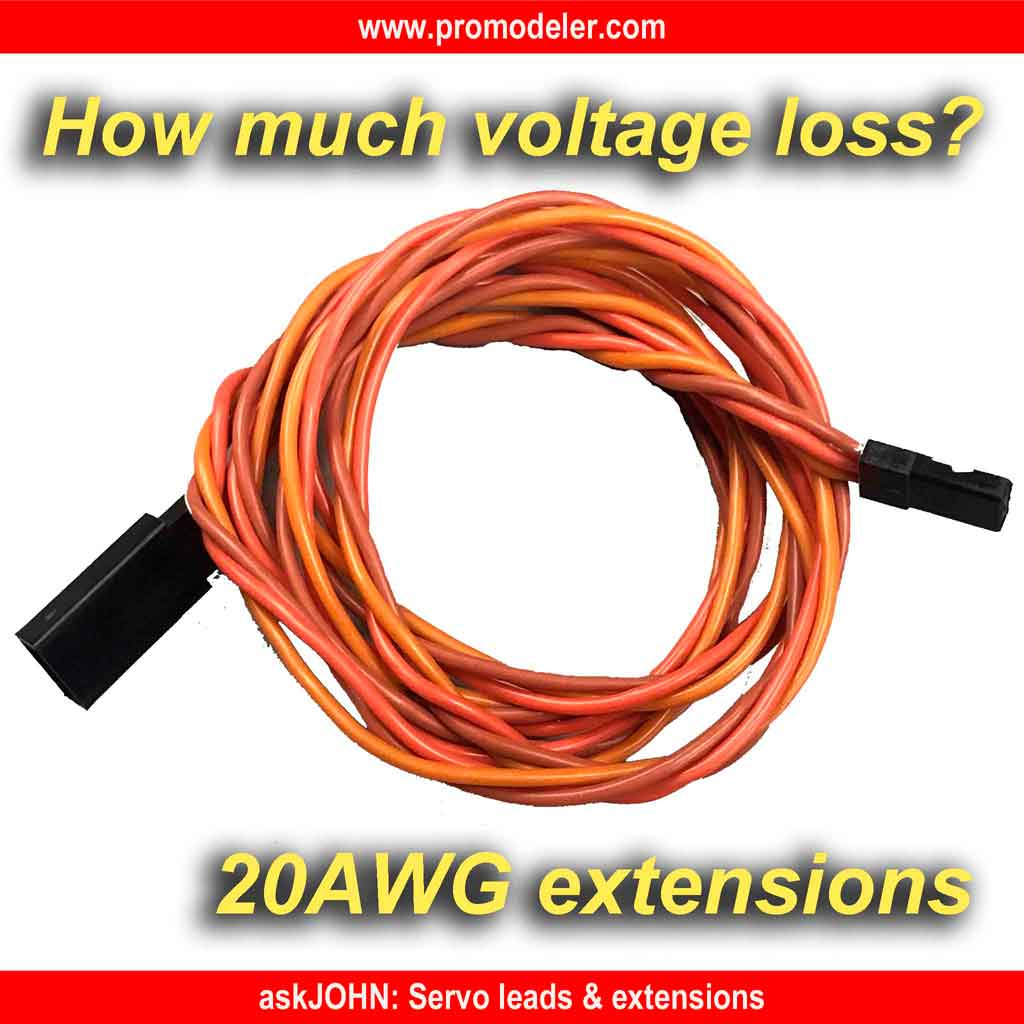
20AWG? Why such thick leads? Simple, because the thicker the wire the more it reduces voltage loss. So 20AWG is also the thickest which can be crimped into the DuPont connector. Want to know more about decisions made when using extensions, e.g. how to calculate voltage loss? This white paper discusses this, and more;
- Review to learn more: Servo Leads & Extensions
Note; these articles are free. Clicking the link opens it within a separate page.
And guys, yes I know all this info comes across as a sales pitch, but it can't be helped and it doesn't really matter where you source extensions. This because the servos only know if they're less than 20AWG, and twisted only matters if an ignition goes bonkers. Otherwise, insulation is more a matter of what's important to you.
And as far as important to us, it doesn't really much matter if you add extensions to your order, or not. Why not? It's because we live off the servos not the nit-noids! So this info is offered mostly to educate and inform what is important and watch out for.
Locking extensions
Oh, and heads up, if you order extensions from us, we offer locking ones, too (a drop down menu selection when ordering). Point being, these are the ones you want wherever you cannot inspect the connection.
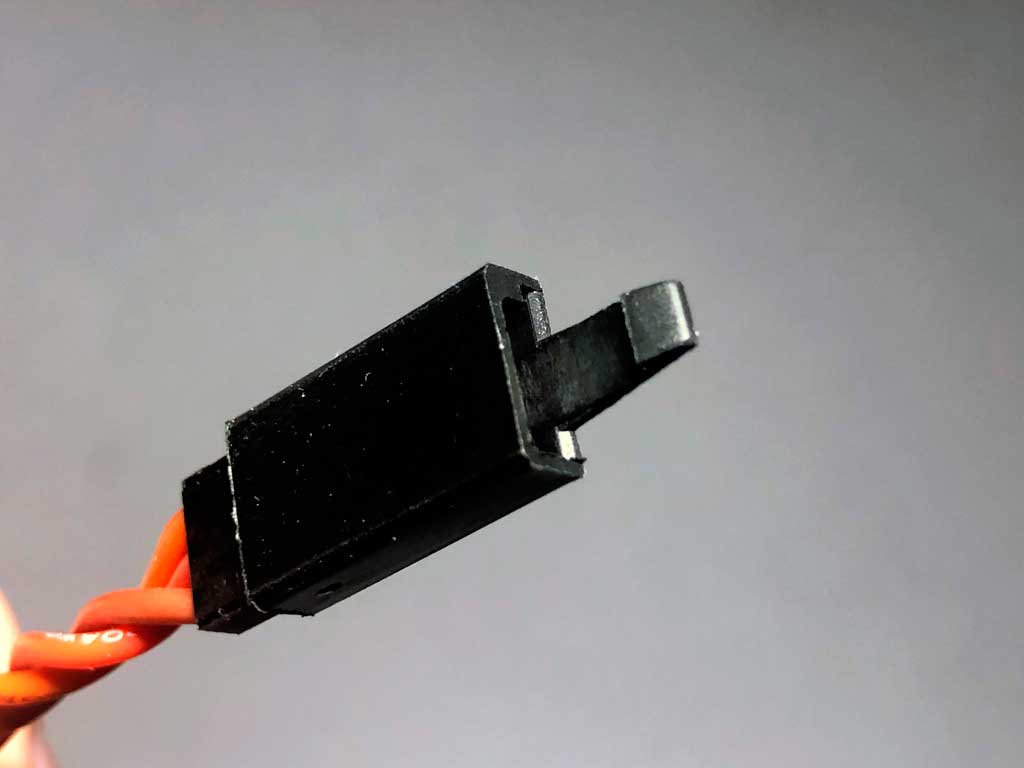
- Locking extensions are quick and easy to use
Capacitance
Also important thing as regards extensions is how the servo works at the end of an extension. Basically, the further away from the voltage source, and the thinner the wire, the worse the servo performs. Once you have the thickest wire, the only thing left to deal with any added length from the receiver is capacitance. So let's touch on this, next.
Folks, this is important; when servo extensions exceed 30-inch in length, it's time to add capacitance. First you've heard about this?
- Review this article; Why and when to add capacitance

Servo arm details
As regards servo arms, we guide folks to aluminum servo arms for this model instead of plastic. Why? Principally due to the weight and speed of which it's capable.
Basically, we stop recommending our heavy duty polymer arms once models get into the 18-20 pound range - unless - they're relatively slow (think 30-pound Piper Cub). Same holds for heavy duty plastic servo arms offered by others. The key detail is don't use plastic because you get to the point where the splined output shaft can strip the plastic. So because this model is in the range of 30 pounds, we guide folks to aluminum, only, for the servo arms on the flight controls.
And in our case, not just any aluminum but 7075-T6 instead of 6061-T6 (like we use for cases and imports use for servo arms). Why is this? Simple, because 7075-T6 is a shit ton stronger than 6061-T6 (shit ton is a engineering technical term). In fact, when comparing tensile strength, the 7075-T6 at 572MPa vs 276MPa for the 6061-T6 is a touch over 100% stronger! In fact, it also exceeds the 370MPa tensile strength of mild carbon 1018 steel . . . so you get the strength of steel at the weight of aluminum! Added to which, these are priced reasonably close to imports so if you can budget for alloy arms, these are what you want.
Anyway, you really should care about the servo arms because there's a lot of money riding on this recommendation. Remember, we all like squeezing a nickel until it squeals . . . right up until it costs us big time. Heads up!

- Big radial cowl tapers down to nought
So this is a typical ProModeler alloy servo arm. Eyeball how these arms feature an H-beam profile, (like an I-beam, but on it's side because of the direction in which it resists flex). Know where else you find this H-beam profile being used?
In highly stressed connecting rods of automotive racing engines, like the ones produced by Carillo . . . and for the same reason! Another thing is these aren't your typical flat Chinesium arms where you're tempted to add a nut to the backside of the screw to sleep better. It's because we use the Machinery Handbook as well as the next guy so we ensure there's 2d depth in the threads (two diameters) so this is not necessary. After all, details count.
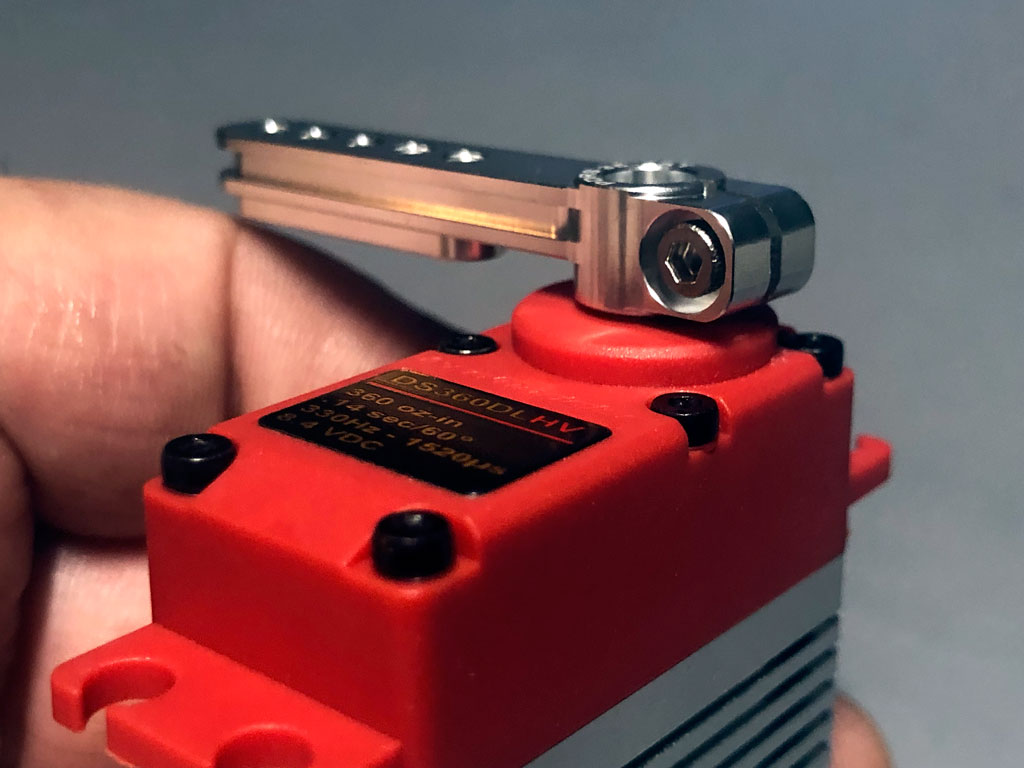
- PDRS35-25T with backlash compensation
Best servos
So there's a problem I don't know how to resolve short of a conversation. It regards the answer to which servos are best for you. And the answer is always . . . it depends. On what? Very simple, it depends on how you're going to power the model, and how you plan to fly it.
By this last meaning it's one thing if you're a sport or club pilot. For example, you mostly fly circuits and perform the odd rolls or loop maneuvers two mistakes high, because then it's pretty easy to guide you into a set of economical servos with the certainty you're going to be very happy.
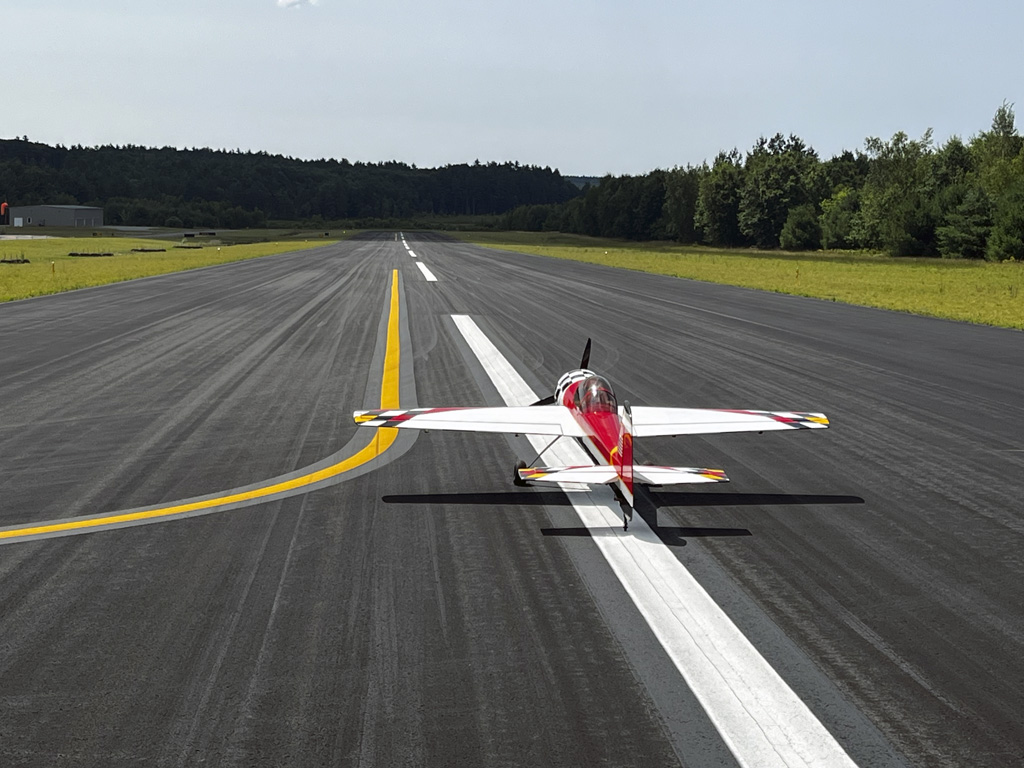
- Purposeful look . . . ready to take throttle up
But it's a horse of a whole other color if you're a sport pilot who flies the model like you stole it down . . . like down low on the deck, then come in and pull up into a wicked Lomcovák or snap roll only to come around inverted - and to cries of lower - you get down and dirty a mere foot off the deck! Take my meaning about sport versus SPORT?
Especially considering this puppy goes every bit of 30 pounds. Added to which, it'll hit an easy 100mph in level flight (maybe more depending on the engine). So this ain't a toy! And what this means in practical terms is when you dive the model out of the sun and pull up at the end of the field and flash into a victory roll, the elevator servos, for example, are seeing some pretty serious G-loads. And at high speed, the ailerons and rudder, in particular, are seeing pretty high aerodynamic loads. Loads you don't want to play around with. Means if you're a hard flying pilot you may consider at least opting for some of the servos from the better group for elevator, capisce?
Next, there's an issue between IMAC and XA maneuvers. Guy who kills me says, 'I fly IMAC, then pauses and adds, but sometimes I pull out the stops and perform XA-maneuevers, too.' This is a problem for the same reason we learned in Bible study you can't serve two masters. You really need to either set the model up for IMAC-maneuvers, which straight up is the purpose of the equipment list from the 'better' group, or XA-maneuvers, which is the 'best' group. So just as you can't be a little bit pregnant, if you fly XA, then equip the model for it. Otherwise, don't bitch the servos aren't fast enough because 'speed' is what you're paying for when you want our very best.
So the reason we're paid the big bucks is to tell you these things . . . without sugarcoating the realities. Remember, the guy selling models wants to sell them to as many folks as possible. So telling someone their existing servos may not be up to the job only hurts their sales. Point being, an airframe vendor's incentives doesn't actually align with yours.
So we're trying to anticipate the 'what if' about flying these things when we put together our avionics list. Saying there are subtle differences between a given set of servos and the 'right' servos for your build. Anyway, if you're unsure about the best course of action, then call us and let's chat! I promise, between us we'll suss it out. And besides . . . I always love talking airplanes!
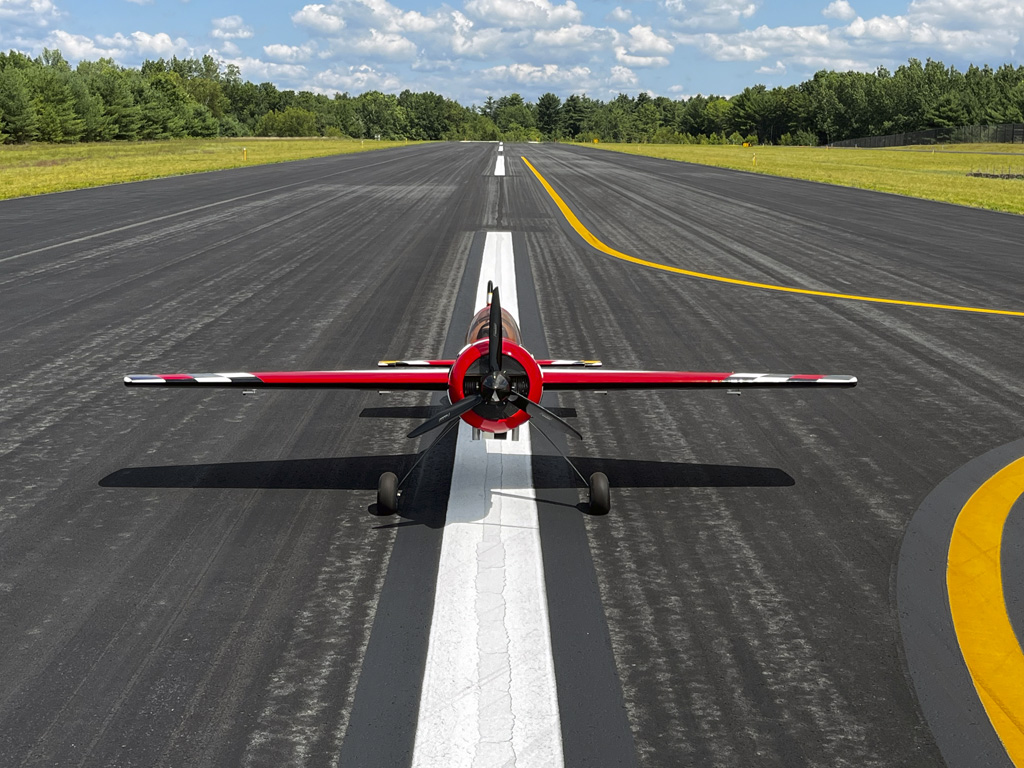
- From the business-end it has that tough guy look
DL-series details
Anyway, Mike expressly said he was open to polymer case servos. That said, I took him at his word about the last few years flying IMAC so I tried to influence him toward better. However, I later noted he opted for a modification of the better list to something a bit stouter torque-wise without opting for the speed of the servos in all-out XA list. Why? Dunno, some guys like a bit of overkill. Basically, he went for a touch more torque-wise on all the flight controls.
Nevertheless, maybe you're wondering if a set of DL-servos with the polymer cases would do for you? Well, know this; the recommended DS360DLHV are the top of the range in DL-series servos. That, and they're the servos that turn more first time buyers into loyal fans than anything else we offer. However, all five servos in the series are build the same other than gear ratio and motor. means mechanically, if you've seen one, you've see them all.
That's why this photo may help you understand why the DL-series may be your cup of tea. And note, this is the DS180DLHV juxtaposed with the world's best selling the servo, the Hitec x645-series. If you're curious how they compare head-to-head, then this article delves deeply - with loads of photos and captions - about what you get for your money;
- Learn more; Hitec D645MW vs DS180DLHV
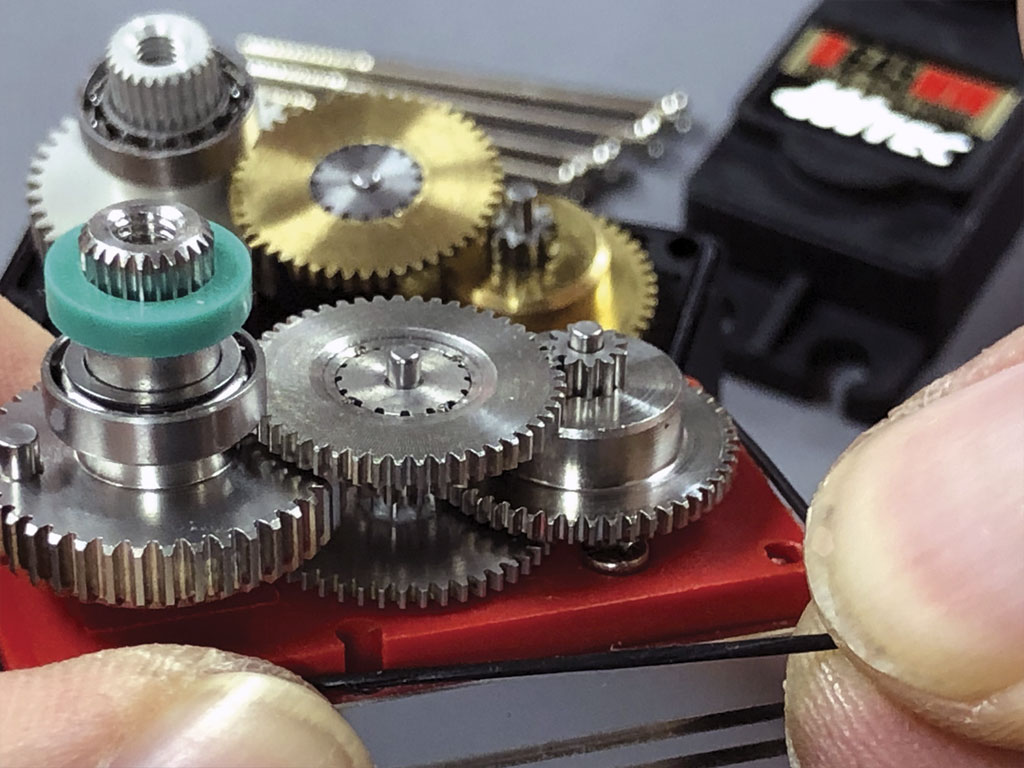
- ProModeler DL-series DS180DLHV servo juxtaposed with a Hitec D645MW
So let's get going and wrap this up. Here are details regarding installation. No surprises for any experienced pilot. And if you're new to giant scale acrobatic models, maybe you'll see details that help you. First up, the two aileron servo installs.
Aileron servo installation
Each wing panel gets two servos for the ailerons. The inboard needs a 12-inch extension and the outboard an 18-inch. Remember, we offer locking extensions (there's a drop down box in the product selection to choose them) and our advice is select these when ordering because once you pull them into the wing you can readily inspect them.
In the alternative, resort to your usual tricks involving dental floss, hot glue, or aftermarket plastic clips. Just do 'something', OK?
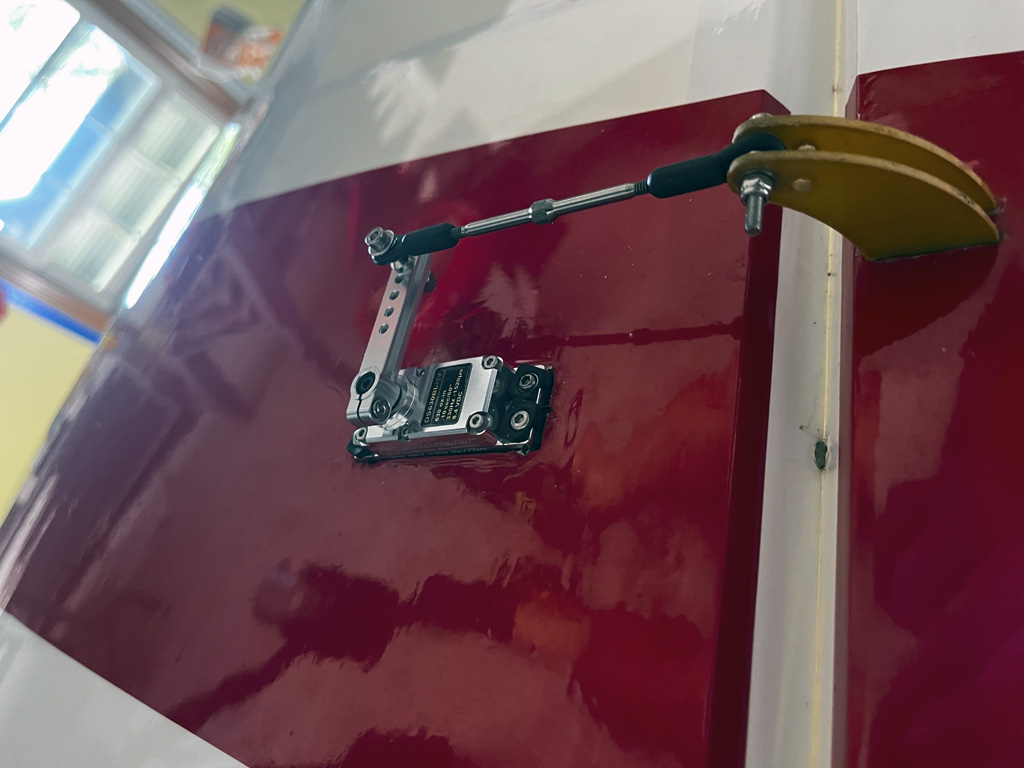
- Inboard servo installed and he used slightly longer PDRS40-25T
And no surprise, the outboard servo installs in the exact same way. Just connect the extension, drop it into the pocket, and secure with the four servo mounting screws. Easy peasy! 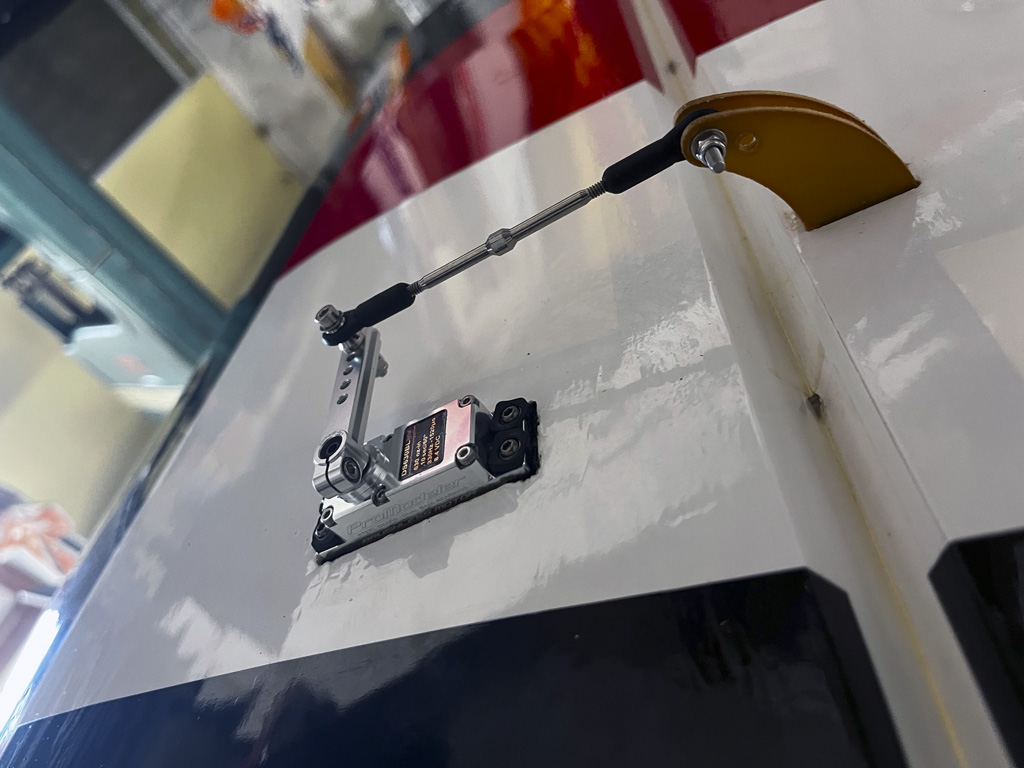
- Outboard servo installed the same way
Rudder servo installation
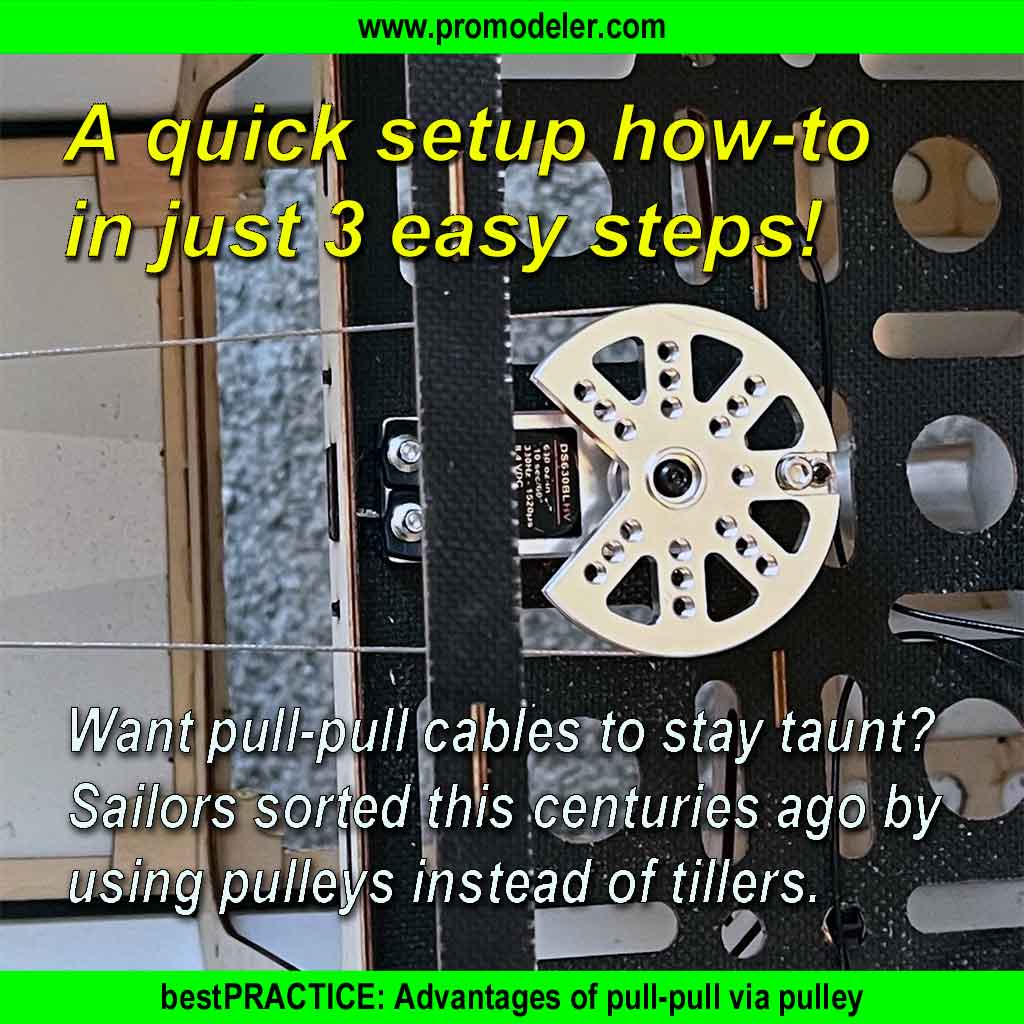
So when it came to the rudder, Mike went his own way and used a tiller arm instead of a pulley. It's a nice clean installation using a DS630BLHV plus an SWB 4-inch horn.
Note; SWB is no longer in business despite making some very, very nice arms and titanium pushrods.
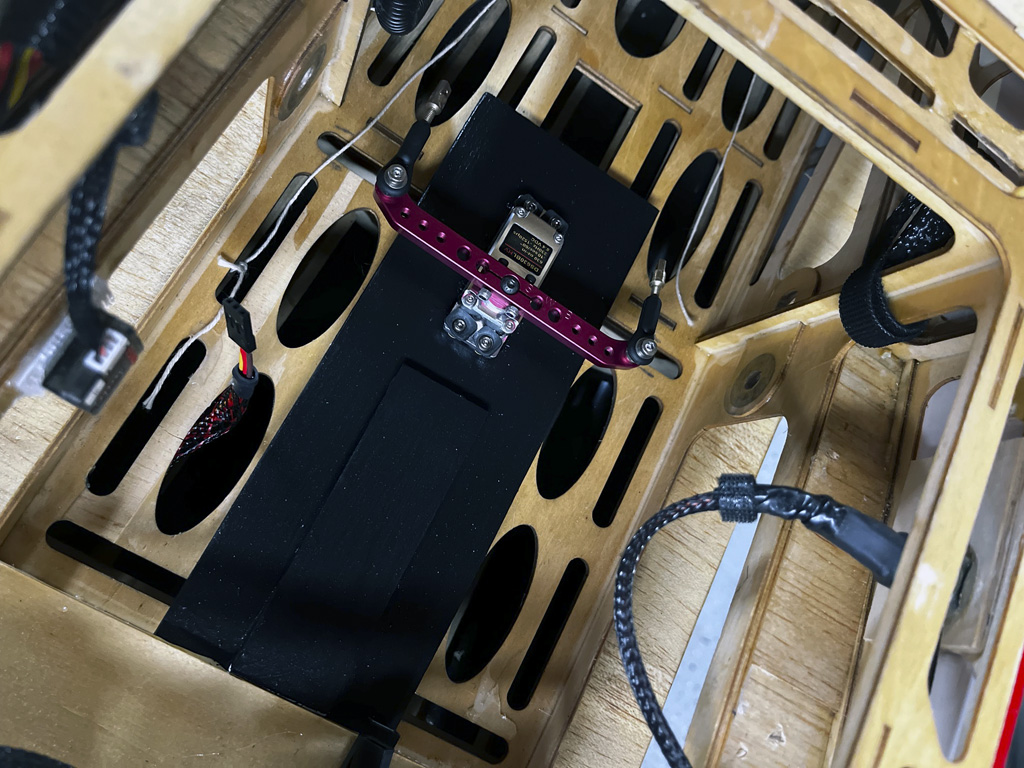
- Tiller arm for pull-pull cables
So if I recommend a pulley instead of a tiller, why is this? Well, to learn a bit more about why, review this article;
- Why a pulley beats a tiller: Advantages of pull-pull via pulley
And by the way, we produce these in 34mm diameter, 50mm, 75mm, and 100mm (the latter being about the same as the 4-inch SWB arm Mike used). For most IMAC routines, the 75mm pulley is all you need but for XA, then the 100mm is definitely the one you want. How can you tell if you went too far?
Simple, if you use full rudder and it's too much throw so you dial it back with ATV to maybe 80% each way, then you may well have been better off with the 75mm pulley because that's effectively giving up a TON of the resolution of the servo.
Look, we're making a recommendation based on experience - but - the feel you prefer is strictly up to you.
Engine installation
Now let's look at the engine install and wrap this up. Mounting is per standoffs, as usual.
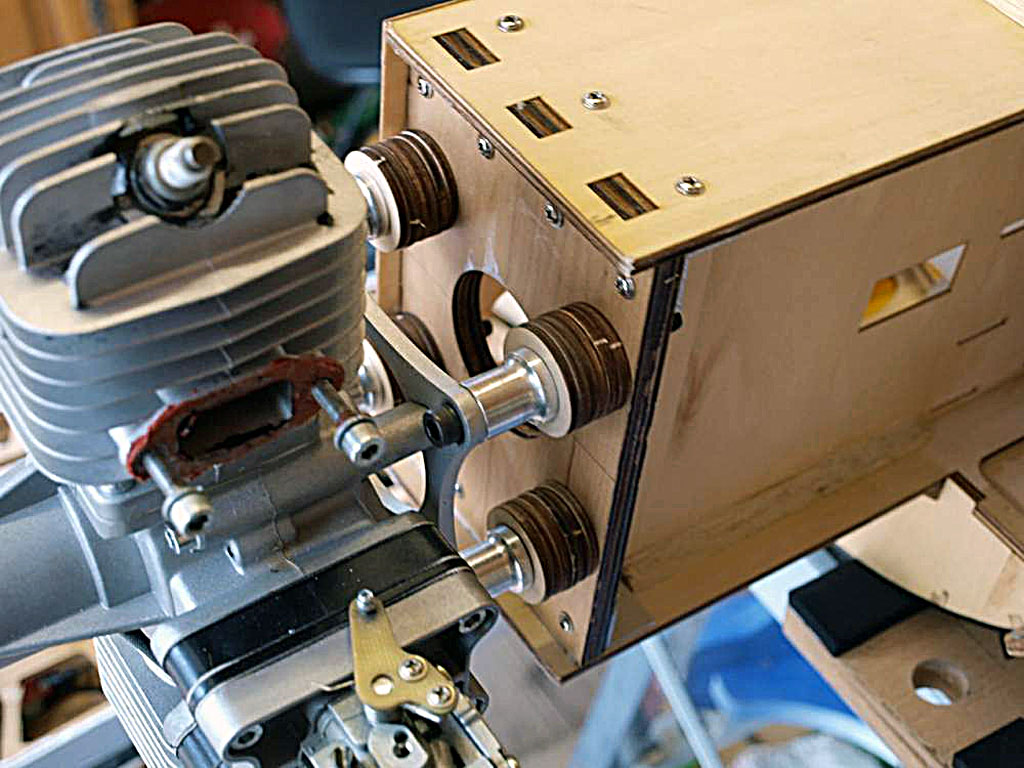
- Engine install uses four multi-washer stand offs for fine tuned thrust adjustment
What you end up with a nice looking set up like this! Canister mufflers, black paint to hide the wood grain, and ignition module mounted on top of the engine box. So here's the thing, if the model is being refurbed as part of getting new servos, then what a savvy pilot like Mike mentioned on the phone is worth noting.
Mike said he's already pulled the tank and replaced the fuel line. And not just between tank and engine but also the fuel line attached to the clunk inside the fuel tank. He also said he gave the control surfaces a good tug to check the security of the hinges while he had all the linkages loose. Like I said, a savvy guy.

- Professional engine installation with lead protection installed
Battery and switch
So what's left? Well, one thing I've neglected to touch on are the battery pack for the avionics (receiver and servos), ignition, and switches for both. Let's go there, now.
Dual packs
There's a school of thought that says, use 2 battery packs to power the receiver and servos for greater safety.
Major vendors like Spektrum even have a name for it . . . PowerSafe. Others, like ARS and Futaba are on the bandwagon with similarly complex widgets with which to take your money. Honestly? I get the appeal because - like everybody else - who doesn't want safety?
Thing is, for safety, I'd rather use one battery pack and two leads in parallel, instead. Connects to the receiver like this.
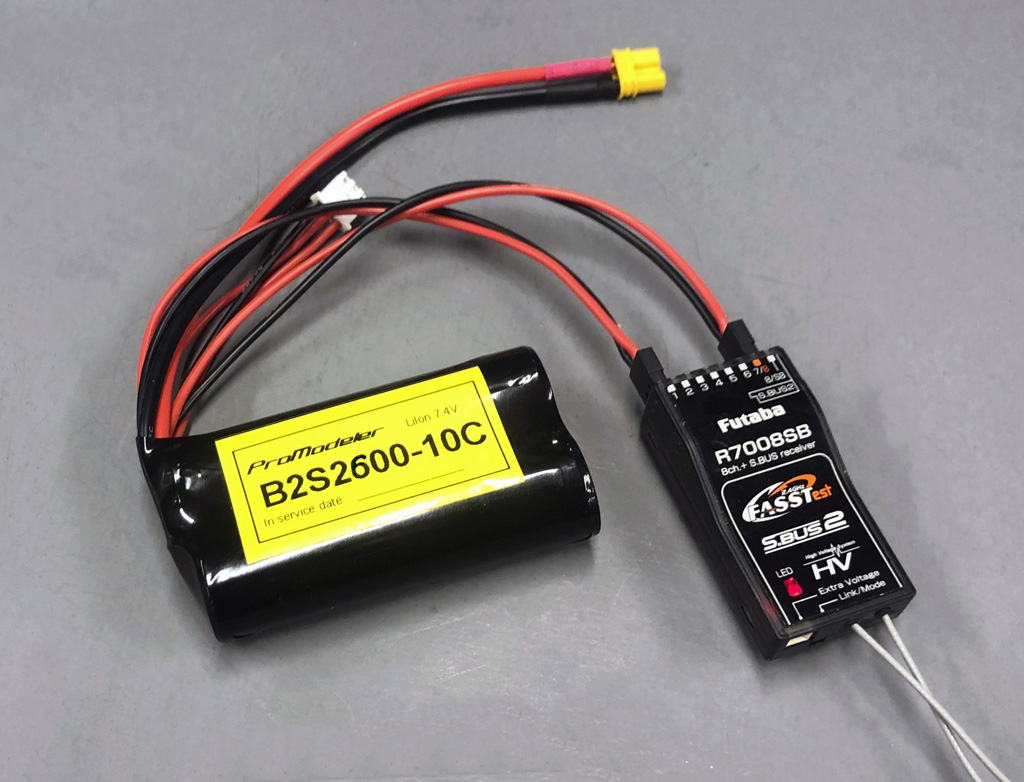
- Receivers use a power bus - means connecting a pack anywhere
Regarding 1 pack and 2 switches
So here's the thing about using two packs. It's impossible to get the benefit without adding significant complexity.
Since statistically two of anything doubles odds of failure, now to the 2nd battery, add a widget with 50 more components and instantly, the failure chain between your model and a smoking hole in the ground just got a lot longer! 'Simpler is better' isn't just a trite saying.
Another reason I'm a hard sell on using two packs (despite as a modeler wanting to believe the hype) is this; where's the proof? Are models are crashing due to battery packs failure common at your field? They sure aren't at mine! Moreover, 90% of models are electric, all using lithium packs for propulsion . . . and for sure those packs aren't failing, either.
Meanwhile, there are several downsides beyond a few hundreds bucks for the widget;
- 2X the expense for a pack
- 2X the work to charge and maintain
- Dead weight of a 2nd pack
- There's no test function
. . . this last is important; how do we test it's working before flight?
Anyway, we could put these things on the website (they're an easy sale) and if you already have one and need two packs, then the businessman in me says, yippee! But what 'this' engineer recommends, instead, is one pack.
Want to get something to add real safety? Buy a 2nd switch.
Switch
Most guys building this models use two switches. One for the radio, another for ignition. Instead, I use three . . . two for the radio.
So the 2nd radio switch is connected in parallel. In fact, if you know how to solder you can add a 2nd lead to an existing pack. Remove the heat shrink, and solder red-to-red and black-to-black. Presto, you're in business without buying another pack! You gain two benefits.
- Odds of both switches taking a crap on the same flight are astronomical.
- Automatic load balancing
This last is a nice added benefit since the connectors are rated at 3.5A continuous. So using two leads cuts the load through each exactly in half, or put another way, instantly means you can discharge the pack twice a ttwice the rate. This is important when flying a model with 8 servos.
Note; since a 10C pack with 2.6Ah cells can be safely discharged at 26A, the connectors are the choke point - not - the battery pack.
Anyway, you don't need fancy switches. What protects your model isn't a $50 switch, it's mathematics. Means even ordinary slide switches (like ones we've used for decades) are perfectly fine so save your money and buy good quality switches instead of buying the snake oil about failsafe switches. They're only failsafe as long as all the components that make them work actually functions. Bottom line? Switches fail. Plan for it because it doesn't take expensive switches to do the job.
Speaking of which, we have this inexpensive 5A slide switch available. What recommends it over a hobby-grade switches are two things. First, the small metal shield wrapped around it rejects stray RFI, e.g. from a failing ignition. Second, the potting compounded serves to protect the solder joints from vibration.
Slide switches aren't inherently unreliable, it's using low quality switches that exposes you!
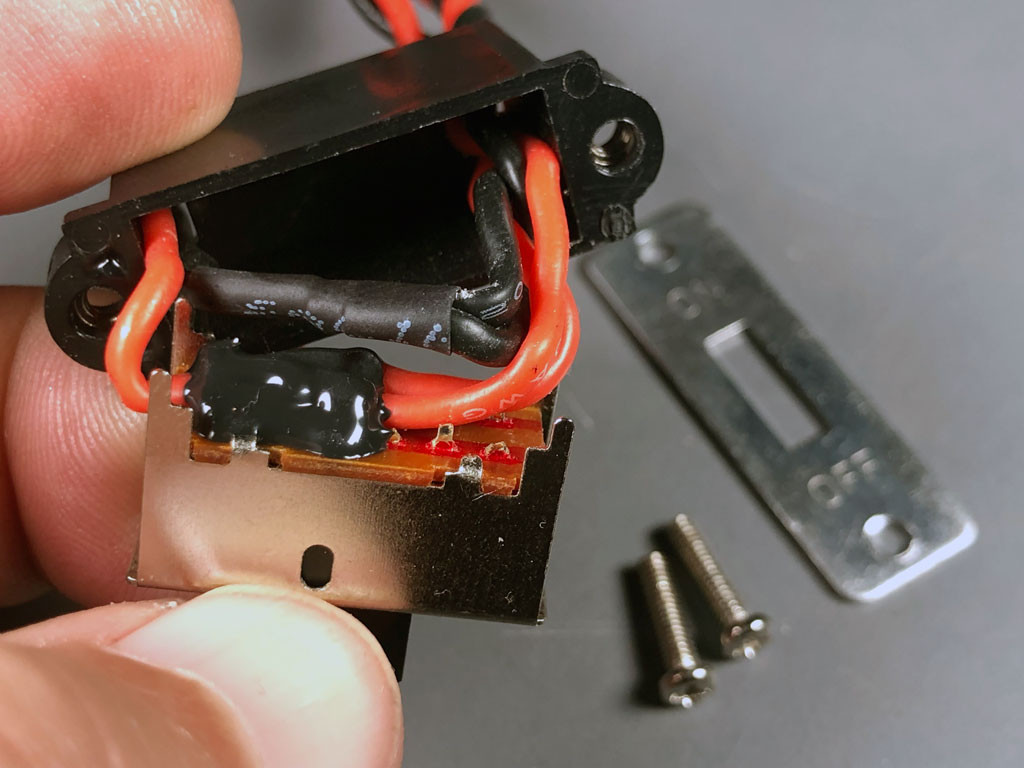 - genuine Nobel brand 5A shielded slide switch
So with a large model like this, specifically because of the load of 8 servos, I'd rather use 10A switches, instead. Yes, still uses connectors rated at 3.5A but this isn't a limit, so it'll flow 5A. However, because in the real world the servo loads are intermittent, they're easier on the contactors inside.
This is why we offer this dual switch (two individual switches mounted for convenience inside one housing).
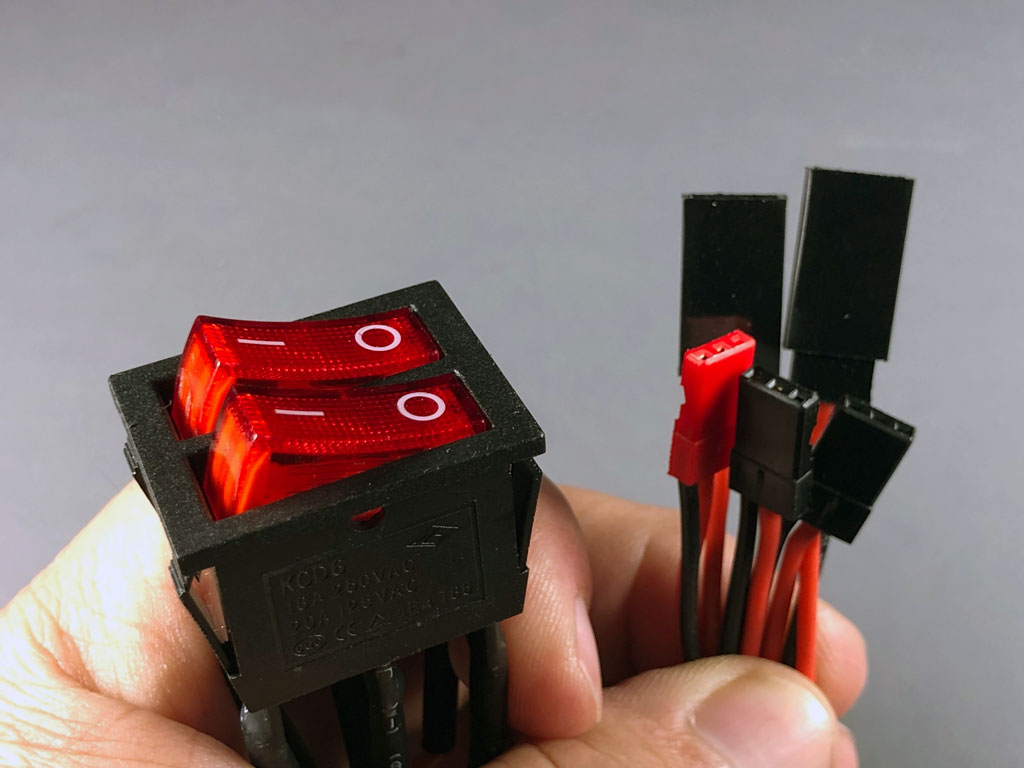
- Charge without disconnecting through the red plug
So in actual use, because these switches are large, folks don't just chop a hole on the side of a fuselage and install it like you would a smaller model. You need to find a place.
For example, here's all three switches installed in my 1/5th scale Ziroli Stearman where the front cockpit floor worked out perfect.
Note: this model has one of our 15A over-center toggle switches for the ignition because it's supplying a 9-cylinder module.
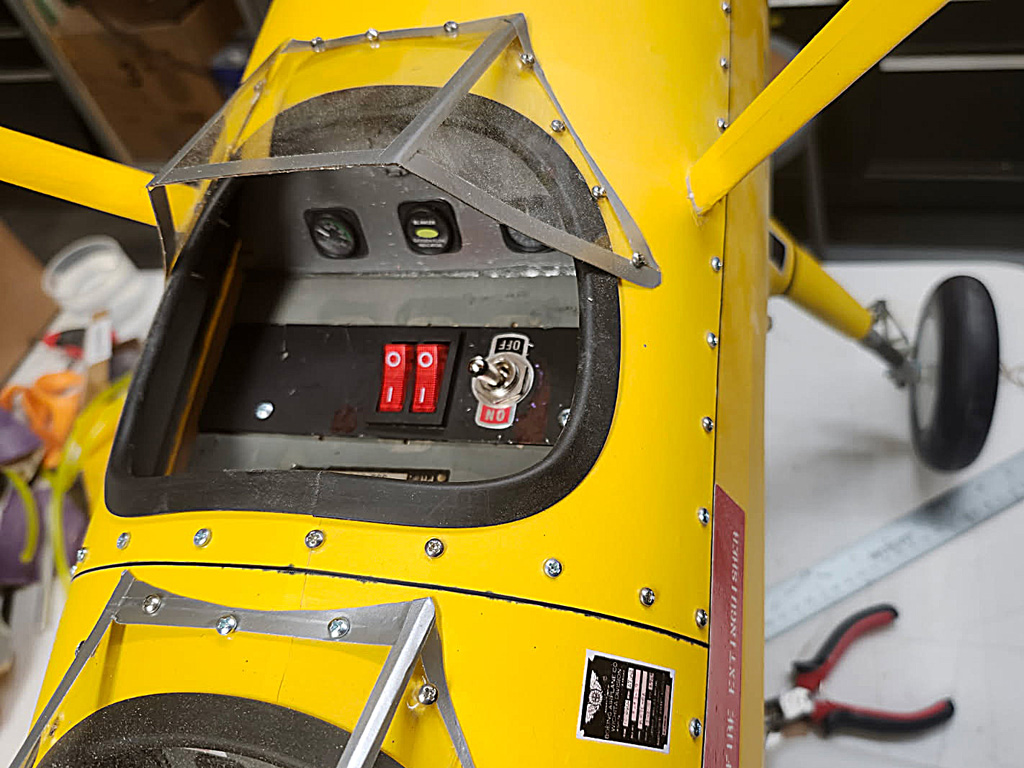
- Finding the perfect spot is key
So because these are illuminated switches, if you forget and leave the model powered, it's easy to suss out. Allow me to share this photo as an example. It's of a pal's TopRC Zero he equipped with a pair of the dual rockers.
Two switches for two batteries; one for the avionics, the other two switches for the ignition pack. The latter, incidentally, also supplies juice for the electric-powered retractable landing gear system.
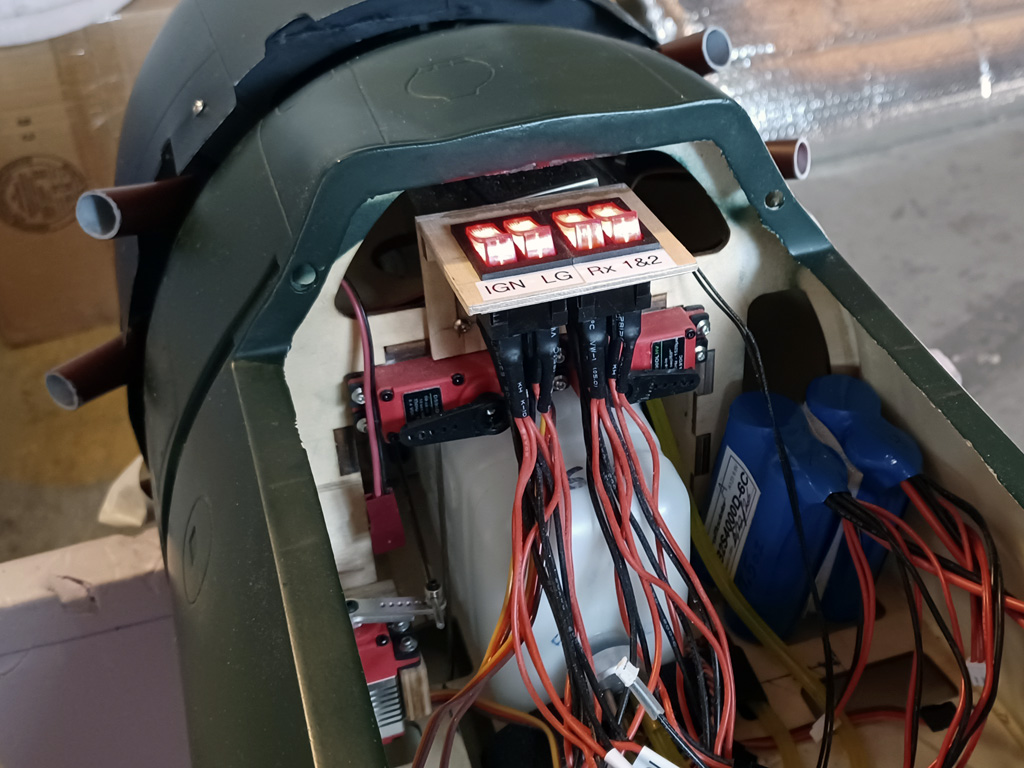
- Bright illumination makes it easy to confirm function
By the way, technically, there are four switches in the ignition-powered model recommendations. This is because I also rely on an opto-kill switch inserted in series after the manual switch. Reason, of course, being on the off chance the model experiences throttle servo failure. After all, we make good servos but only God is perfect!
If you still need one when you order, we offer these on the site. If you're unaware of the product, this is what it looks like installed.
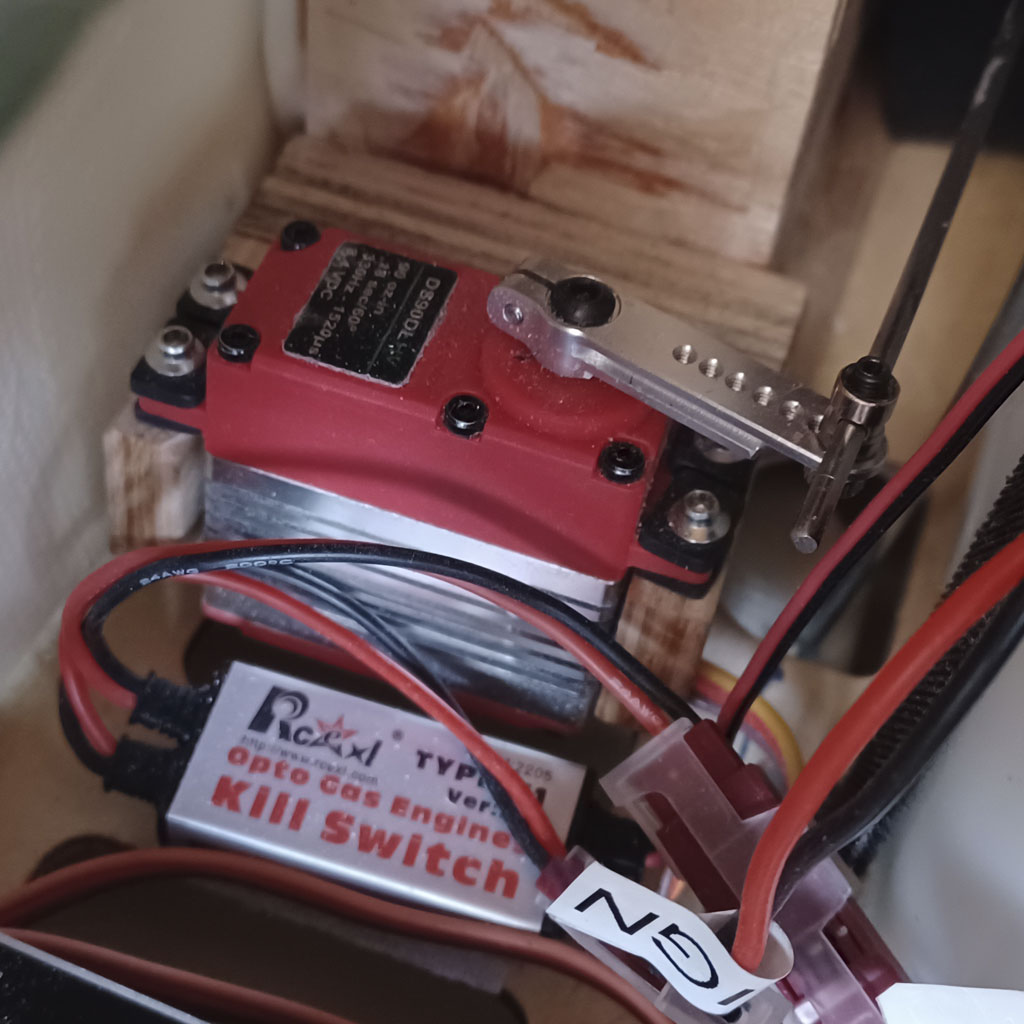
- Mounted with Velcro and on a switched channel
Wrap up
So we've shared three equipment alternatives based on if your focus is on sport flying, IMAC, or XA-type maneuvers. We've tried not to be obnoxious in recommending products but obviously, we're going to mention our wares. We hope, however, we've shared some good ideas for your build in exchange for the propaganda.
If you have further question, or just want to pick our brain, reach out via email or telephone (top left corner of every page on the site, or in the footer). And if you're curious what it's like to live with such a model, Mike kindly shared this photo of his mounted within his trailer!
Note; he's used E-track to create a second level, a loft area

- Eyeball this photo closely for tips


